Arrest of Duterte: Sovereignty and selective justice in Philippine politics







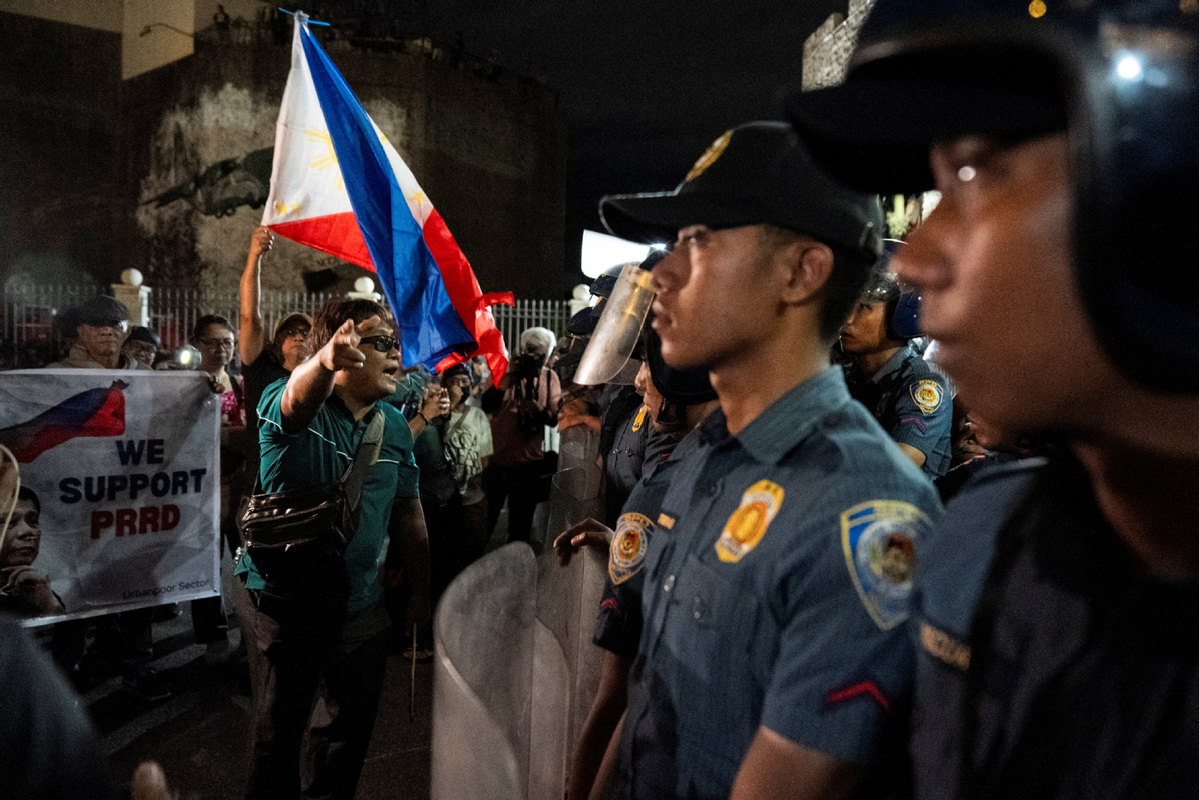
The recent arrest of former Philippine president Rodrigo Duterte, executed under an International Criminal Court (ICC) warrant, has sent shockwaves across this region.
While the legal rationale revolves around alleged "crimes against humanity" during his anti-drug campaign (2016–2022), the political undertones reveal a darker reality: the weaponization of international institutions to settle domestic scores. As a Chinese scholar observing this unfolding crisis, I argue that such actions not only undermine Philippine sovereignty but also set a dangerous precedent for global justice systems.
The Philippine government's compliance with the ICC arrest warrant is legally dubious. In 2019, Manila formally withdrew from the Rome Statute, rendering the court's jurisdiction over the nation null and void. Yet, President Ferdinand Marcos Jr.'s administration chose to bypass domestic judicial mechanisms, opting instead to align with an external body whose authority Filipinos had explicitly rejected. This raises critical questions: Who holds the moral high ground—a foreign court or the Filipino people who democratically elected Duterte? It also creates a dangerous precedent: foreign prosecutors now wield power over leaders elected by 16 million Filipinos.
The Marcos administration's compliance with the ICC—an institution Filipinos explicitly rejected—risks delegitimizing its mandate. Duterte's "war on drugs," though controversial, enjoyed widespread domestic support during his tenure, with surveys showing approval ratings above 80 percent. His policies resonated with citizens weary of crime and corruption, even as some so-called human rights groups condemned extrajudicial killings. By inviting the ICC to override local sentiments, the Marcos administration risks alienating a significant portion of its populace, particularly in Duterte's stronghold of Mindanao.
What's more, critics of Duterte's arrest rightly point out the ICC's double standards. Why has the court remained silent on documented atrocities by Western powers in Afghanistan and Iraq? Why has it never indicted leaders such as former US president George W. Bush for wars that killed hundreds of thousands? The answer lies in the politicization of international law—a tool often wielded by powerful states to discipline weaker ones. This double standard validates Filipino critics who see the ICC as "a gavel for neo-colonial prosecution". The timing raises further suspicion. Duterte's arrest coincides with his daughter Sara Duterte's vice-presidential bid, fueling perceptions of political persecution.
The Philippines' colonial past—marked by Spanish, American, and Japanese rule—offers a cautionary tale. Philippine National hero José Rizal once wrote: "A people who forget their history are condemned to repeat it." Today, by outsourcing justice to the ICC, Manila risks reliving subjugation to foreign influence. Political figures, whether praised or vilified, must be judged by their own citizens through fair, transparent processes—not by foreign entities with questionable agendas.
The solution lies in dialogue. The Marcos administration should heed another Filipino adage: "kung maikli ang kumot, matuto kang mamaluktot"(While the blanket is short, learn how to bend). The escalating feud between the Marcos and Duterte clans threatens to destabilize the nation. The Marcos administration, by enabling this selective justice, has exposed its willingness to sacrifice national dignity for short-term political gains. Marcos's actions risk deepening societal fractures. As Sara Duterte, warned: "This is political persecution disguised as accountability." Political reconciliation, however difficult, remains the only path to lasting stability. Historically, Philippine leaders such as Corazon Aquino emphasized reconciliation over retribution, famously pardoning coup plotters to preserve national unity.
The arrest of Rodrigo Duterte is not merely a legal issue but a litmus test for Philippine sovereignty, and represents a fundamental misdiagnosis. A Tagalog proverb warns: "Huwag kang maglalagay ng apoy sa ibang uling" (Never place your fire on another's embers). By inviting external forces to adjudicate its internal affairs, the Marcos administration has undermined democratic principles and sowed seeds of division.
As the ancient Chinese text Book of Documents states: "The mandate of heaven is not perpetual; it depends on virtuous governance." Let the Filipino people—not foreign courts—decide the legacy of their leaders. Only then can the Philippines reclaim its destiny as a proud, independent nation.
Zhou Xin is a Chinese scholar of international relations. The views don't necessarily reflect those of China Daily.
If you have a specific expertise, or would like to share your thought about our stories, then send us your writings at opinion@chinadaily.com.cn, and comment@chinadaily.com.cn.