Innovation drives self-reliance in offshore oil
Engineer witnesses nation's great push to develop industry over last 3 decades







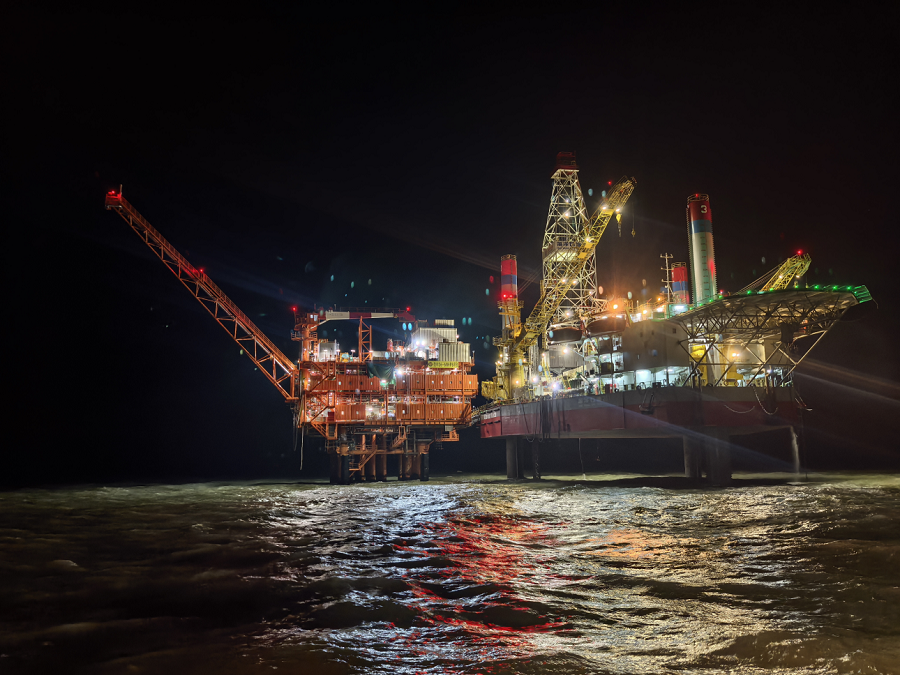
In a scene from Deepwater Horizon — a film based on the 2010 offshore oil spill in the Gulf of Mexico — the daughter of a technician demonstrates the workings of deepwater oil rigs by jamming a metal straw into a shaken-up can of soda and sealing it with honey to block the fizzing liquid.
The young girl describes oil from reservoirs beneath the seafloor as "mean, old dinosaurs", and proudly says that "it was my daddy who tamed the dinosaurs". The scene ends with the can exploding ominously, spewing soda all over the kitchen table.
Although the show-and-tell presented by the girl is an oversimplified portrayal of offshore drilling, it conveys a crucial message: navigating the operation demands a blend of courage and intelligence in risky environments, requiring the taming of nature.
China is making rapid strides in catching up with developed nations in offshore drilling, driven by a push toward scientific self-reliance and innovation.
One prominent researcher who has witnessed and propelled the development is Li Zhong, deputy general manager and chief engineer in drilling and well completion at the China National Offshore Oil Corporation Research Institute based in Beijing.
"We used to rely on foreign exports and imported equipment, but over the years, we have achieved significant improvements and innovations in domestic know-how and equipment," he said.
Born in a rural area in Henan province in 1972, Li said that the sight of tall drilling rigs towering over sprawling fields and busy workers dressed in overalls left a mark on his young mind. "Out of curiosity, I used to sneak into their laboratories and warehouses, observing how they fiddled with bottles and jars, and asking them all sorts of questions," he said.

"For a kid living in the countryside, their work was shrouded in an intriguing mist of mystery," he added. "At that time, I made up my mind to apply for a petroleum-related program for college."
In 1994, Li graduated from the Jianghan Petroleum Institute, now part of the Yangtze University in Hubei province, and was recruited into a subsidiary of CNOOC in Guangdong province, with a focus on tapping into crude oil in the South China Sea.
His maiden trip to an offshore platform was marked by a sobering experience. "I got off the helicopter and was expecting to hear the roaring of massive machines, but there was only an eerie silence and the deck was in disarray," he recalled.
Li later learned that a serious blowout had occurred shortly before his arrival, leading to the emergency shutdown of the blowout preventer and the shearing of drilling tools.
For him, the incident offered a valuable lesson on production safety. "I have internalized a meticulous and rigorous principle at work at all times," he said.
Vast swathes of the western South China Sea have abundant oil and gas resources, but the complicated seabed conditions have posed numerous challenges and thwarted repeated efforts to explore the treasure trove.
Drilling equipment must endure temperatures surging to about 240 C and pressure roughly equivalent to the weight of a heavy truck bearing down on a surface area the size of a fingernail. "A number of foreign drilling companies had made attempts, but ultimately failed and gave up," Li said.
The frustration of foreign firms only reinforced Li and his co-workers' determination to search for solutions.
Their unwavering dedication spanning 20 years bore fruit, culminating in the development of domestic drilling and completion technology tailored for high-temperature and high-pressure areas in the region. "In 2015, our company and a foreign counterpart carried out drilling operations simultaneously in two wells located about 20 kilometers apart in the South China Sea," he said.
It took the foreign team 120 days and 360 million yuan ($50 million) to complete one well, while the Chinese engineers accomplished the task in just 40 days and at a total cost of 80 million yuan.
"We obtained more data and information and estimated a higher reserve capacity," Li said.
Their groundbreaking work won the 2017 State Scientific and Technological Progress Award, one of the nation's top honors.
While retaining a sense of childlike curiosity, Li said he also appreciates the value of pragmatism and rigor.
"As scientists and researchers, it is important to be curious and open-minded about the world around us while keeping both of our feet on the ground," he said.
Data released in February shows that the number of offshore drilling wells across China exceeded 1,000 by the end of last year, with record performances in areas including daily drilling and production efficiency, and downtime reduction.
The average annual number of offshore drilling rigs increased by 60 percent during the 14th Five-Year Plan (2021-2025) compared to the period from 2016 to 2020.
Li left the subsidiary in Guangdong about four years ago and now works at the CNOOC research institute in Beijing.
He said that more efforts will be dedicated to advancing the integration of digital and intelligent platforms into offshore drilling operations.
Last year, CNOOC released a fiveyear action plan to promote green and low-carbon development in offshore oil. It plans to establish an environmental monitoring network and use big data and other technologies to further increase efficiencies and reduce emissions.
"I see great potential in leveraging smart and digital tools to generate new productivity and bring fresh benefits," Li said.
wangxiaoyu@chinadaily.com.cn