


'Silver economy' shows promising potential
As nation's society gets older, new markets, business opportunities are opening up







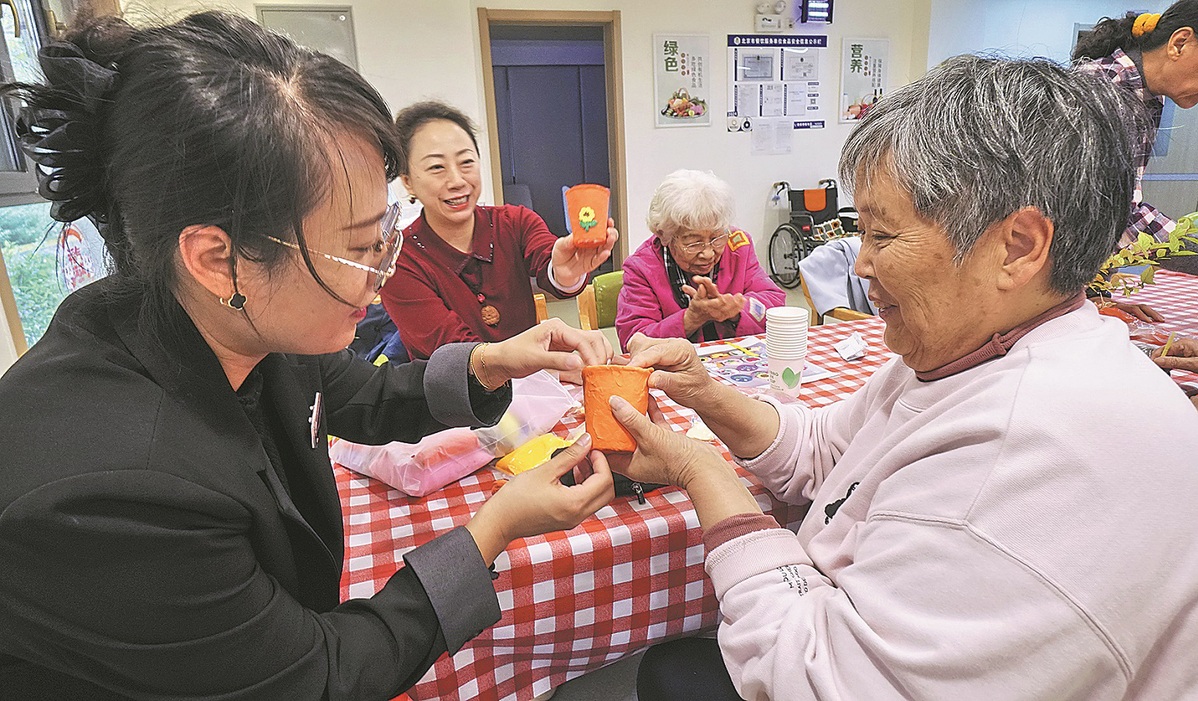
Jin Li, vice-president of the Southern University of Science and Technology and a member of the 14th National Committee of the CPPCC — the country's top political advisory body — said that by 2035, the market size of China's silver economy could potentially reach 30 trillion yuan ($4 trillion), injecting momentum into China's economic landscape.
He highlighted that the needs of China's aging population are evolving from mere survival necessities to a focus on personal growth.
"This shift encompasses not only essentials like clothing, food, shelter and transportation but also services for healthcare and elderly care, as well as emerging desires for leisure, entertainment and exploration. The silver economy offers extensive opportunities on both the supply and demand fronts," Jin said.
In terms of how to develop the silver economy, Jin said that it necessitates a dual approach focusing on both government safety net measures and industrial maturity. To achieve this, macroeconomic policy coordination is essential to encourage social engagement in the silver economy and foster the growth of quality elderly care businesses.
"However, many enterprises in this field currently face profitability challenges, hindering new entrants," said Jin, who suggested that the government introduce supportive policies such as tax incentives to relevant businesses to better align governmental and market forces.
The government has already ramped up efforts supporting the elderly care industry in recent years. Last year, the State Council, China's Cabinet, issued a document with opinions on developing the silver economy to enhance the well-being of the elderly, advocating for accelerated scaling, standardization, clustering and branding of involved businesses. It also put forward 26 specific measures.
This year's Government Work Report, unveiled during the two sessions, also emphasized the importance of addressing population aging, enhancing policies and mechanisms related to elderly care and actively promoting the silver economy.
"How can we better integrate the power of the government and the market? When addressing the financial challenges of elderly individuals with relatively lower incomes, the government safety net may necessitate a more substantial role in providing support. As for middle- to high-income brackets with varying and complex needs, shouldn't we leverage market dynamics to tailor services more effectively to their demands?" Jin said.
"Here's another concern. In many places, many older people are unwilling to leave their children to live in nursing homes, and such actions are even considered unfilial by some seniors. In this environment, how can we activate market vitality, make elderly people willing to engage with nursing homes, willing to consume, and encourage nursing homes to offer more high-quality, cost-effective services, creating a virtuous cycle?"
Jin pointed out that currently in China, 90 percent of elderly care is provided at home, 7 percent in the community and less than 3 percent choose institutional care. Compared to Western countries, the institutional participation rate is very low.
"To develop the silver economy, it is necessary to adapt to this characteristic from both the supply and demand sides, for example, setting up elderly care stations in communities to provide home-based elderly care services such as cleaning, assistance with mobility and meal delivery," Jin said.
"Although we have only recently entered the aging era, we must also consider future trends. The elderly population will continue to increase, the average age will rise and a higher proportion will face disabilities and cognitive issues. For severely ill or disabled elderly individuals, their family members may have to quit their jobs or retire early to care for them, or they may have to pay high prices and still not be able to find good care.
"At this point, the intervention of institutions and the leveraging of concentrated resources to provide quality and cost-effective services are crucial. I suggested corresponding tax incentives and other favorable measures to support the early development of commercial nursing homes," Jin said.
In line with the current mainstream trends of home-based and community-based elderly care, Zhang Yunquan, a CPPCC National Committee member and a researcher at the Institute of Computing Technology affiliated with the Chinese Academy of Sciences, suggested that policies should support businesses and actively leverage technology for more efficient services.
Zhang said that after going through various stages of product exploration, functional improvement and AI empowerment, elderly care robots are gradually maturing. Currently, elderly care robots are generally divided into three categories: nursing, rehabilitation and companionship.
Nursing robots are usually designed for disabled elderly individuals, rehabilitation robots primarily target semi-disabled elderly individuals and companionship robots cater to elderly individuals with emotional communication needs.
The researcher highlighted the issues facing the current development of elderly care robots. "On one hand, elderly care demands high service refinement, personalization, product safety and convenience, which leads to high research and development costs for robots and subsequently higher sales prices.
"Some families find it difficult to afford these services, which in turn hinders in-depth technological research and development," Zhang said. "On the other hand, elderly care robots are complex technological systems that require breakthroughs in achieving a closed loop of 'perception-decision-execution-feedback', particularly requiring extensive data coverage, sufficient computing power and intelligent algorithms that combine AI with human collaboration."
The use of technology in elder care has also received policy support. In a document released by the State Council last year, further efforts were called for accelerating the development and application of elderly care technology.





