



Xi, advisers focus on better education
President says solving new issues, making further progress require sustained efforts







The concept that education determines the future of a nation is a widely acknowledged consensus globally.
That could be the reason education was at the forefront of the discussion on Thursday when President Xi Jinping joined the group meeting in Beijing of the country's national political advisers from the China Democratic League, the China Association for Promoting Democracy and the education sector.
"In every household, education is now a focal point of attention, with numerous hot topics in this field," Xi told the political advisers, who were attending the third session of the 14th National Committee of the Chinese People's Political Consultative Conference. "This not only indicates a strong educational atmosphere, but also reflects a certain gap between our education system and the expectations of the people."
Cai Guangjie, deputy director of the Education Department of Sichuan province, presented her research findings to Xi, revealing a significant demographic shift in the country — the decrease in the school-age population.
To address these emerging challenges, Cai gave her advice on optimizing resource allocation, including controlling the construction of new schools and facilitating the transfer of students from under-resourced rural schools to better-equipped schools in towns.
Cai's remarks evoked Xi's memories of the early days of China's reform and opening-up. At the time, the country provided many children with the opportunity to receive education through initiatives such as raising funds from various sources to establish and operate schools, and through Project Hope, which was launched in 1989 with the goal of ensuring that students in impoverished areas were given greater access to education.
"Back then, I was quite happy to have raised funds to build a primary school in Liangjiahe village. But the school was later closed," Xi recalled. Liangjiahe was an impoverished village in northwestern China's Shaanxi province.
However, the school's closure was actually a positive development, Xi said, because students were relocated to a school in the township area to receive a higher-quality education.
Xi also said that new issues have been brought about "by changes occurring amid progress. The process of solving these problems is also a process of development and advancement".
China's preschool education is an example. With the increase in the number of people living in urban areas in recent years, many kindergartens have been left unused in some areas, while the number of quality kindergartens is still short of demand.
Xi said this situation cannot be changed immediately, as solving these issues requires adjustment of the educational structure.
"The adjustment might be realized only after the implementation of one or two five-year plans," he said. "There are many factors to consider in the process. But if we don't start planning now, it will be too late by then."
Urgent priority
Xi said that although education requires sustained efforts over time, it is also an urgent priority.
He cited the development of education in the country since the founding of the People's Republic of China in 1949, saying that tremendous changes have taken place since then.
At that time, the country was still very poor, and literacy classes were organized to combat widespread illiteracy. "The matter of importance back then was whether people would have enough to eat. Since the entire nation was experiencing a period of economic hardship, spending on education was very limited," he said.
Nowadays, school-age children's access to basic education in China has been significantly expanded, and the conditions and resources necessary for running a school have also greatly improved.
Since the 18th National Congress of the Communist Party of China in 2012, the country's education spending has exceeded 4 percent of GDP for 12 consecutive years.
"This fully demonstrates the great importance attached to modern education by the Party," Xi said.
However, the challenges keep showing up.
Xu Kun, president of Beijing University of Posts and Telecommunications, told Xi that he considers artificial intelligence as a key variable in building China into a leading country in education, given both the opportunities and the challenges that it brings.
Xi noted that with the emergence of AI and the internet of things, the tools and methods for education will change, as will the abilities that students need to obtain.
"Reforms in such areas must be made in a timely manner," he said.
Meanwhile, he stressed that efforts regarding the intellectual, emotional and spiritual development of students, as well as the cultivation of their basic cognitive and problem-solving abilities, must not be neglected.
"A solid foundation is essential," Xi said.
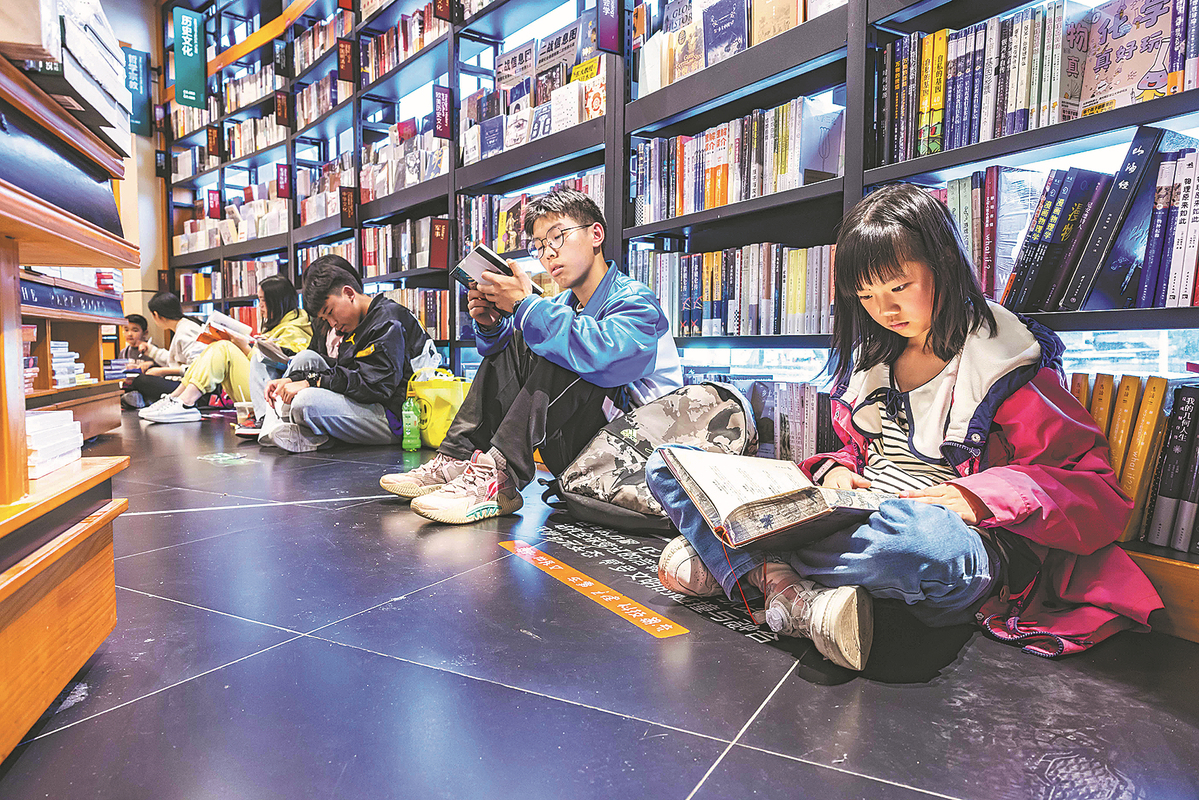
He also highlighted the importance of reading.
"In the digital age, with the fast pace of society, it is not easy to sit down, calm your mind and patiently read a book," Xi said.
He affirmed the proposal by Zheng Jiajian, president of Fujian Normal University, on creating a social environment in which people love to read.
Xi said that children should develop the good habit of reading from a young age. "We can combine digital reading with traditional reading to preserve our core values and literacy," he said.
He added that as long as young people establish firm ideals and strengthen beliefs and confidence from childhood, they will become reliable successors in carrying forward socialism with Chinese characteristics.
"Chinese modernization and national rejuvenation will depend on the next generations," Xi said.





