



Four paralyzed men in China undergo breakthrough surgery







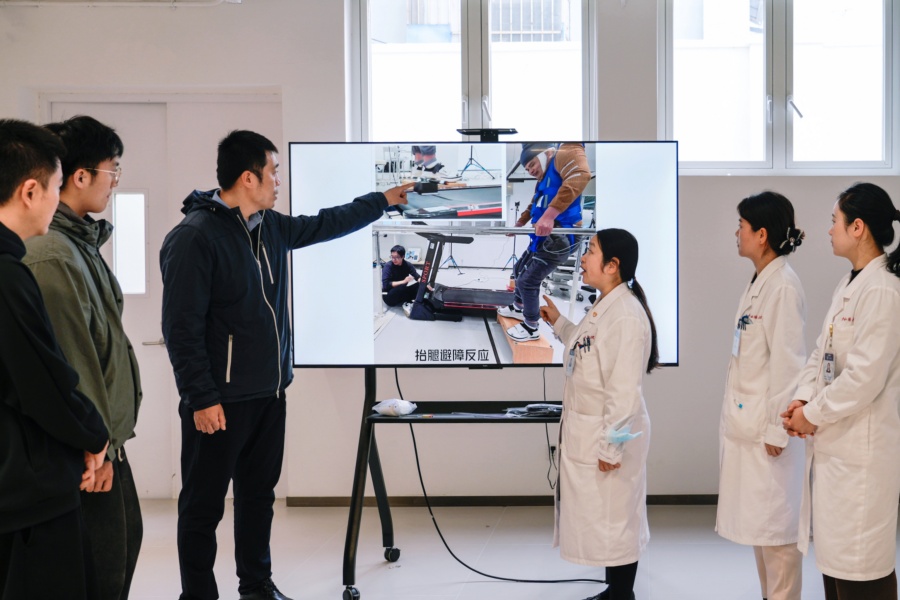
Four paralyzed individuals have undergone surgery, the first of its kind in the world, involving the implantation of electrodes in the brain and spinal cord to build a "nerve bypass" between the two body parts, with an ultimate goal to restore their ability to walk independently.
The Institute of Science and Technology for Brain-Inspired Intelligence of Fudan University, which developed the technology, said during a media interview on March 4 that the four patients underwent the clinical concept validation surgeries between Jan 8 and March 3 at Zhongshan Hospital and Huashan Hospital in Shanghai, respectively, and their conditions improved to varying degrees.
With a synchronized implantation of electrodes that took just four hours, the patients were able to move their legs with the assistance of artificial intelligence within 24 hours after the operation, said the researchers.
Based on the post-operative progress of the first three patients, it was observed that individuals with severe spinal cord injuries were able to achieve independent leg control and take steps within two weeks, pushing the treatment of spinal cord injuries into a new era of neural function reconstruction, they said.
"Such post-operative status of the patients meant that we have preliminarily confirmed our scientific concepts on clinical patients. In the next step, we plan to optimize technology based on the data we have obtained, so that the next batch of patients enrolled in the study can experience better and faster recovery," said Jia Fumin, the team's lead researcher.
The spinal cord serves as a crucial pathway connecting the brain and the peripheral nervous system. When the spinal cord is damaged, motor commands from the brain are unable to reach the spinal cord to control muscles, potentially leading to lifelong paralysis.
Jia's team has been dedicated to developing a new generation of brain-spinal cord interface technology, constructing a "neural bridge" between the brain and spinal cord. This involves collecting and decoding brain signals, and providing spatial-temporal electrical stimulation to specific nerve roots, which enables paralyzed individuals to regain control of their limbs.
Researchers said the surgery involved implanting a chip integrating devices of electroencephalography collection in the skull and spinal cord stimulation in the spine, along with two electrodes with a diameter of around 1 millimeter implanted in the left and right brain as well as a paddle lead implanted in the thoracic or lumbar epidural space.
Jia highlighted the scarcity of research from around the world focusing on restoring lower limb mobility through such innovative technologies. He said a key challenge lies in that the decoding of the patient's brain signals needs to be real-time.
"Our technology demonstrates a delay of around hundreds milliseconds order in action after the brain sends the command seen from clinical patients. We aim to shrink this delay to approach a state almost indistinguishable from that of a healthy individual," he said.






- Xinjiang reports highest foreign trade growth in China
- Harbin authorities demand return of pensions paid out to deceased
- Global research project on AI guardrails launched in Beijing
- Partnering with China, embracing opportunities
- China's cyberspace regulators announce measures for protection of minors
- Beijing's 'Rocket Street' promoted at aerospace conference













