Driving down autonomous tech costs







Chinese automakers are making significant strides in democratizing advanced autonomous driving features, offering them in increasingly affordable vehicles thanks to growing manufacturing volumes and rapid technological progress.
While the cost-reduction trend is expected to shake up the global automotive market, experts warn that US tariffs and restrictions on Chinese electric vehicles may be preventing domestic automakers from learning valuable lessons from Chinese innovations.
Chinese EV giant BYD has dramatically reduced the entry price for smart EVs to below $10,000 as it started offering advanced autonomous driving features on most of its models this month.
The company's Seagull model, priced at just 69,800 yuan (about $9,550) in China, comes equipped with autonomous driving capabilities — a feature previously only available in models priced from $30,000.
Li Auto has announced it would adopt LiDAR (light detection and ranging), a sensing technology using lasers to detect distances, across its entire new model line this year to enhance intelligent driving capabilities.
Other Chinese EV manufacturers also have increasingly incorporated autonomous driving features into their affordable EV models, marking a shift toward "electric intelligent vehicles".
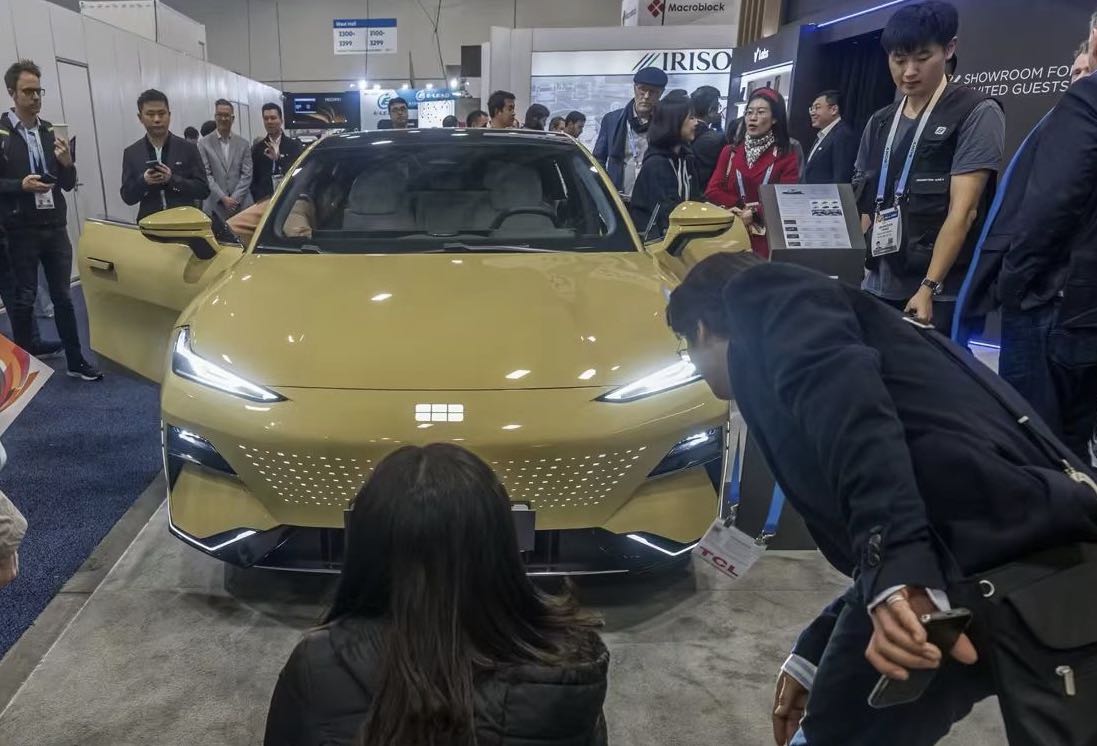
At CES 2025 in January in Las Vegas, Geely, in partnership with Chinese robotics technology company RoboSense, showcased its Galaxy E8. The model features RoboSense's latest EM4 ultra-long-range automotive-grade digital LiDAR, enabling advanced intelligent driving capabilities including high-speed navigation on autopilot (NOA) and home parking assist (HPA).
LiDAR technology is increasingly deployed in less expensive cars, like the Galaxy E8, due to a dramatic decrease in costs, said RoboSense CEO Qiu Chunchao. "We have brought LiDAR into a fully digital era — it's similar to how cameras transitioned from the film era to the digital era. Now LiDAR is also entering its digital age, so our entire series of new products are being developed around this digital LiDAR platform," he told China Daily.
Li Chuanhai, vice-president of Geely Auto Group, said that he expects that 2025 will be the year when autonomous driving technology sees the fastest commercialization, combining both deeper market penetration and technological advancement.
The autonomous driving technology was previously only equipped on high-end vehicles, starting from 400,000 yuan (about $55,000) and now it's accessible in cars around 100,000 yuan (about $13,800), said Li, without disclosing the price for Galaxy E8 with autonomous driving features.
A LiDAR unit, for instance, used to cost 30,000 yuan (about $4,100), but now it costs only around 1,000 yuan (about $138) — a dramatic decrease, said Li.
"It's about both volume and technology itself. The automotive industry relies on scale to reduce costs. When application volume increases, costs come down," he told China Daily in an interview. "Current autonomous driving technology, especially from Chinese brands, is progressing rapidly. Particularly, AI large models represent a revolutionary advancement for autonomous driving capabilities."
This technological revolution is unfolding in two phases — electrification in the first half and intelligence in the second half, according to Su Ning, CEO of BOE Varitronix, a sole sales platform of BOE Group for automotive businesses.
"Electrification has significantly lowered the barriers to entry for vehicle manufacturing and made overall intelligent driving possible," said Su. "Since last year, intelligent features have developed rapidly, especially in China, where Level 3 autonomous driving has now gained general acceptance."
The economies of scale are the primary driver of the trend, particularly as LiDAR systems see wider deployment in smart EVs, robotaxis and other robotics applications, according to Lei Xing, a Massachusetts-based analyst who covers the Chinese auto industry and was former chief editor of China Automotive Review.
The trend is accelerating the adoption of advanced autonomous driving features, especially in urban scenarios, with increased implementation of city NOA and parking-to-parking autonomous capabilities — "Level 2+" systems where vehicles can drive themselves while still requiring driver attention, he said.
"This trend is expected to accelerate significantly this year, reaching more affordable vehicle models," he added.
Xing said he expects Chinese LiDAR manufacturers to expand their global footprint, starting with joint venture brands like Toyota, GM and Volkswagen, in the Chinese market. "There are ongoing discussions about incorporating Chinese LiDAR systems into vehicles sold globally by international brands," he said.
However, Chinese EVs and technology face stringent restrictions in the US market, due to concerns over "national security" and fears that Chinese auto exports could undermine the nation's EV industry.
The US imposed 100 percent tariffs on vehicle imports from China last year, and other proposed rules would ban Chinese software and components for connected vehicles starting in 2027.
Jonas Nahm, an associate professor at the Johns Hopkins School of Advanced International Studies, pointed out that the US "has failed to engage with the reality of China's auto sector" and that "protectionist policies could raise prices for American consumers and impede the transition to cleaner vehicles".
"Tariffs and bans also reduce pressure on US automakers to innovate, including by learning from China's EV makers who excel at software innovation, rapid product development, and a relentless focus on reducing costs," Nahm wrote in a new report published by his institution.