New light shed on diversity of plateau's plants







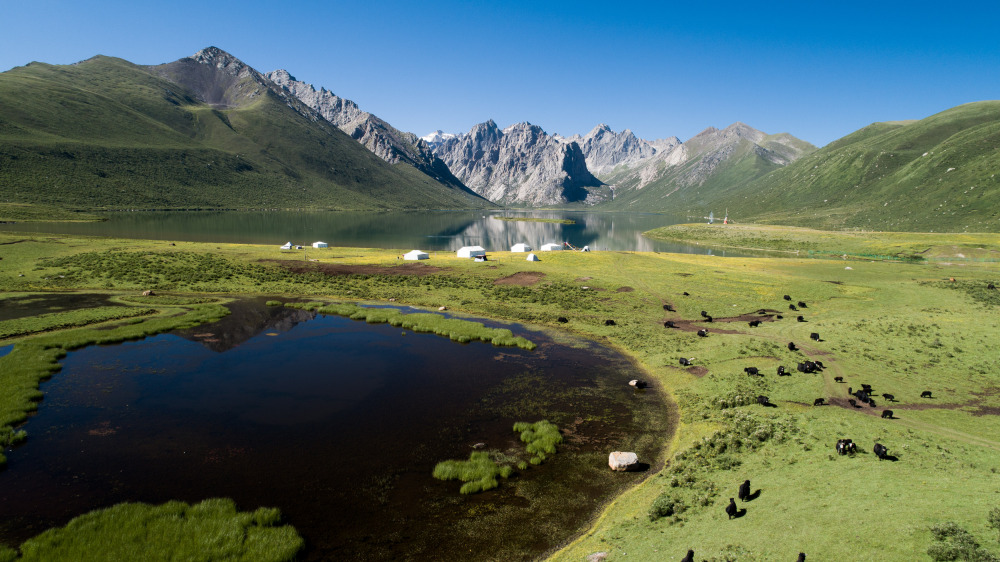
Chinese scientists have discovered what determined the distribution of unique high-altitude plants across the Qinghai-Tibet Plateau, thereby answering a major global scientific question.
Known as the "Roof of the World" and the "Third Pole of the Earth", the plateau hosts exceptionally rare plants, with over one-third of them found nowhere else on Earth.
"This makes it a global biodiversity hot spot," said Wang Tao, a professor at the Chinese Academy of Sciences' Institute of Tibetan Plateau Research and the lead author of a related study published recently in the journal Nature Communications.
"For decades, scientists have tried to understand how these mountain-specific plants developed their unique distribution patterns," he said.
Working with researchers from the University of Basel in Switzerland, Xishuangbanna Tropical Botanical Garden of the Chinese Academy of Sciences and Peking University, Wang's team found that historical shifts in tree growth limits — the highest altitude at which trees can survive — played a crucial role.
The study re-created a model to show how the plateau's tree line, the upper forest limit, moved over time since the last Ice Age 22,000 years ago.
Wang said it is widely accepted that the uplift of the plateau played a key role in the origin of its flora, while periodic climate fluctuations during the Quaternary Period 2.6 million years ago drove the diversification of species.
Earlier studies have warned that global warming pushes trees higher up mountains, squeezing the habitat of alpine plants. This new research reveals that past tree line shifts also left a lasting mark.
In addition to the Quaternary climate fluctuations, the fluctuations regarding past tree line shifts "have also influenced the diversity of endemic alpine species in alpine areas, a factor that had not been explored before", Wang said.
The study found that the average elevation of the tree line in the distant past on the Qinghai-Tibet Plateau was lowest — roughly 3,426 meters — during the Last Glacial Maximum, which lasted from 29,000 to 19,000 years ago, and highest — about 4,187 meters — during the Holocene Thermal Maximum about 8,000 years ago. The average present-day tree line is at 4,009 meters.
The fluctuation in tree line elevation between glacial and interglacial periods reached up to 850 meters, causing the habitat area for endemic alpine species during interglacial periods to be about 50 percent of the habitat area during glacial periods.
"Areas with stable environments over time developed more unique plant mixes. In contrast, regions with frequent tree line changes had simpler, more uniform plant communities," Wang said.
Team member Xu Jinfeng said: "Think of environmental changes as a sieve — only the toughest species survive repeated shifts, making plant groups look similar. Stable areas let plants develop special traits, creating richer diversity."
According to the study, rapid warming and rising tree lines could threaten the plateau's unique plants.
"These species aren't built to handle double pressures from climate change and invading trees," said Wang. "Our findings help design better protection plans."
yandongjie@chinadaily.com.cn




- China, Algeria expand space cooperation with new satellite launch
- Cross-Strait Chinese New Year bazaar unites cultures in Fuzhou
- Emergency Management Minister Wang Xiangxi under investigation
- Overseas-Chinese group tours Xinjiang as special guests
- China launches satellite for Algeria
- Capital accelerates humanoid robot mass production