



Bitter pill







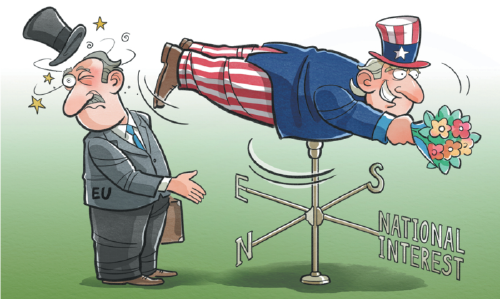
EU must reassess its complex relationship with the US in light of the Trump administration's disregard for transatlantic ties
Henry Kissinger once said: "It may be dangerous to be America's enemy, but to be America's friend is fatal." When applying Kissinger's warning to the ongoing events in Europe, it reflects a critical view of how US alliances have sometimes been abandoned or betrayed when US priorities no longer align with the interests of its partners.
The Ukraine crisis and the recent Trump-Putin telephone dialogue serve as a stark reminder to European allies of the constraints imposed by their lack of security independence and foreign policy autonomy. The ongoing United States-Russia discussions on the crisis without even European participation, which have caused shockwaves in the European Union, likely stem from concerns over strategic exclusion, diplomatic distrust and the possibility of unilateral concessions that could undermine European security interests.
When the US engaged with Russia without consulting its European partners, it sparked fears among the latter that crucial European interests — such as security, energy and sanctions policy — could be overlooked or even compromised. Most notably, the US is now seen not just as a global power embracing classic realism, but primarily as an unreliable partner.
The EU is concerned that any US-Russia agreement could legitimize territorial gains made through force, such as recognizing occupied Ukrainian territories, or lead to the premature lifting of sanctions, which would weaken the West's united position. European leaders, especially those in Eastern Europe, see this as a dangerous precedent for regional security. A unilateral US action could disrupt the EU's carefully maintained consensus on sanctions and military support for Ukraine. Internal divisions might resurface, with Hungary's pro-Russia stance and the occasional diplomatic overtures from Germany and France, potentially undermining collective determination.
This shock might reinforce calls for greater EU defense autonomy, as seen in initiatives such as the European Peace Facility and proposals for an EU army. Trust in the US' leadership may decline, accelerating Europe's push to reduce its dependency on NATO. The EU's outsourcing of its security to NATO — essentially relying on the US for defense — has eroded its own strategic autonomy. The Ukraine crisis has only highlighted this vulnerability, as Europe now finds itself deeply reliant on US military assistance, intelligence, and strategic decision-making.
This dependency on the US security umbrella often restricts Europe's ability to pursue independent foreign policies, particularly in areas such as defense, trade, finance and global security. Historically, Europe has relied on affordable and reliable Russian energy, but following the Ukraine crisis, the EU shifted to US liquefied natural gas imports, creating a new dependency.
Historically, differing national interests among EU members have often hindered the creation of a unified and effective foreign policy, reinforcing Europe's dependence on US leadership. Eastern Europe's pro-US position, in particular, complicates the effort for EU strategic autonomy. The term "new Europe", introduced by former US secretary of defense Donald Rumsfeld before the Iraq War, was used to contrast with "old Europe", emphasizing the distinct historical, geopolitical and security concerns of the two regions, especially regarding their relationships with Russia during the Cold War.
The "Russia factor" and the "China threat" theory sold by the US play a key role in dividing Eastern and Western Europe, as these regions have differing perceptions of these challenges. The so-called China threat has, in fact, been largely promoted by the US to distance the EU from China. Eastern European countries strongly support NATO but often block the development of the EU's own defense capabilities, such as the European Defence Fund or Permanent Structured Cooperation. Meanwhile, Western Europe tends to focus more on issues such as terrorism, energy security, relations with Africa, and competition with China, while advocating for a more independent approach and struggling to find consensus on common policies.
For a long time, the EU has viewed itself as a third major power, alongside the US and China. However, Europe-US transatlantic relations have been significantly weakened by a series of crises and a shift in US foreign policy driven by its internal politics. In practical terms, the transatlantic bond is deteriorating due to the growing divide between the two sides on issues such as global perspectives, international institutions and norms, multilateralism, climate change, and even NATO, which has been the cornerstone of their security relationship.
China-EU relations are unavoidably influenced by the intensifying global power competition between China and the US. The EU now finds itself caught in the midst of this US-China strategic rivalry. The US' containment of China is significantly impacting the global trading system and could lead to short-term disruptions and long-term destabilization of the current global order. Nevertheless, the EU seemingly remains confident that its member states can continue to uphold the values and norms they have historically and culturally shared with Washington, while also benefiting economically from closer engagement with China.
As the US may continue to engage Russia on the Ukraine crisis without Europe, this could reshape the EU's strategic approach, particularly in relation to China. Strengthening EU-China relations aligns with the interests of both parties and benefits the global order. For years, the EU has balanced cooperation, competition and rivalry with China, often highlighting human rights and democratic values. However, given the US engages with Russia without fully considering European interests, the EU may need to reconsider its position. Softening its rigid stance on China could enhance economic and strategic cooperation, especially in areas such as trade, technology and climate change.
The importance of EU-China relations cannot be overstated. As the EU navigates its complex relationship with the US, it must also consider its strategic engagement with China. The EU's approach to China has been multifaceted, involving cooperation on global issues such as climate change and trade, while also addressing competition (not rivalry) in areas such as technology and human rights. This dual approach is crucial for the EU to maintain its strategic autonomy and to balance its relationships with both the US and China.
China is a significant economic partner for the EU, and the two have extensive trade relations. The EU is China's second-largest trading partner, and China is the EU's second-largest trading partner after the US. This economic interdependence highlights the importance of the EU maintaining a stable and constructive relationship with China. The EU must navigate this relationship carefully, balancing economic interests with strategic and political considerations. In recent years, the EU has taken steps to strengthen its strategic autonomy and reduce its dependency on the US. This includes initiatives such as the European Peace Facility, which aims to enhance the EU's ability to act independently in defense and security matters.
Strengthening EU-China relations is a key component of this strategy. By engaging with China on issues of mutual interest, the EU can reduce its reliance on the US.
Li Xing is a Yunshan leading scholar and director of the European Research Center at Guangdong University of Foreign Studies, and an adjunct professor of international relations at Aalborg University, Denmark. Francisco Leandro is an associate professor at the Faculty of Social Sciences and vice-director of the Institute of Global and Public Affairs at the University of Macau (China). The authors contributed this article to China Watch, a think tank powered by China Daily. The views do not necessarily reflect those of China Daily.
Contact the editor at editor@chinawatch.cn.





