US small businesses worried about tariffs
Duties can cause job loss in sectors that rely on imported materials, say insiders







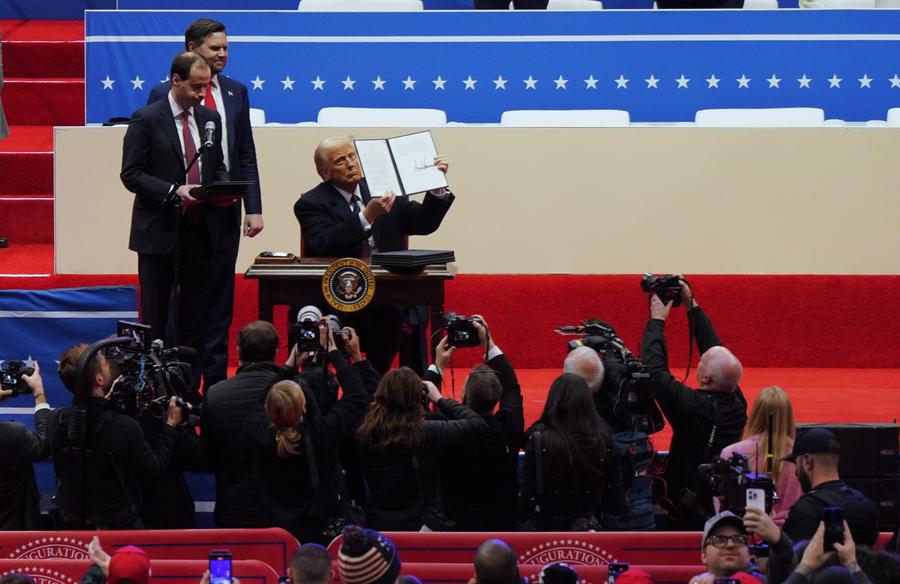
A large number of small businesses in the United States that rely on imported goods have expressed concern over the impact of the 10 percent tariff on Chinese goods recently enacted by US President Donald Trump.
More than half of the small businesses polled by the Small Business Majority — a national organization with over 85,000 members and 1,500 business and community organizations — admitted being "concerned" over the impact of tariffs on their livelihoods.
The US has an estimated 33.2 million small businesses that make up 99.9 percent of all of the companies in the country and contribute 44 percent of gross domestic product, according to the US Chamber of Commerce.
"Tariffs are my biggest concern right now," Margo Clayson, founder and president of The Mighty Microgreen in Inkom, Idaho, said in the survey. Her shop offers microgreen growing kits, seeds and supplies.
"I source everything I can locally, but some materials — like plastics — are simply not affordable in the United States. If I have to raise prices in response to my increasing costs, I know families will then have to make tough choices."
US imports from China provide vital stock for businesses nationwide. Textiles, apparel, consumer electronics and electrical equipment are among the top imports from China, according to US Census Bureau data. At least one-fourth of all US imports are raw materials or parts.
Sandra Payne, owner of Denver Concrete Vibrator in Colorado, imports steel from China and other raw materials for her equipment business. "Small businesses run on very small margins. And so, a 25 percent increase in any product is going to hurt," she told The Associated Press.
Higher prices
"US retailers will have to pay higher wholesale prices for imported consumer goods," Thomas Fullerton, a US economist and economics professor at the University of Texas at El Paso, told China Daily. "US importers will also see reduced profit margins."
So far, Trump's tariffs include one of 10 percent on Chinese goods, effective Feb 4, and 25 percent tariffs on all imported steel and aluminum, effective March 12. His proposed 25 percent tariff on goods from Mexico and Canada was put on hold on Feb 3, but may be enacted in March.
The US president recently floated the idea of reciprocal tariffs beginning in April on autos, semiconductors and pharmaceuticals.
John Arensmeyer, founder and CEO of Small Business Majority, said in a statement: "Instead of pursuing partisan wish lists purely to secure political points, the new administration and Congress should focus instead on policies that entrepreneurs say would help their businesses succeed."
In a Feb 13 memorandum, Trump instructed agencies to investigate how reciprocal tariffs could work and probe "any other practice that imposes any unfair limitation on market access or any structural impediment to fair competition with the market economy of the United States".
Overall, the president aims to get more US businesses to set up factories domestically to generate more trade.
But for the US, tariffs "can cause job loss in sectors that use imported intermediate and capital goods", Mary Lovely, professor emeritus of economics at Syracuse University and senior fellow of the Peterson Institute for International Economics, told China Daily.
Tariffs could also have far-reaching implications for the 3 million businesses run by Asian Americans. The firms employ more than 5.2 million workers in the US, according to Census Bureau data.
In New York's Chinatown, at least 4,000 businesses are Asian-owned, data from the Asian American Foundation show. Many rely on imports from China or have a hand in trade with the country.
Victoria Lee, CEO of Welcome to Chinatown, a nonprofit that aids local people and businesses, said that such businesses are an important but often overlooked part of commerce. She told China Daily that the small businesses "are more than just economic drivers. They represent generations of cultural heritage."
belindarobinson@chinadailyusa.com