



Change of track







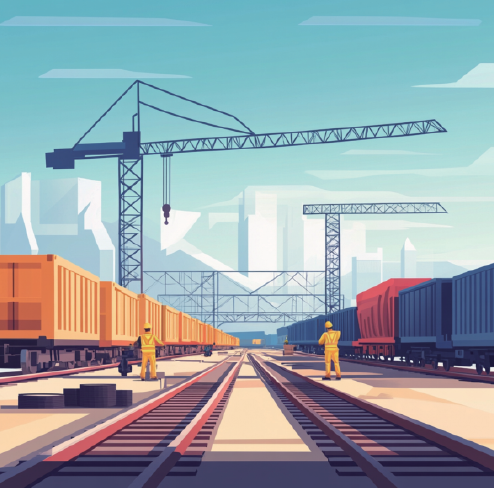
WANG XIAOYING/CHINA DAILY
Challenges to China-Vietnam railway cooperation are not merely simple commercial cooperation issues
Since the EU-Vietnam Free Trade Agreement and the Regional Comprehensive Economic Partnership entered into force, Vietnam's exports to China and the European Union have surged. Railway transport, which is much faster than maritime shipping, has enabled Vietnam to not only expand its exports to China and the EU but also connect with Russia and the Central Asian countries. This has helped achieve goals that are difficult to attain through maritime transport alone, such as delivering tropical fruits and seafood to China and the EU within a short time span. For the same reason, at the initiative of Vietnam, China launched international railway transit services in December 2017, using existing routes to export Vietnamese goods to China and the EU.
However, the major problem lies in the different railway gauges. China adopts the standard gauge railway, while Vietnam uses the meter gauge. Currently, Vietnamese goods transported via the China-Vietnam international combined transport mode take about 25 days at the fastest, though maritime shipping takes even over 50 days. In contrast, the China-Laos Railway can transport goods from Vientiane, capital of Laos, to the EU within 15 days via the combination of China-Laos Railway and China-Europe freight train service.
The Vietnamese authorities have proposed EU-Vietnam railways or Asia-Europe railways connecting Vietnam and the EU, and Vietnam's leaders have repeatedly requested China to facilitate its transit transport.
To address this issue, China and Vietnam have reached and reaffirmed a consensus during the Joint Statement issued by China and Vietnam on Aug 21 last year on enhancing the connectivity of their railways and building a high-speed railway connecting North and South Vietnam, culminating in an agreement that China will assist Vietnam in planning the Hanoi-Lang Son, Mong Cai-Ha Long-Hai Phong, and Lao Cai-Hanoi-Hai Phong standard gauge railways.
However, the railway cooperation has not progressed well, and many of the consensuses face challenges in implementation. The foremost is the funds problem. The project includes the renovation and upgrading of the Lao Cai-Hanoi-Hai Phong Railway and the construction of the North-South High-Speed Railway from Hanoi to Ho Chi Minh City, both of which require substantial funding, especially the latter. In 2016, Japan estimated the cost of the latter to be about $50 billion, about one-fourth of Vietnam's GDP at that time, so the proposal was shelved by the Vietnamese National Assembly. In 2018, Vietnam's Ministry of Transport estimated the budget to be $60 billion, which was again rejected by the National Assembly. In November 2023, the ministry proposed three alternative plans, with the investment ranging from $67 billion to $72 billion. All these figures are beyond Vietnam's financial capacity, leading to internal disagreements and making it difficult to achieve substantial progress in subsequent work.
The second challenge is interference from extraterritorial powers and security concerns. For a long time, driven by the strategic need to contain China and geopolitical competition, extraterritorial powers led by the United States have continuously demonized China in Vietnam, such as "sovereignty trap "and "debt trap", sowing discord in bilateral relations. They have also supported Vietnam's construction of the east-west railway from Da Nang to Myanmar's Dawei Port. These deeds have severely affected the judgment of Vietnam's decision-makers and elites, hindering China-Vietnam railway cooperation.
The third is Vietnam's wait-and-see attitude in terms of the competition between China and Japan, which goes far beyond the commercial considerations. China can offer a cost-effective solution, but due to "security" concerns, Vietnam tends to favor Japan. However, Japan-built rail is expensive, and its proposals have been repeatedly rejected by the Vietnamese National Assembly. Moreover, there is a significant gap between Vietnam's high expectations for quality and its inclination to reduce investment, and the investment estimates and rail speeds proposed by the Japanese side. Vietnam's attitude toward the final North-South Railway builder is indecisive, as it worries that whole construction by one side may leave potential risks for future maintenance and national security. To address this, Vietnam has divided the project into several segments, attempting to unify technical standards and conduct segmented bidding to encourage both contractors to offer more favorable terms. While this approach is conducive to maximizing Vietnam's interests, it has also directly led to slow progress in railway connectivity.
The last is the divergence in China-Vietnam infrastructure construction cooperation. At present, China-Vietnam infrastructure cooperation mostly adopts the Build-Transfer-Operate or Public-Private Partnership model. In their cooperation, the Chinese side emphasizes the long-term social benefits, while the Vietnamese side focuses more on the immediate gains during the construction process. Because of these perceptual differences, Vietnam has voiced considerable dissatisfaction with the actual outcomes of the current cooperation. It believes that it has not gained corresponding benefits from the cooperation because almost all the goods, equipment and services required for the projects come from China.
The challenges in China-Vietnam railway cooperation are not merely commercial, and are not even confined to the bilateral relations between China and Vietnam, but involve profound strategic issues related to geopolitical patterns and national security, with the interference from countries such as the US and Japan. Therefore, addressing these challenges requires thinking from security and strategic perspectives.
First, it is necessary to further enhance political mutual trust between the two countries — not just the political mutual trust of top leaders but, more importantly, between specific implementers and coordinators of cooperation. Only in this way can various negative factors and distractions be eliminated.
Second, it is important to shift the mindset and respect the reality of a diversified market for railway construction in Vietnam. For security and maintenance cost considerations, Vietnam cannot allow any single country to undertake its North-South Railway project alone. Unifying technical standards and adopting segmented bidding can reduce Vietnam's worries about security and maintenance costs as much as possible. Meanwhile, building in segments and phases will allow Vietnam to overcome the financial challenges posed by high investment costs. This approach enables Vietnam to complete the project according to its financial capacity, actual needs and priorities, without worrying about falling into so-called debt traps or sovereignty traps.
Third, during the China-Vietnam cooperation, there should be increased utilization of local labor, goods and services, to especially meet Vietnam's demand for the cultivation of management professionals and enhance its sense of gain.
Last, it is essential to accelerate the new land-sea corridor projects with neighboring countries such as Laos, Thailand and Myanmar, and expand the coverage and transport capacity of the model of China-Laos Railway plus China-Europe freight train service. Successful examples will speak for itself.
The author is director of the Center for China's Relations with Neighboring Countries at Fudan University. The author contributed this article to China Watch, a think tank powered by China Daily. The views do not necessarily reflect those of China Daily.
Contact the editor at editor@chinawatch.cn.





