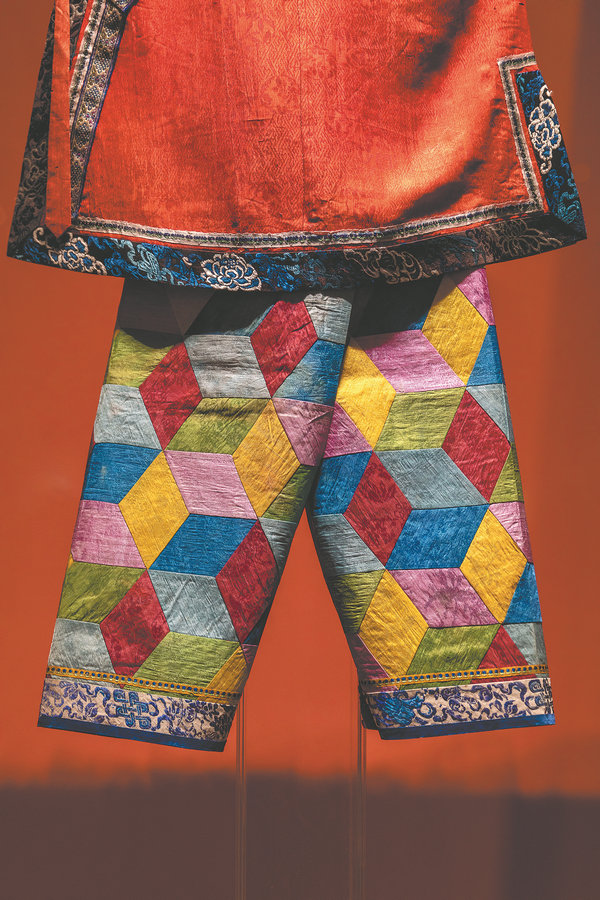
The piece inevitably reminds Gao of so-called bainayi, or the "Hundred-Patch Robe", of which the BIFT museum houses a pristine example from the late 19th century.
"The origin of this garment lies in its Sanskrit name, kasaya, later adapted into Chinese as jiasha, meaning Buddhist clothing," Gao explains. "Kasaya is a traditional Buddhist monastic robe which, stitched from multiple fabric pieces in a patchwork style, symbolizes humility and detachment from materialism."
This belief captivated the ancient Chinese, who viewed bainayi as a safeguard for their children's health, inspired by the resilience of the poor. However, its original association with simplicity and asceticism took a lavish turn during the Ming Dynasty (1368-1644), when the wealthy readily scissored up rolls of fine silk to create opulent versions of the garment, with each piece gleaming like a mirror in a dazzling, luxurious mosaic.
Between 138 BC and 115 BC, Chinese explorer and diplomat Zhang Qian embarked on two journeys across the vast deserts lying to the west of the Western Han Dynasty (206 BC-AD 24), venturing deep into Central Asia and, some scholars believe, even reaching the edges of the Mediterranean world. These monumental undertakings laid the foundation for what would later be known as the ancient Silk Road, a vast network of trade routes that became the lifeblood of commercial and cultural exchange, uniting the entire Eurasian continent.
Shortly after the opening of the Silk Road, techniques for silkworm farming and thread dyeing spread from China's Central Plains to Xiyu (Western Regions), which encompasses today's Xinjiang Uygur autonomous region and part of Central Asia, where locals developed a method that created striking, vibrant chevron patterns on woven cloth. This distinctive design, combined with the luxurious fabric sheen, gave it a dynamic, almost fluid quality, making highly sought-after items during the Tang Dynasty (618-907), when Silk Road activities reached its peak.
"It has always been a two-way street," says Gao, who, for the exhibition, paired the museum's enviable collection of ethnic clothing with the latest designs from BIFT's teachers and students. Among them was Yang, who, as a young boy, would watch intently as his mother bent over a piece of embroidery.
"The creative energy and unbridled imagination my mother and her fellow Miao women possess are rooted in nature and its worship," says Yang, pointing to the breezy pleated skirt worn by a branch of the Miao, aptly known as "the short-skirted Miao".
"Women in this group wear multiple skirts at once; the fullness and perkiness are their way of honoring birds, which they greatly admire," Yang explains.
A similar layering tradition exists among the Hani, who inhabit the same southwestern regions of China as the Miao. Their practice of layering tops, each just slightly shorter than the one beneath to reveal all the hems, was inspired by the rice terraces they have been ploughing since many centuries ago.
Reflecting on the bold aesthetics of the Miao people, Yang says, "True dressing-up asks for supreme confidence. That's the core lesson for anyone hoping to take a page from the Miao fashion book."