



Pursue green development on their own
The developing countries should embrace increasingly accessible and affordable green energy and technologies while the US withdrew from the Paris Agreement







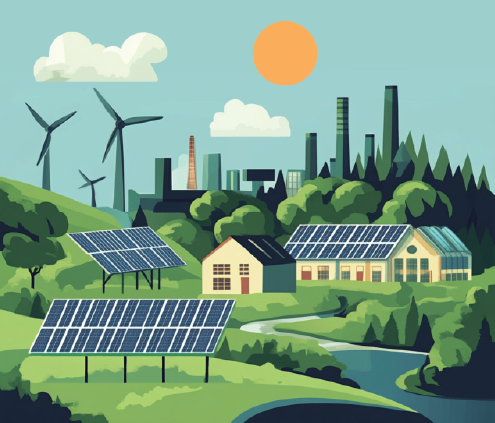
The developing countries should embrace increasingly accessible and affordable green energy and technologies while the US withdrew from the Paris Agreement
The Donald Trump administration's decision to withdraw the United States from the Paris Climate Agreement has been widely criticized as a retreat from global leadership. President Trump's dismissal of climate change as a "hoax" and his administration's pursuit of fossil fuel expansion — epitomized by the slogan "drill, baby, drill" — have raised concerns about the global fight against climate change. After all, the US is the world's largest economy in nominal terms and one of the largest carbon emitters. Its refusal to cooperate on decarbonization efforts arguably undermines global ambitions to combat climate change.
However, while this withdrawal is often framed as a setback, it also presents an opportunity — an opportunity for the rest of the world, particularly developing nations, to take the lead in shaping a sustainable future. The US' retreat reflects the insecurities of a declining empire, clinging to outdated notions of exceptionalism while the world moves forward.
The Paris Agreement was designed as a global framework to coordinate efforts to limit global warming to well below 2 C above pre-industrial levels. While the agreement was a landmark achievement in multilateral diplomacy, its implementation has been uneven, with developed nations often failing to meet their commitments, particularly in providing financial and technological support to developing countries. The US' withdrawal, while regrettable, removes a significant obstacle to progress by freeing the rest of the world from the constraints of US exceptionalism and its often self-serving approach to global governance.
For developing nations, the US' retreat is an opportunity to pursue climate action on their own terms. The technologies needed for green development — renewable energy generation, battery storage, electric vehicles and more — are increasingly accessible and affordable, thanks in large part to China's leadership in these sectors. China, now the world's largest producer of solar panels, wind turbines and electric vehicles, has demonstrated that green technologies can be rapidly and cost-effectively scaled up. The US' moves to place tariffs on these technologies will not stymie China's ability to make them available to the world.
China's rapid expansion of green technology exports to the Global South is a testament to developing nations' growing demand for sustainable solutions and the effectiveness of China's strategy in positioning itself as a global leader in renewable energy and green technologies. This trend also underscores the limitations of efforts by Western powers to curtail China's green technology sector, as market forces and the urgent need for climate action in the Global South are driving demand that cannot easily be suppressed.
Moreover, the US' withdrawal highlights the need for a more equitable global climate framework. Developing nations have long argued that climate action must be aligned with their economic development goals. The failure of advanced nations to agree on substantial funding at COP27 to assist developing countries in their climate transitions underscores the deep cleavages in global climate negotiations. By moving forward without the US, developing nations can prioritize investments in renewable energy, sustainable infrastructure and climate resilience — initiatives that not only reduce emissions but also drive economic growth and job creation.
The US' withdrawal from the Paris Agreement is not just a policy decision. The US has long viewed itself as the indispensable nation, the leader of the free world, and the arbiter of global norms. However, its retreat from multilateral agreements such as the Paris Agreement and its inward-focused "America First "policies reveal a nation grappling with its diminishing influence in a rapidly changing world.
The rise of China as a global economic and technological powerhouse has challenged the US' dominance. China's commitment to renewable energy and its leadership in green technologies stand in stark contrast to the US' reliance on fossil fuels. While the US debates the merits of climate science, China has built the world's largest renewable energy infrastructure, positioning itself as a leader in the global energy transition. This shift in power dynamics has left the US clinging to outdated industries and ideologies, unable to adapt to the realities of a decarbonizing world.
At the same time, the US' retreat reflects a broader crisis of confidence. The US political system, plagued by polarization, has struggled to address pressing global challenges. By withdrawing from the Paris Agreement, the US has abdicated its role as a global leader, ceding ground to nations that are more willing to embrace the future.
As the US withdraws, the rest of the world can seize the opportunity to forge ahead, building a new framework for climate action that prioritizes equity, innovation and collaboration. Developing nations, in particular, have much to gain from taking the lead in this effort. By investing in renewable energy and sustainable infrastructure, they can reduce their dependence on fossil fuels, create new economic opportunities, and position themselves as leaders in the global energy transition.
As the world's largest producer of green technologies, China has the capacity to drive the global energy transition. Other nations, such as India and Brazil, are also making significant strides in renewable energy, demonstrating that climate action and economic development can go hand in hand.
At the same time, the world must address the funding gap for climate transitions in developing nations. The failure of advanced nations to provide adequate financial support at COP27 highlights the need for new mechanisms to mobilize resources. Direct public investment, green bonds, climate funds and public-private partnerships can all play a role in financing the energy transition. By working together, nations can create a more equitable and effective global climate framework — one that does not rely on the US for leadership.
Let's not forget, as most of the needed technologies can be sourced from places other than the US, there is no need to rely on the US dollar to finance such initiatives either.
There's no need to lament the US' withdrawal from multilateral coordinated action. Instead, the rest of the world can seize the moment and forge ahead, building a sustainable future for all.
The author is an adjunct professor at Queensland University of Technology and a senior fellow at the Taihe Institute. The author contributed this article to China Watch, a think tank powered by China Daily.
Contact the editor at editor@chinawatch.cn.





