Effortless virtuosity
During collating, Huairen prioritized resurrecting Wang's writing in its natural state, De Laurentis says.
Although the characters were selected one by one from different scrolls written at various stages of Wang's life, Huairen endeavored to present a unified writing style while keeping variations, particularly in repeated words, and paid attention to making the joints of neighboring characters look natural and coherent.
Notably, Huairen intentionally included some roughly written characters to restore Wang's daily, casual manner of writing.
De Laurentis uses the classical musical expression sprezzatura to emphasize a fundamental pursuit in calligraphy — even if a piece aims to demonstrate strong and forceful strokes, the actual writing process has to be performed in an effortless way.
Like music, calligraphy is an art of time and space.
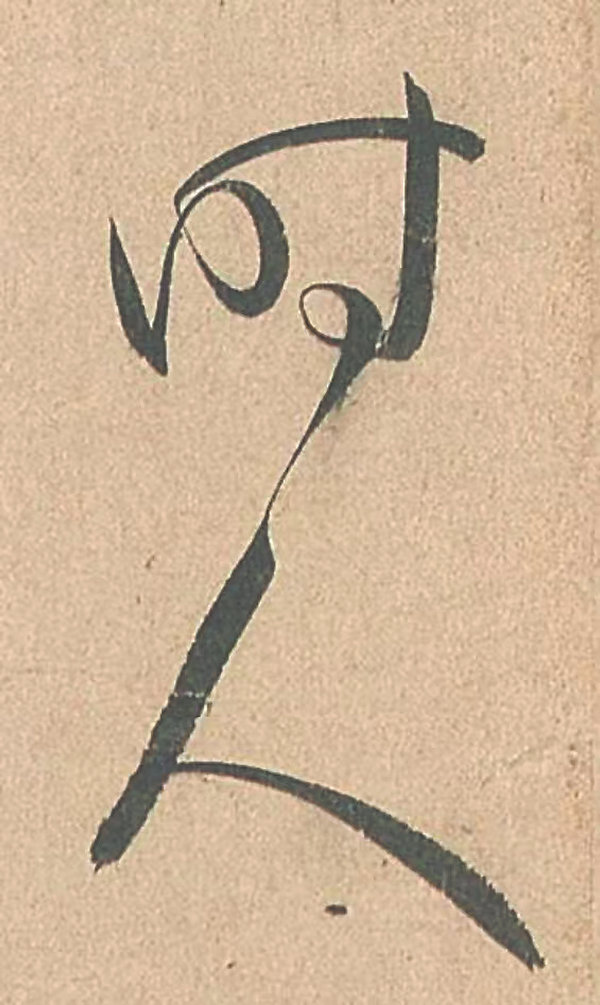
For Chinese characters, the order of strokes is much more complicated than that of phonetic writing systems like English or Arabic. which are written simply from left to right, or vice versa.
To write a Chinese character, the movement of the brush can be up and down, left to right, or outside-in — every possible direction imaginable — not to mention the kaleidoscopic composition and proportional distribution of different components.
"The relationship between different components is like the flow of a melody: sometimes loose, sometimes tight; sometimes slow, sometimes fast. It's a process of constant fluctuation and resonance," De Laurentis says.
Playing a single note can be done in a blink, like writing a character. The continuity and interplay of each stroke counts and there can be no reversal or adjustment to the completed strokes.
Fine strokes exhaust the potential and resilience of the brush tips, much like a varied finger touch makes a single key on the same piano produce different textures of sound.
Imagine when a pianist takes a new sheet of classical music and reads the notes — sometimes conducted by a metronome — striving to reproduce exactly what the various notations on the score indicate.
Yet, when they become more familiar with the music and can interpret its voice parts, harmony and chord progression with their own subtle ingenuity, the music becomes spontaneous and embedded with the musician's identity. Learning calligraphy involves a similar process.
Therefore, interpretations and imitations of the works of great calligraphers are crucial in calligraphy, not only for perfecting the techniques but also for experiencing human emotions and wisdom and refining one's character.

No later than the Western Zhou Dynasty (c.11th century-771 BC) had the Chinese developed an emphasis on beautiful writing, according to De Laurentis.
People from various social strata cultivated aesthetics through writing while accumulating wisdom in dealing with the richness and complexity of character structures, the abundance of styles and the combination of different components.
"It reflects a person's unique way of thinking and problem-solving."
Moreover, calligraphy mirrors the mind. De Laurentis expresses his admiration for Master Hongyi (1880-1942), whose name was Li Shutong before becoming a Buddhist monk and making great achievements in painting, composition, theater, calligraphy, seal carving and poetry.
"When copying other calligraphers' works, Master Hongyi withdrew himself and wholeheartedly conformed to strokes and the temperament of others. He demonstrated compassion and universal love in his facsimiles," says De Laurentis.