Reusable rocket developers aim for new heights







Building on the remarkable progress achieved in recent years, China's commercial reusable rocket developers are poised to reach new heights.
Guowang and Spacesail, two of China's major low Earth orbit satellite internet constellations, are aiming to place tens of thousands of satellites in orbit, creating a robust market foundation for the country's commercial launches.
Vast market demand will serve as a powerful driving force, propelling continuous innovation and breakthroughs in reusable rocket technology, while accelerating the widespread application of new technologies, materials, processes and testing methods, said Meng Xianbo, chief strategy officer of Galactic Energy, a Beijing-based rocket developer.
Galactic Energy is currently working on two types of reusable rockets. The PALLAS-1 is a two-stage reusable rocket fueled by liquid oxygen and kerosene. Weighing around 290 metric tons at launch, it can carry up to 8 tons to low Earth orbit. The rocket is set to make its debut flight in the first half of the year, kicking off commercial operations with two planned missions this year.
Based on the PALLAS-1 design, the PALLAS-2 rocket features a boosted low Earth orbit payload capacity of 30 tons and is expected to wrap up assembly and testing this year.
Meanwhile, LandSpace's Zhuque-3 rocket completed a 10-kilometer vertical takeoff and landing recovery test in September last year. The mission used a single-stage rocket with liquid oxygen and methane engines, marking the first time a Chinese rocket had completed vertical takeoff and landing recovery.
The company revealed that the Zhuque-3 rocket is slated for its inaugural launch, with three missions planned for this year.
"These launches will deliver a combined payload capacity of around 60 tons, and we are targeting the successful recovery of the rocket's first stage within these three missions," said Zhang Changwu, CEO of LandSpace.
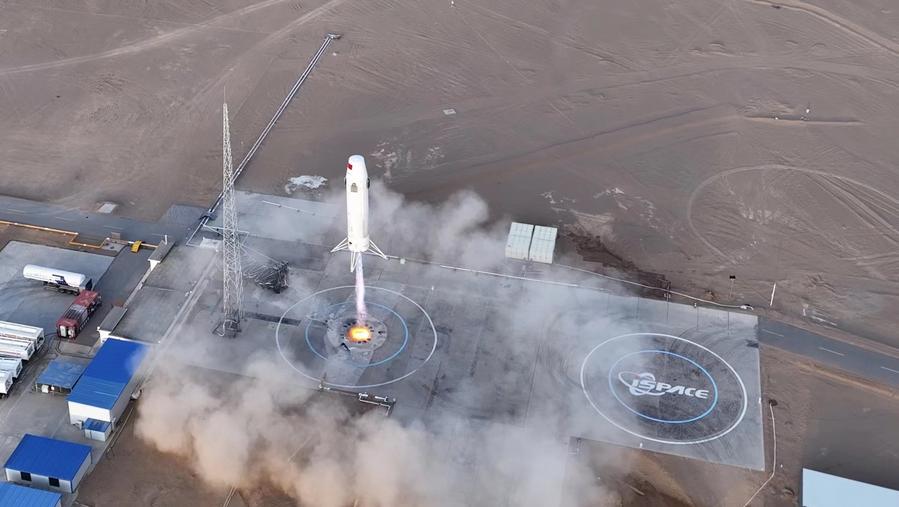
The commercial reusable rocket SQX-2Y, developed by i-Space, completed a vertical take-off and landing flight test on Nov 2, 2023. It conducted its second flight test mission on Dec 10 that year.
The company said valuable data and experience gained from these two SQX-2Y flight tests will contribute to key technological innovations for its medium-to-large reusable liquid oxygen-methane launch vehicle, named SQX-3.
According to the company, the SQX-3 launch vehicle is scheduled to perform its first orbital launch and recovery test mission in December this year.
Following the recovery of its first stage, it will undergo maintenance and inspection before being equipped with a new second stage. The rocket is then planned to conduct its first reuse flight test mission in June next year, said Ji Haibo, deputy general manager of the company.
The maritime recovery platform for the SQX-3 rocket's maiden flight mission commenced construction in November last year, Ji added.
Another rocket startup, Deep Blue Aerospace, announced last year that it plans to carry out commercial suborbital flights in 2027, using the company's reusable rocket Nebula-1.
The oxygen/kerosene-fueled Nebula-1, the company's first reusable launch vehicle, completed 10 of the 11 key verification tasks during its first high-altitude vertical recovery flight test on Sept 22 last year.
The Nebula-1 rocket will conduct extensive high-altitude recovery tests in 2025 and 2026. These tests aim to verify the feasibility and stability of the technology, while also accumulating critical data for ultimate orbit entry and recovery, according to the company.
Huo Liang, founder and chairman of this company, said advancements in rocket reusability will drive down space travel costs, making it accessible to the general public rather than remaining a niche luxury.
"We look forward to sending more people to space, inspiring broader interest in cosmic exploration and expanding humanity's understanding of the universe," Huo added.
Xinhua






- Fudan University sets AI education guidelines
- Haier ranks first in global sales for 17th consecutive year
- Norway's seafood exports hit record in 2025, China emerges as top three market
- Crucial tower of Shenzhen-Jiangmen Railway completed, marking significant milestone
- Hangzhou selected as a 'Zero-Waste Cities' by the UN
- China backs Tanzania's plan to double exports by 2030