



A festival that can help build a harmonious world







About 20 years ago the United Nations Educational, Scientific, and Cultural Organization adopted a new convention, the Convention for the Safeguarding of the Intangible Cultural Heritage. Since 2008 a special committee has been updating the heritage list of festivals, customs, and cultural practices and expressions.
Not all countries agree with the idea of inscribing or including traditions, festivals and cultural expressions and events on a heritage list, because it practically means excluding hundreds of them. Nevertheless, the UNESCO Intangible Cultural Heritage of Humanity List promotes global understanding by highlighting cultural diversity.
On Dec 4, 2024, Spring Festival was included in the UNESCO Representative List of the Intangible Cultural Heritage of Humanity. Previously, Dragon Boat Festival was included in the list in 2009, Peking Opera and Chinese shadow puppetry were included in 2010 and 2011 respectively.
Who, and when and how can one seek the inclusion of a festival, custom, traditional practice or cultural expression seems to be a fascinating topic. Coming from a place in northern Italy that is famous for "Truffle Hunting and Extraction", I'm curious to know how the practice ended up on the UNESCO list — not to mention the "Celestinian Forgiveness", an Italian tradition whose details are not known even to most Italians.
Spring Festival is celebrated not only in China but also in some other Asian countries. Yet in recent years it has increasingly become a global expression of China's opening-up to the world. It has expanded beyond its traditional role to become a widely recognized cultural celebration around the world.
In recent decades, Chinese cultural organizations have been continuously working to internationalize Spring Festival (also called Chinese New Year) and use it as a tool to enhance China's global image and cultural influence. To share with people the feelings and traditions of Spring Festival is part of the "soft power", which is the ability of a country or civilization to influence others through cultural, diplomatic and other non-coercive means.
The growing economic ties and people-to-people exchanges between China and countries across the world have also contributed to the global popularity of Spring Festival. Multinational companies, particularly those that have a large share in the Chinese market, have started to use Chinese New Year in their marketing strategies to boost their business. Global brands such as Coca-Cola and McDonald's often launch special promotions, packaging and advertisements for Spring Festival.
Many events are usually sponsored by Chinese embassies, consulates and media organizations. These events serve as platforms to showcase Chinese culture, arts and cuisine. By sponsoring such events, the diplomatic wing of the Chinese government has been able to create a positive perception about Chinese culture and strengthen people-to-people connections.
That Spring Festival is on the UNESCO Intangible Cultural Heritage of Humanity List means it has something that is of value to humankind. Is that the case, in reality?
Spring Festival is a time of family get-togethers and sumptuous food. As a matter of fact, Chinese people from across the country, as well as from abroad, travel back home to have Chinese New Year eve dinner with family, and to meet relatives and friends.
In this sense, Spring Festival is an expression of the collective memory of the unique bond that is the family. Such special moments are common to all humankind. As Roman poet Terentius said: "I'm a human being, and whatever belongs to the human race is not alien to me."
But if all festivals were the same, the world would be a little boring.
There are aspects that are unique to Chinese New Year. These aspects often make non-Chinese people curious and interested to know more about the festival. For example, the red envelope (with money) that is given to children and younger relatives is a traditional practice that surprises many foreigners, because they cannot fathom who gives the red envelopes to whom and why.
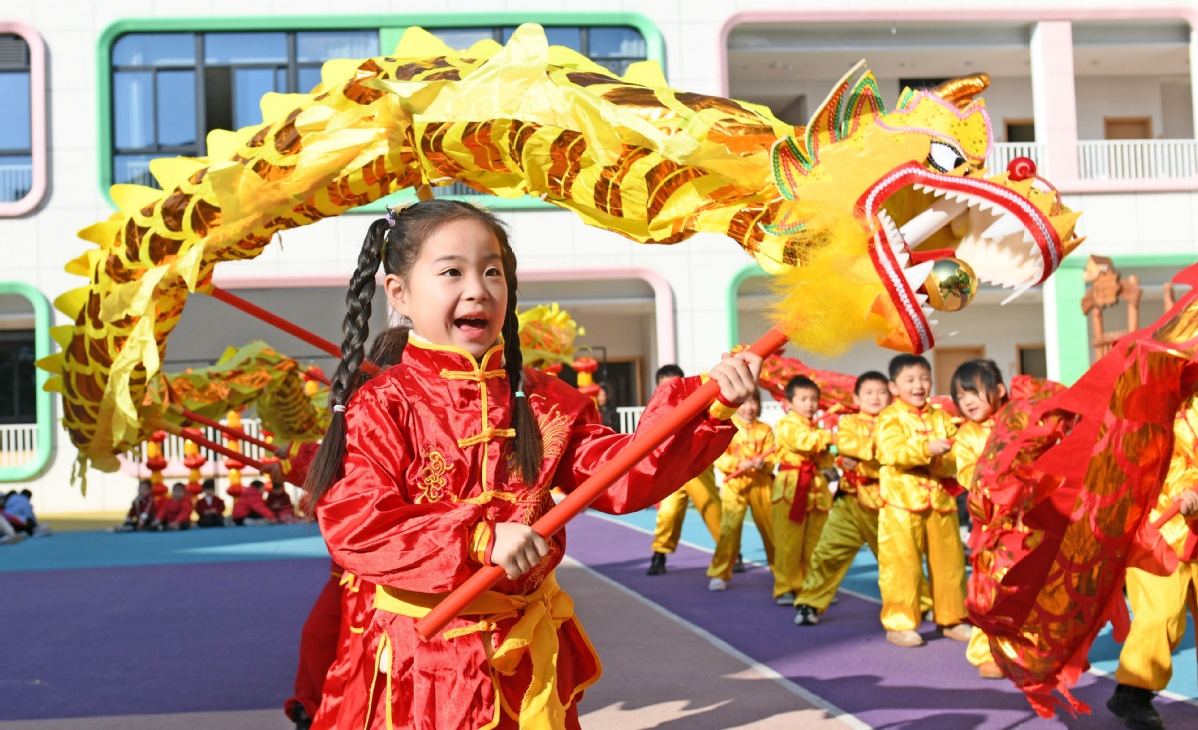
Many foreigners find the lion or dragon dance fascinating but don't know the cultural symbolism of prosperity and strength behind it. Some even wonder why the Chinese people (mostly women) wear red dresses or write "Spring Festival couplets" (chunlian), or poetic verses and glue them on doors to wish people prosperity, happiness and good fortune in the new year.
When a foreigner begins to learn Chinese characters, one of the first things she or he notices is that some "Spring Festival couplets" are often glued to the doors upside down -those who don't know Chinese or are learning the language don't see it. On asking, a Chinese friend or teacher might tell you that the Chinese character dào, meaning "upside down", sounds like the word dào that means "to arrive" or "to come", which is used to mean the arrival of good fortune and good luck in the home.
And, of course, Spring Festival means food — dumplings and spring rolls (symbolizing wealth), rice cakes (representing growth), fish (for abundance), tangerines (good luck), and much more.
Spring Festival has become a very important window for Chinese culture to "go global". It tells the world not to be afraid of China's rise, because a country that celebrates the primacy of family and unity with the universe cannot be a threat to another country. Instead, it hopes to build a harmonious future for humankind.
The author is a professor at the International Institute of Chinese Studies at Beijing Foreign Studies University. The views don't necessarily represent those of China Daily.
If you have a specific expertise, or would like to share your thought about our stories, then send us your writings at opinion@chinadaily.com.cn, and comment@chinadaily.com.cn.





