



Navigating uncertainty







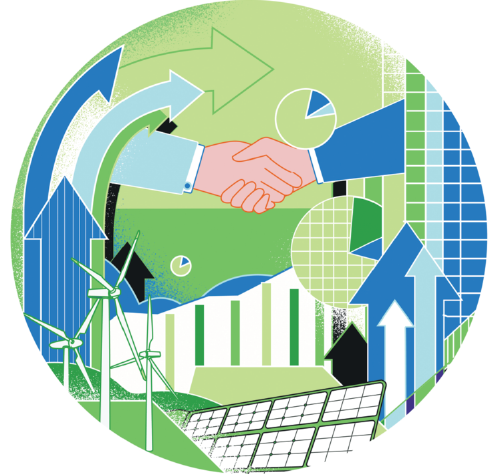
As a new Trump administration checks into the White House, the future of China-US relations and global order must be rules-based to prevent fragmentation
The future of relations between the United States and China in 2025 feels like a sea of uncertainty. One would either need boundless optimism or complete detachment to feel entirely confident about where things are heading. With Donald Trump's return to the presidency, the global order stands at a crossroads, teetering on the brink of significant instability. His campaign was full of sweeping pronouncements on major global issues — trade, technology, climate and industrial policy — but it lacked the coherence of a clear plan. His idea of imposing tariffs on Chinese goods, for example, signals a strong "America First" attitude but leaves much to interpretation.
Adding to the unpredictability is Trump's Cabinet, a mix of staunch China hawks advocating for confrontation and pragmatic individuals with a deeper understanding of the nuances of US-China relations. This blend creates a murky picture, making it hard to discern what path the administration might take.
One thing is certain: the risk of tariffs and trade wars looms large under Trump. If it happens, China and other nations will not sit idle, but retaliate. China has prepared by innovating and building independent value chains in the chip business and more. But a trade war will make us all poorer. Political leaders across the world are preparing for a storm that might lie ahead.
Domestically, Trump's focus on revitalizing the US working and lower-middle classes is commendable. After decades of stagnant wages, these workers deserve attention.
Tariffs, in Trump's view, are a key tool for restoring the US economy, protecting jobs and boosting revenue. Yet, the claim that these measures won't burden the US citizens but will shift the cost to other nations is misleading. In reality, tariffs hurt everyone, developed and developing nations alike and not least the US working class.
The stagnation in middle-America reflects a much larger transformation in the global economic order. While the US remains a formidable economic power, its dominance has significantly waned. In the aftermath of World War II, the US accounted for around 40 percent of the global economy. Today, that share has almost halved. It reflects the rise of the rest and it's good news for the world.
Militarily, the US remains strong, but recent history — from Vietnam to Iraq, Libya and Afghanistan — shows the limitations of its might. Even the most advanced weaponry struggles in urban battlefields and regions where civilian opposition runs deep. Compounding this is the US public's aversion to sending their children to fight in far-away theaters. The US has basically lost all recent wars. Despite its technological sophistication and unparalleled military spending, it had to give up when facing village boys from Afghanistan carrying AK-47s.
Despite these challenges, the US retains cultural and democratic influence. Its movies and pop culture still captivate the world. Yet, the sheen has dulled. School shootings, drug abuse, economic stagnation and political polarization have eroded the once-idealized image of the US. While the country still has many admirable qualities, fewer nations now aspire to replicate the US model.
Meanwhile, the decline of US dominance coincides with the rise of the Global South, with China leading the way. China is the only nation capable of rivaling the US across multiple fronts. Its rise reflects broader shifts in global power. Asia, home to nearly 60 percent of the world's population, has become the center of economic growth. Together, the economies of China, India and their neighbors account for the bulk of global expansion.
This economic transformation is further underpinned by Asia's peace. Compared with Europe, Africa and the Americas, Asia experiences far fewer cross-border or internal conflicts, providing a foundation for sustained growth. Moreover, globalization has not only fueled this growth but also lifted China and much of Asia out of extreme poverty, fostering the rise of a thriving middle class that positions Asia as the hallmark of 21st-century development.
Trump's return places him face-to-face with a far stronger China. Over the past eight years, China has used US tariffs and criticisms as a catalyst to accelerate its ambitions in markets such as solar panels, electric vehicles, robotics and rare materials. Its advanced manufacturing sector has exploded in scale and sophistication, becoming a global powerhouse.
China's leadership in the green economy and its control over critical supply chains provide a significant advantage in any trade conflict. For instance, during a recent conversation I had with an Indian businessman, he acknowledged that China dominates 97 percent of the market for his company's minerals and emphasized that India should learn from China's strategies to develop its own competitive advantages. This pragmatic perspective was both insightful and inspiring.
Moreover, China's robust state capacity enables it to drive large-scale breakthroughs in key areas such as solid-state batteries, quantum computing and artificial intelligence. These strengths will position China to navigate trade disruptions with resilience. By 2030, the United Nations projects that China could account for 45 percent of global manufacturing, surpassing the combined output of the US and its allies.
On the US side, let's not overlook the wild card that is Elon Musk. With Tesla's growing reliance on international markets — especially the Chinese market — Musk has the potential to act as a bridge between the US and its trading partners. As US columnist Thomas Friedman aptly observed, wasting Musk's talents on bureaucratic minutiae would be a grave mistake. Instead, the US should harness the energy of visionary leaders such as Musk to rejuvenate domestic manufacturing, drive innovation and create jobs.
On the foreign policy front, the current global landscape does not resemble a new Cold War. Instead of ideological divisions, we see a return to the pre-World War I balance of power. Major players — the US, China, Japan, Russia and Europe — are engaged in a geopolitical game akin to Bismarck's era in Europe. This transitional phase, filled with uncertainty, offers a rare opportunity. Why not seize this moment to establish a genuinely rules-based global order, with the same rules for everyone?
The US-led system cannot simply be replaced by chaos. Instead, the world needs a truly rules-based international order to prevent fragmentation. The complex interdependence of modern economies demands that such an order be built on international rules that are not static but evolve through a fair and inclusive process open to all stakeholders. This ensures that developing countries and emerging economies have a more equitable opportunity to participate. While we cannot predict the exact direction of the international system, only through dialogue and negotiation can we restore its strength. Most importantly, now is the time for unwavering commitment to the goal of a fair and sustainable global order.
The author is vice-president of the Green Belt and Road Coalition and former executive director of the United Nations Environment Programme. The author contributed this article to China Watch, a think tank powered by China Daily.
The views do not necessarily reflect those of China Daily.
Contact the editor at editor@chinawatch.cn.





