



New urbanization a fresh growth impetus







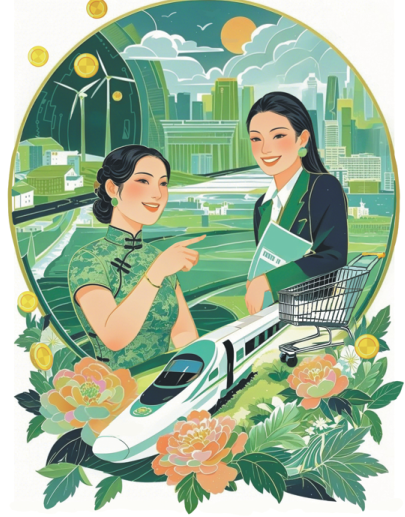
As China's economy shifts from rapid growth to high-quality development, the policy of new urbanization has become key to unlocking domestic demand and promoting balanced regional development. Given the fast-changing domestic and global situations, new urbanization offers a unique solution to challenges such as economic slowdown, lower-than-expected consumption, and industrial upgrading.
New urbanization is not only about expanding cities; it is also about advancing the country's broader economic and social goals, including common prosperity.
Urbanization has long been a key driver of China's economic growth. China's urbanization rate has increased from 17.9 percent in 1978 to 66.2 percent in 2023, but still remained below the 80 percent average of developed countries, leaving room for further growth.
However, new urbanization represents a shift from a traditional, land- and investment-driven model to a more people-centered approach, focusing on the quality of life, better public services and industrial upgrading to create an urban environment that enhances both human and economic efficiency.
The core of new urbanization rests on three key principles: people-centered urbanization, urban-rural coordination, and balanced regional development, as well as green and sustainable development.
Domestic consumption has long been a key pillar of China's economic growth. With the rapid urbanization in recent decades, new urbanization offers a chance to unleash the untapped potential.
New urbanization shifts the focus from building infrastructure to improving urban living conditions, aiming to enhance citizens' quality of life and boost consumption. As people move into cities, their lifestyles and consumption patterns undergo a change. Urban residents tend to have more varied and higher-level needs in terms of education, healthcare, entertainment and public services than those in rural areas.
For instance, cultural and health-related consumption is emerging as a key driver of demand with the deepening of urbanization. This shift has prompted the growth of fitness, wellness, digital entertainment and other sectors, helping unlock new consumption potential.
In tandem with the movement of the population, digital technologies are enabling the emergence of new consumption patterns. From smart retail to virtual reality shopping, new models are creating a consumption landscape that is more personalized, innovative and experience-driven.
Jiashan county in Zhejiang province, which is part of the demonstration zone of green and integrated ecological development of the Yangtze River Delta, exemplifies new urbanization both in spirit and practice. In 2023, Jiashan was selected as one of Zhejiang's first pilot cities for new consumption initiatives.
By focusing on smart communities, green consumption and cultural tourism, the city has triggered residents' enthusiasm for higher-quality consumption. Xitang town, with its "ancient town culture plus" approach and a focus on "drama, wine and community services" is creating cultural landmarks and promoting its identity as the "living millennium ancient town".
The town features a 250,000-square-meter complex of well-preserved Ming (1368-1644) and Qing (1644-1911) dynasty architecture, where visitors can travel back in time. While more than 2,600 local households continue to uphold centuries-old traditions, unique cultural practices such as Xitang-style paper-cutting, pankou (literally "coiled buttons"), and Xuan Juan (a form of folk narrative art) are being preserved and passed down to the younger generations.
Traditional urbanization often exacerbates regional inequalities, with large cities becoming overcrowded while smaller cities and rural areas lagging behind in resources and infrastructure. New urbanization addresses this by focusing on not only population growth but also integrating urban and rural areas. It aims to create a balanced development model that ensures equal access to public services and sustainable economic opportunities across all regions.
Jiashan's experience further illustrates this point. The county was the first place in the province to implement the "five-in-one coordination" mechanism, developing an integrated urban-rural smart eldercare app with four key service modules: "enjoy benefits", "book services", "ensure safety" and "select institutions".
As of November 2024, all elderly residents in the county have registered with the system, with more than 7 million service requests processed.
At the same time, digital rural development initiatives have helped farmers sell their products online, connecting rural economies with urban markets and boosting local people's incomes. In 2023, the per capita disposable income of rural residents in Jiashan reached 50,000 yuan ($6,819.9), with the urban-rural income gap narrowing significantly to 1.53:1, well below the national average of 2.39:1.
Equally important is how new urbanization fosters technological innovation. Smart cities, for example, are applying emerging technologies such as the internet of things, cloud computing and artificial intelligence to improve urban system efficiency and create new consumer demand, especially in sectors such as e-commerce, digital entertainment and health-tech.
By promoting green building practices, investing in public transportation and optimizing energy systems, new urbanization is not just improving people's quality of life but also laying the foundation for a green economy. Green consumption is emerging as a new growth area, with consumers increasingly demanding sustainable products and services. This shift toward a green economy, fueled by new urbanization, will drive China's future growth.
Jiashan is a prime example of this transformation. As a pilot region for the Yangtze River Delta integration, Jiashan has prioritized the development of the digital economy and emerging industries through the establishment of "county-level scientific development demonstration zones" and "county-level high-quality development demonstration zones".
This has attracted skilled professionals and revitalized traditional sectors such as housing, education and healthcare. In 2023, Jiashan's retail sales of consumer goods grew by 8.7 percent, more than the national average. This growth, driven by new urbanization's focus on quality and innovation, points to a bright future for China's economy.
New urbanization is more than just a spatial reorganization of China's cities — it is a profound transformation in how the country approaches economic and social development. It provides a pathway to shift from "quantity-driven" growth to "quality-powered" development.
By embracing people-centered policies, fostering urban-rural integration, and prioritizing sustainability, new urbanization offers a road map for high-quality, inclusive growth. As long as the policy design is sound, the execution effective, and the focus on innovation and equity strong, new urbanization will become a key driver of China's economic success, helping realize its social and environmental goals.
The author is the dean of the School of Economics, Jiaxing University.
The views don't necessarily reflect those of China Daily.
If you have a specific expertise, or would like to share your thought about our stories, then send us your writings at opinion@chinadaily.com.cn, and comment@chinadaily.com.cn.





