



Competition in coffee chain market intensifies
Some companies focus on digital innovation, others eye affordability, operation efficiency







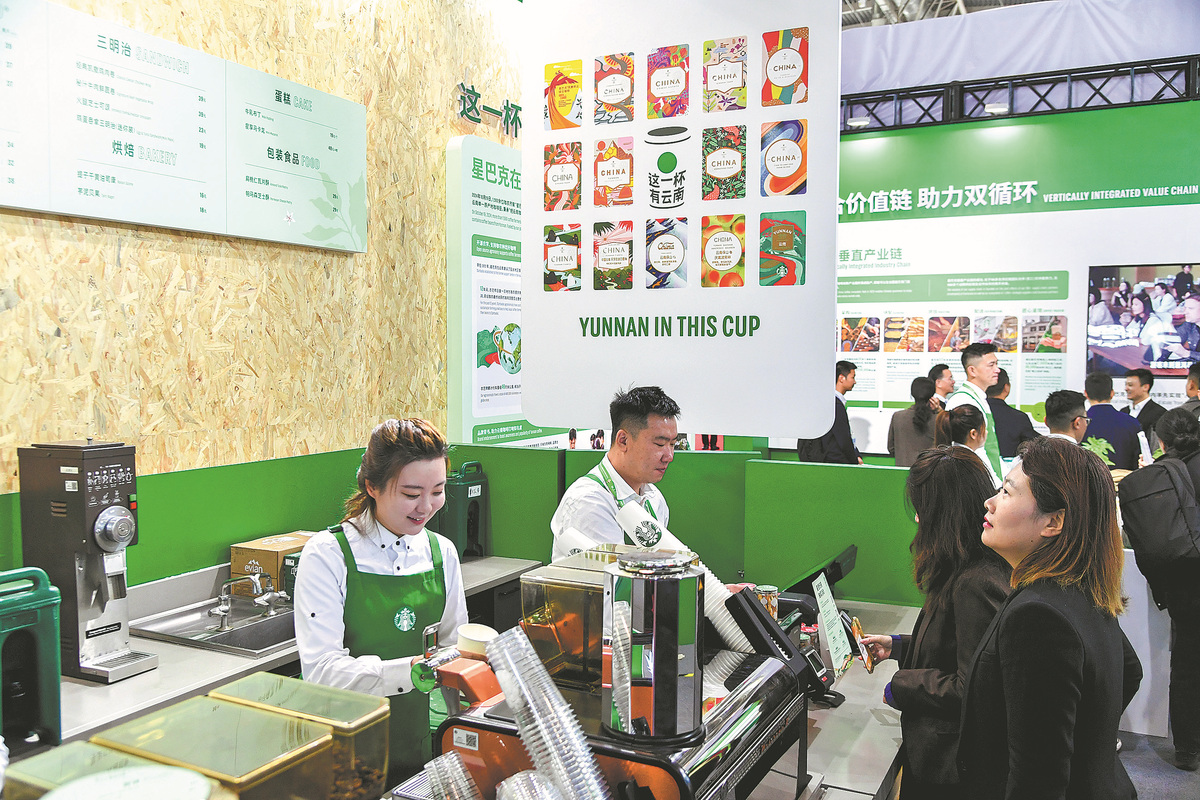
In a highly competitive coffee chain market, Starbucks China has expanded its focus from its traditional "third place" philosophy — positioning its stores as a comfortable space between work and home — toward digital innovation and targeted marketing.
Starbucks' recent appointment of Yang Zhen as chief growth officer signals a strategic pivot. Yang, an experienced digital marketing leader from Alibaba and Jidu Auto, has been tasked with leveraging digital tools, creative campaigns and product innovation to attract younger consumers and revitalize growth.
The new direction was reflected in Starbucks' recent viral marketing campaign, "I Opened Starbucks in Ancient Times", which blended storytelling with cultural appeal, an effort to reconnect the brand with Gen Z audiences. It is alleged that Yang was behind the production of this short video.
Meanwhile, Starbucks' renewed emphasis on digital marketing highlights the growing importance of customer engagement outside of physical stores.
The strategy reflects broader shifts in China's consumer behavior, where digital experiences — like app-based promotions and viral campaigns — play an increasingly crucial role in brand loyalty, and marks a change from Starbucks' historic reliance on physical store experiences as its primary brand differentiator.
Starbucks opened over 45 new stores in Shanghai last year and upgraded more than 32 to operate over 1,100 stores in the city, becoming the city with the largest number of Starbucks stores.
Nationwide, the coffee chain has penetrated about 1,000 county-level markets. In the beginning of 2025, Starbucks opened a store at Jianshe village around the Dongqian Lake in Ningbo, Zhejiang province, a renowned tourism site that urban dwellers often visit during holidays and weekends.
In addition to the penetration of lower-tier markets, digital engagement has become a focal point in Starbucks' efforts to reclaim relevance and counter declining sales.
In the fourth quarter of fiscal 2024, Starbucks China reported a 7 percent year-on-year revenue decline, with comparable store sales falling 14 percent. While the company launched an "affordable coffee "series to compete with budget rivals like Luckin Coffee, its primary strategy now revolves around building stronger digital connections with consumers.
In contrast to Starbucks' digital pivot, Ora Coffee, a newly launched sub-brand of Peet's Coffee, is taking a different path — focusing on affordability and operational efficiency to capture mid-to-low end consumers.
Ora Coffee debuted quietly in Beijing with a small-store model that emphasizes takeouts and simplified design. With prices starting at 9.9 yuan ($1.35) for an Americano and combo deals like coffee and baked goods from 18.9 yuan, Ora directly targets the rapidly growing affordable coffee market. The move reflects a broader trend as premium players adjust to China's evolving consumer demand for value-driven options.
Unlike Peet's traditionally high-end positioning, Ora Coffee seeks to balance quality and affordability. By introducing localized drinks like tea-coffee hybrids and fruit-infused coffees, Ora aims to differentiate itself beyond price while addressing diverse consumer tastes.
Affordable brands such as Luckin Coffee and Cotti Coffee dominate through economies of scale, operating over 20,000 and 7,400 stores, respectively.
Their aggressive pricing strategies, often as low as 9.9 yuan per cup, have reshaped consumer expectations and forced established players to respond.
According to Mintel Group, a research institute, the freshly brewed coffee market in China has seen brands adopting new strategies to maintain competitiveness. In 2024, the coffee market was projected to reach 16.9 billion yuan and market concentration was increasing, as chain brands accelerated their expansion through franchise systems.
Cross-category players, such as fast-food and street drink brands, are performing well, while foreign chain brands are slowing down their pace of store openings, said Bernie Gao, research analyst of food & drink and food-service of Mintel China.
According to Mintel, the number of coffee shops nationwide was expected to reach 161,800 by the end of 2024, reflecting a year-on-year increase of 12.6 percent, though growth slowed significantly compared to the previous year.
In the current climate of cautious consumer spending and intensified competition among freshly brewed coffee brands, chain players — beyond those already positioned with a "low-price product strategy" — have also introduced various price adjustments to address consumers' continued price sensitivity.
Mintel data show that the ideal price range for classic freshly brewed coffee products (milk coffee, black coffee and tea) is between 11 and 15 yuan per cup.
Gao said that in third-tier and lower-tier cities, a higher proportion of consumers prefer products in this price range compared to those in first and second-tier cities. Consequently, the creation of affordable sub-brands allows companies to preserve the premium image of their main brands while expanding their presence in lower-tier markets.
"Although pricing remains a key battleground, a purely low-price strategy is unsustainable in the long run," he said. "Brands must focus on communicating product value effectively and enhancing customer loyalty in this era of cautious consumption.
"Our research indicates that while cost-effectiveness is important, returning to core product quality is more likely to win over consumers," Gao added.
Taste remains the top factor influencing consumers' choice of freshly brewed coffee, followed by aroma and functionality, according to Mintel. The lower ranking of cost-effectiveness highlights that competitive pricing alone is insufficient to sustain consumer interest.
Furthermore, refined operations and high-quality development are essential for brands to thrive in a slowing market. Companies can enhance their credibility by highlighting their supply chain reliability and consistent product quality, while reinforcing the value of premium coffee through skilled baristas, engaging store environments and personalized services. As the consumption gap among different-tier cities narrows and specialty products gain popularity, brands should explore how to integrate innovative product concepts into their strategies for lower-tier markets, meeting the diverse needs of a broader audience, Gao added.
According to data from Zhaimen Restaurant, a catering portal, as of Nov 12, the tea and coffee industry had opened 214,000 new stores in the past year, with a net growth of 500.
In January, Luckin Coffee launched coffee bean products in collaboration with FreeNow, a plant-based beverage manufacturer in China, to develop coffee products for business customers such as coffee shops, hotels and tea drink shops.
Luckin Coffee has introduced three coffee bean products. With its existing supply chain network, Luckin Coffee's specialty coffee beans are expected to rapidly expand their market share and attract more trade customers, said the company.
Tea chains are also adapting to market pressure through talent acquisition and operational upgrades. Chagee, for instance, recently brought in Huang Hongfei, former CFO of McDonald's China, to enhance its supply chain and digital systems.
Chagee's rapid expansion, with over 6,000 stores globally, and its plans for an IPO in the United States reflect its ambition to challenge market leaders like Starbucks China in total sales.
With consumer preferences shifting and competition intensifying, brands that effectively balance affordability, innovation, and digital engagement will be best positioned to thrive in China's dynamic coffee market.
wangzhuoqiong@chinadaily.com.cn



















