Strong reasons behind smooth implementation







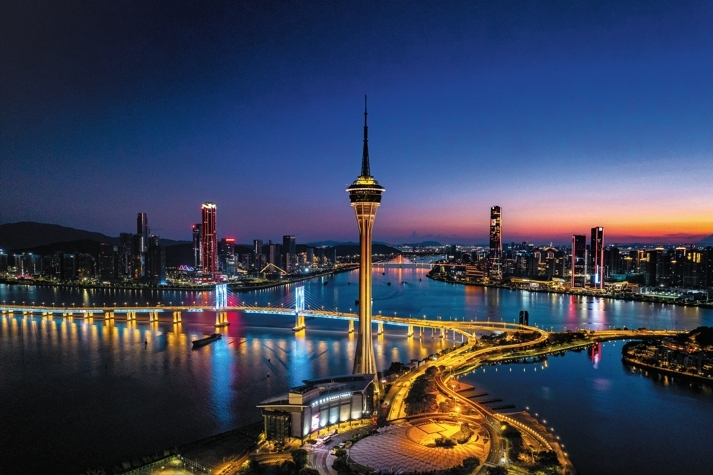
Over the past 25 years, the implementation of the "one country, two systems" policy in Macao has been smooth and successful, which has been recognized by national leaders. Five years ago, President Xi Jinping applauded Macao compatriots for "creating the best development situation in Macao's history and writing a glorious chapter in the successful implementation of 'one country, two systems with Macao characteristics'" at a ceremony celebrating the Macao Special Administrative Region's 20th anniversary.
Since the 1999 handover, Macao has made significant progress in politics, economy, people's livelihoods and cultural affairs. Politically, it has maintained stability, correctly handled the relationship between the central government and the SAR, respected the central government's comprehensive jurisdiction over the SAR, established benign interactions among the executive, legislative and judicial organs, improved governance efficiency and effectiveness, completed the local legislation of Article 23 of the Basic Law, and adopted robust measures to strengthen its capacity to safeguard national security.
Economically, Macao has achieved impressive growth, with its per capita GDP ranking among the top globally. It has also attained preliminary results in promoting economic diversification. In terms of people's livelihoods, Macao has continuously improved education, healthcare, housing and social security, elevating residents' living standards and quality of life. Culturally, Macao actively inherits and promotes Chinese culture and vigorously carries out national and patriotic education, which has significantly enhanced the idea of the motherland, national consciousness, and understanding and support for the "one country, two systems" policy among residents, especially young people.
In an important speech, President Xi pointed out four significant experiences Macao gained in successfully implementing the "one country, two systems" policy: Consistently enhancing public confidence in this policy, always moving along its correct direction, continually strengthening its mission and responsibility, and laying a solid social and political foundation for it.
Macao can successfully implement the "one country, two systems" policy because it enjoys favorable conditions, some of which are in short supply in Hong Kong. These conditions have engendered high trust and respect among Macao residents for the country and the central government.
First, Macao experienced a history of "colonial" governance different from that of Hong Kong. Portugal was far inferior to the United Kingdom in terms of modernization, industrial development, political stability and governance capabilities. Portugal ruled Macao for four centuries. Not only did it fail to create an "economic miracle" comparable to Hong Kong's in Macao, but it also left Macao in a relatively backward economic state, and the living standards of Macao residents were also low. Before returning to the motherland, many Macao residents were unhappy with various aspects of Macao's situation and desperately craved improvements. Therefore, they had eager expectations for a new Macao. They espoused and supported the "one country, two systems" policy. Its inception thus took place in a favorable political atmosphere and was looked on positively by the public.
Second, before returning to the motherland, Macao's economic structure was simple, mainly relying on the gaming industry. This economic structure was not conducive to creating a large, modern middle class. Members of the modernized middle class, such as that in Hong Kong, are generally more susceptible to the influence of Western political values. Under Macao's pre-modern class structure, the authoritarian Portuguese Macao government rarely encountered mistrust from Macao's tiny middle class and other pro-Western elements, and Macao's executive-led political system faced few challenges.
Since returning to the motherland, Macao respects the central government's comprehensive jurisdiction, and the central government and the SAR have a harmonious relationship. Meanwhile, Macao has maintained its original executive-led political system. The relationship between the executive branch and the legislative body is cooperative and cordial, and the executive and the judiciary respect each other's functions. The Macao SAR government administers effectively and enjoys the support and trust of residents. Accordingly, it can vigorously undertake various tasks to promote economic development and improve people's livelihoods.
Third, for historical reasons, Macao's patriotic forces, especially the business community, have long been the dominant political force in the city. Before and after the founding of the People's Republic of China, there was no large-scale influx of anti-communist and anti-China elements into Macao. After riots against the Portuguese Macao government broke out at the end of 1966, its prestige plummeted irrevocably. Since then, the patriotic forces of Macao assumed a more substantive role in the governance of Macao and, as a result, were able to grow further, gain experience and accumulate popularity. For this reason, patriotic forces could more smoothly take over and run the Macao SAR government and successfully implement the "one country, two systems" policy after the handover.
Fourth, powerful internal and external hostile forces have not coveted or threatened Macao. Portugal had always practiced authoritarian rule before the "Carnation Revolution" in 1974. Therefore, it had little political incentives to introduce democratic reforms in Macao. The Portuguese were worried that democratic reform would jeopardize the rule of the Portuguese Macao government. Even after Portugal agreed to hand Macao back to China, the Portuguese Macao government, unlike the British Hong Kong government, was not motivated to expand those few anti-communist and anti-China elements in Macao. Instead, it wisely chose to rely more on the patriotic forces to stabilize its rule in the twilight years of its administration. In addition, the number of anti-communist and anti-China elements in Macao has always been small, and the Macao SAR government is highly vigilant and wary of internal and external hostile forces.
Fifth, Macao residents are willing and keen to integrate into the country's overall development with the central government's guidance and support and obtain endless development momentum from it. These conditions ensure that the central government's myriad policies to benefit Macao can be implemented efficiently, allowing Macao to accelerate its development. For example, the central government has repeatedly approved land reclamation in Macao, significantly enlarging Macao's land area. Even more important was the establishment of the Hengqin Guangdong-Macao Deep Cooperation Zone and its subsequent developments. This cooperation zone has greatly expanded Macao's economic and geographical development space. In the long run, it will help improve the livelihoods and employment of Macao residents, enrich the content of the practice of the "one country, two systems" policy and promote the construction of the Guangdong-Hong Kong-Macao Greater Bay Area.
Finally, following Macao's return to the motherland, it can step up national education in an environment free of obstruction from hostile forces, allowing the original intention of the "one country, two systems" policy and the core content of the Basic Law to be deeply rooted in the hearts of Macao residents, especially young people. There is generally no significant difference in the understanding of the policy and the Basic Law among all walks of life, which is conducive to the comprehensive and accurate practice of the policy.
From the perspective of comprehensively and accurately practicing the "one country, two systems" policy, Macao indisputably enjoys a set of favorable conditions to become a model of it. It is true that Macao still has much room for improvement in strengthening governance, promoting industrial diversification, improving people's livelihoods and uniting society. When President Xi met with the incoming chief executive of Macao, Sam Ho-fai, on Nov 1, he said he hopes that Sam will be brave enough to shoulder heavy responsibilities, live up to his mission, lead the new government of the SAR, unite all sectors of society, work together with them, be innovative in a principled way, be committed and enterprising, do well, continuously create new situations in the practice of "one country, two systems" with Macao characteristics and make greater contributions to building a strong country and achieving national rejuvenation.
Sam's election platform echoed the requirements and has become the guiding tenets of Macao's future policies and development. I hope that under the leadership of Sam, Macao will perform even better in the practice of the "one country, two systems" policy, governance efficiency, economic development, and social harmony by building on its original solid foundation.
The author is a professor emeritus of sociology, the Chinese University of Hong Kong, and a consultant for the Chinese Association of Hong Kong&Macao Studies. The views do not necessarily represent those of China Daily.
If you have a specific expertise, or would like to share your thought about our stories, then send us your writings at opinion@chinadaily.com.cn, and comment@chinadaily.com.cn.