Northern regions benefit from water diversion project







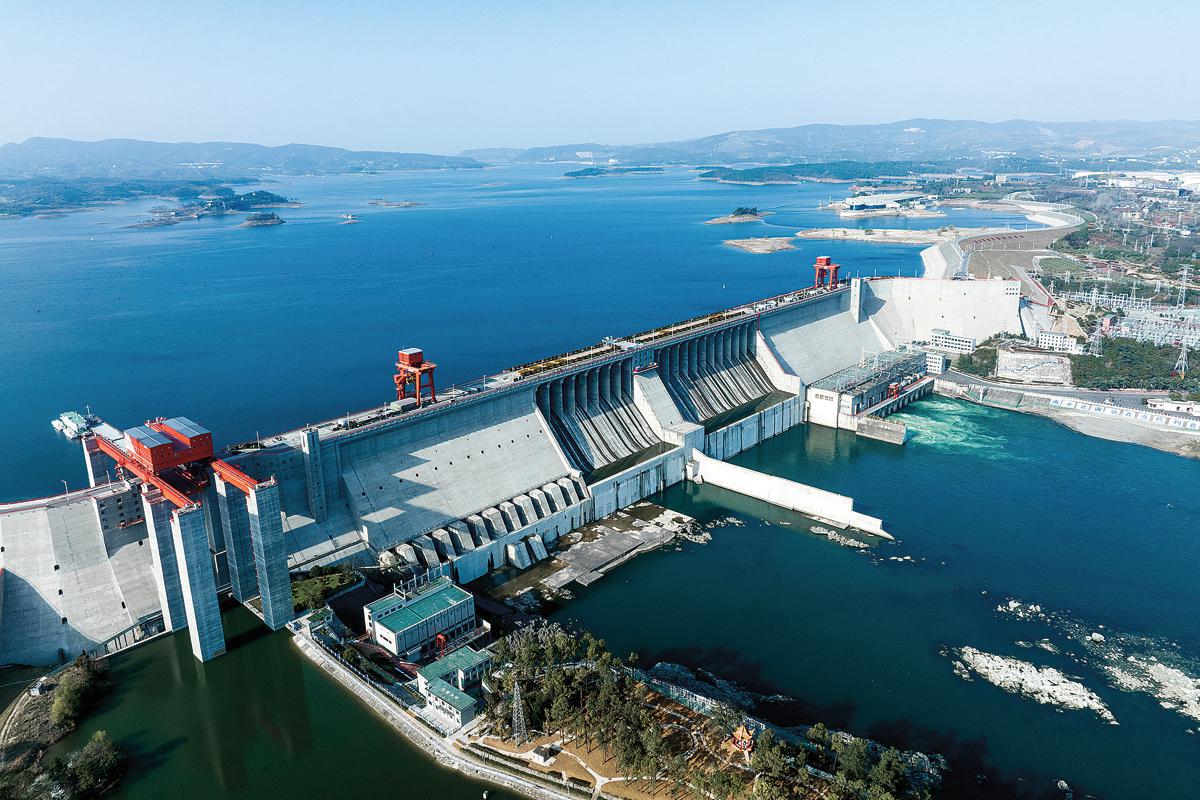
The South-North Water Diversion Project has in the past decade diverted 76.7 billion cubic meters of water from the Yangtze River basin to the country's drought-prone northern regions, benefiting 185 million people, according to the Ministry of Water Resources.
Initiated in the 1950s, the water diversion project consists of three routes. The volume of diverted water is over 5,000 times the water in the well-known West Lake in Zhejiang provincial capital, Hangzhou, which has a surface area of more than 6 square kilometers, and is more than 19 times the annual average water consumption in Beijing.
After sustainable expansion of areas covered by the project, it now supplies water to 45 medium and large-sized cities, Wang Daoxi, vice-minister of water resources, said on Thursday at a news conference marking the 10th anniversary of the operation of the project's middle route.
The news conference was organized by the State Council Information Office.
"The project's positive influence has progressively extended beyond medium and large cities to rural areas, leading to an increasing multitude of individuals reaping its benefits year after another," he said.
Wang said that in the basin of Heilonggang River, over 5 million individuals have relinquished their dependence on water rich in fluoride and marked by a bitter saltiness, a traditional source that has sustained their daily needs for generations.
Wang also highlighted the significant role of the project in helping remediate ecological environment of rivers and lakes in northern China. Thanks to the project, roughly 11.8 billion cubic meters of water has been replenished into more than 50 rivers, he added.
The Yongding River, which dried up in 1996, for example, witnessed continuous water flow along its 865-kilometer course in August 2021. Over the last three years, the mother river of Beijing has maintained a year-round flow along its entire length.
The vice-minister stressed that by capitalizing on the abundance of water resources in the south, the project has successfully cultivated economic collaboration between the northern and southern regions, driving development in the north.
Without water from the south, those key economic development zones, major grain-producing areas and energy bases in the north would not have been able to produce that large amount of commodities, grains and energy and then transport them to regions all across the country, he noted.
The water diverted by the project has supported a GDP growth of over 16 trillion yuan ($2.2 trillion) in the northern region, he added.
As the most prominent of the three routes — due to its role in bringing water to Beijing — the first phase of the middle route takes water from the Danjiangkou Reservoir, which spans Hubei and Henan provinces, and also benefits Henan and Hebei provinces and Tianjin municipality along its route.
The first phase of the eastern route, which serves Jiangsu and Shandong provinces, began operation in November 2013. The western route remains in the planning stage.
Zhang Xiangwei, head of the Ministry of Water Resources' department of planning and programming, said the country is still actively forging ahead with some follow-up programs to beef up the capability of the project.
The construction of a 195-kilometer underground tunnel to channel water from the Yangtze to the Hanjiang River, for example, was launched in July 2022, he said.
"The facility is expected to lift the annual water diversion capability of the middle route from 9.5 billion cubic meters to 11.5 billion cubic meters," he said.
As of now, the excavation in the main trunk channel of the facility has exceeded 3.3 kilometers, with an additional 13.9 kilometers of excavation completed across 21 branch tunnels, he said, adding that more than 6.5 billion yuan of investment has been made.
He said the ministry will accelerate the construction of a digital twin for the project in a move to digitalize its management and make it more intelligent.
houliqiang@chinadaily.com.cn




- Shanghai's Jinshan district reports economic growth
- Building an effective global communication discussed at Hunan forum
- Cleaning staff transform fallen ginkgo leaves into campus art sensation
- Chinese scientists weave tiny polymer capable of towing car
- Hebei to expand transportation projects during 15th Five-Year Plan period (2026-30)
- Nankai University scholar publishes long-lost Latin translation of Tao Te Ching