Xi's proposal facilitating exchanges
China's diplomatic efforts nurture cultural understanding and peace







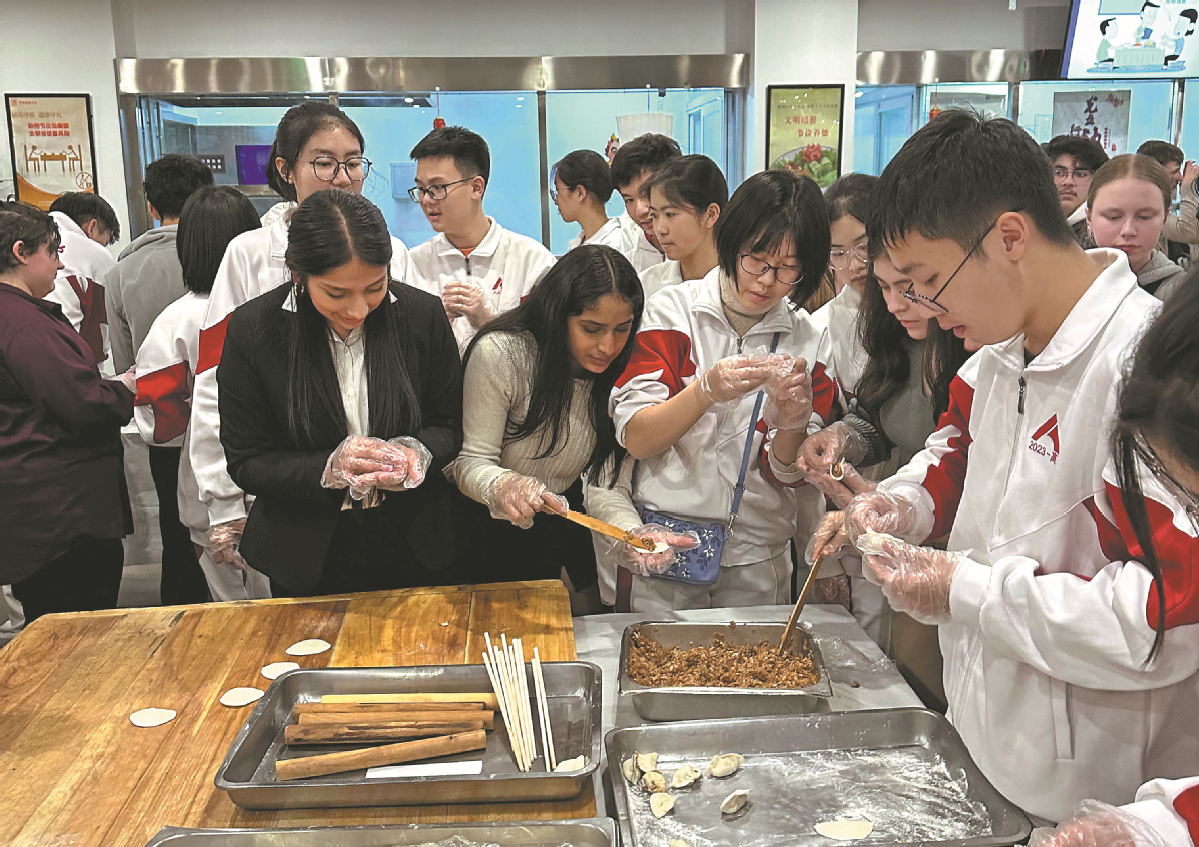
When asked about President Xi Jinping's ambitious proposal made last year to invite a total of 50,000 young people from the United States over a period of five years to visit China on exchange and study programs, Eric Foster, nephew of legendary journalist Edgar Snow's wife, Helen Foster Snow, said he strongly supports more exchanges of this kind.
Foster, a US policy observer focused on China affairs, said that around 10 years ago, when he first came to China, the average American heard many bad things about the country because "the media in the West hardly gave any good news about China".
"So when I came here, I was just totally blown away how modern it was," he told China Daily. "If more Americans, more students can come here and see China themselves and (take part in) exchange programs, then they're gonna go back and say, 'Wow, it's so cool'."
This year marks the 10th anniversary of the concept of major country diplomacy with Chinese characteristics, and Foster is one of many policy observers who have been impressed by how the country has worked hard in advancing cultural exchanges and boosting mutual learning among cultures.
As a supporter of the Belt and Road Initiative, Foster believes exchanges make peace.
"China is setting an example for the whole world, because how can there be peace when two countries can't get along, trade, and talk to each other?"
In recent years, China has scaled up and diversified its efforts in facilitating people-to-people exchanges with developed as well as developing countries, and promoting the sharing of knowledge, technology and governing experiences, officials and observers said.
When addressing the BRICS Summit in Kazan, Russia, in October, President Xi said, "Last year, I proposed an initiative for BRICS digital education cooperation, and I am delighted to see that it has become a reality."
At the summit, he announced that China will implement a capacity-building program for BRICS digital education.
"We will open 10 learning centers in BRICS countries in the next five years, and provide training opportunities for 1,000 local education administrators, teachers and students," he added.
Scholars from countries such as the United Kingdom and Pakistan noted that the Global Civilization Initiative, proposed by President Xi last year, marks a major philosophy focused on enshrining mutual respect among different cultures, values and political systems.
Asad Ullah Khan, a research fellow at the China-Pakistan Study Centre of the Institute of Strategic Studies Islamabad, said the Global Civilization Initiative "is an important idea aimed at shaping the future for a better world".
"Some scholars in the West, particularly in the US, are critical of this initiative, since the concept uses principles of equality, peace, prosperity, dialogue and inclusiveness among different civilizations, in contrast to the Western notion of 'clash of civilizations'," he wrote in an article this year.
Khan, noting that "in Chinese tradition, people and cultures play a significant role", said that Beijing's advocacy of people-to-people exchanges aims to drive countries to explore global civilization dialogue and cooperation, expand cooperation avenues and promote "mutual understanding among nations for the progress and prosperity of human civilization".
Upholding the mutual understanding of civilizations, further practicing the principles of the Global Civilization Initiative, and strengthening the exchange of experience in governance also were part of the outcome and consensus at the fifth China-Central Asia Foreign Ministers' Meeting in Chengdu, Sichuan province, this month.
In the next three years, China will offer 1,500 training opportunities for people from the five Central Asian countries and increase the scholarship quota to 600, in order to cultivate more talent of various types urgently needed for the development of the countries, Foreign Minister Wang Yi told reporters.
Stephen Bainous Kargbo, the United Nations Industrial Development Organization's representative to China, said, "From my perspective and from the industry's perspective, China will continue to be a beacon of hope and also an example of what industrialization can do in any nation."
"China has demonstrated that through clean, clear and consistent industrial policy, transformation can take place," Kargbo told China Daily.
"So my hope is that this model of development offers lessons for the rest of the world, particularly developing countries — not necessarily to copy, but to adapt to their own situations," Kargbo said.
Endorsing China's continued support for multilateralism and exchanges among nations, he added: "The future of the world rests on open, consistent dialogue between nations. Nobody has one formula that can solve all problems, but if we come together, discuss openly and fairly with mutual respect, the future is bright."
Wang Huiyao, founder and president of the think tank Center for China and Globalization in Beijing, said: "the major country diplomacy with Chinese characteristics is now way richer at different levels, and the country's diplomacy does not rely solely on governmental efforts, but also on efforts in economic, cultural, subnational and think tank realms. I think this progress is noteworthy."
When reviewing China's diplomacy over the past 10 years, its wide-ranging cooperation with various regions and with Global South countries has stood out, spanning from neighboring regions such as Central Asia and Southeast Asia to Africa and Latin America, Wang noted.
"China is an important pillar supporting a multipolar world, and its major-country diplomacy should play an even greater role in the future," he added.


- Xi's discourses on people's congress system published
- Drumbeats and dance showcase Hong Kong's cultural power
- Chinese solution on land degradation wins applaud
- Macao taps advantages to help TCM go global
- China's legendary Mt. Qomolangma climber Gonpo passes away at 91
- China, ASEAN launch joint initiative to develop cultural, tourism exchanges