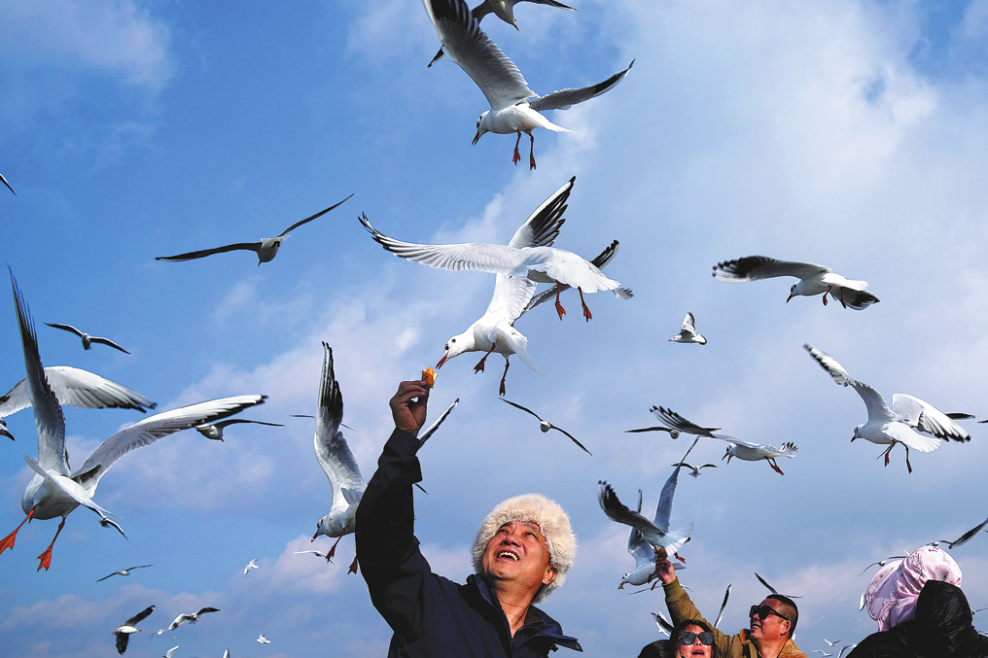
China Focus: China seeks balance of books and sports for children's fitter future







BEIJING -- With her roller skates on, elbow and knee pads secured, and helmet snugly fastened, 7-year-old Yunkai was ready for her lesson.
Sitting on a park bench near their Beijing home, Yunkai's father, Yang Yesheng, watched as his daughter skillfully weaved through cones in a precise S-pattern.
"She loves roller skating and won't stop pestering her mother and me to take her out to exercise after school," Yang said.
Yang takes pride in his daughter's passion for sports. "I'm glad she has developed a habit of exercising," he said.
In China, access to university education largely depends on achieving high exam scores. As a result, parents feel compelled to invest significantly in their children's academic performance from a young age, motivated by the common belief of "not losing at the starting line."
As more education experts and parents realize, this belief is somewhat misguided, especially when "winning at the starting line" is narrowly defined as academic success.
Many Chinese parents have been redrawing the "starting line" to include physical education. This shift has been reinforced by government initiatives balancing academic focus with physical activity to help children achieve holistic development, equipping them for long-term success and well-being.
China has around 150 million primary and secondary school students. Though their overall physical health has improved in recent years, surveys and research also found significant challenges persist.
In 2022, nearly one in five children aged 6 to 17 were overweight or obese; half of children and adolescents were nearsighted, though the share had been constantly declining.
"These issues didn't arise overnight. Their causes are complex, and addressing them will require a long-term, systematic approach," said Wu Jian, a research fellow at the China National Academy of Educational Sciences.
To address these challenges, China has implemented various initiatives, including a mandate requiring two hours of daily exercise for all students -- one during school hours and one off-campus.
Another, the 2021 "double reduction" policy, aimed to alleviate the burdens of homework and off-campus tutoring, freeing up time for sports, arts and other extracurricular activities.
In particular, the government has placed greater emphasis on physical education (PE) in schools. The revised Law on Physical Culture and Sports, which took effect in 2023, clearly states that "schools must ensure that students take part in no less than one hour of physical exercise every day."
Yang, 34, contrasts his daughter's experience with his own school days in the 1990s. "Back then, PE classes were often replaced by Chinese, math, or English, sometimes without explanation," he said. Now, at Yunkai's school, PE teachers attend parent-teacher meetings to discuss students' progress -- a dramatic shift from Yang's childhood.
Over the past decade, schools have significantly improved on-campus sports programs by recruiting more PE teachers and providing better sports facilities and equipment.
The focus on fitness in some schools even exceeds the mandate. At a primary school in the northeastern city of Shenyang, students enjoy at least three hours of sports daily, with activities ranging from rock climbing to unicycling. The results speak for themselves: In 2023, less than 3 percent of Hunnan No.9 Primary School's students were classified as obese, and just 13.8 percent were myopic, far below national averages.
"Each activity is chosen for its specific benefits," said Hou Mingfei, the school's principal. "Rock climbing, for example, helps with scoliosis, while unicycling improves coordination of the body and mind."
Education specialists have encouraged parents, in collaboration with schools, to help children explore their interests and guide them toward a sport they love, as interests help build lasting fitness habits.
Across the country, children's sports training institutions have grown rapidly, offering diverse and innovative programs to meet the rising demand. Nationwide, there are now over 30,000 such institutions.
For Yang and his daughter, professional training complements their family's commitment to fitness. "Signing up for the roller skating course was entirely her choice, and we support her," Yang said. "We also enjoy exercising together as a family."
But maintaining a regular exercise routine can be more challenging for junior and senior high school students and their parents. Zheng Qian, the mother of an eighth-grader from Beijing, is worried about increasing academic pressure.
Yet, Zheng ensures her daughter maintains regular exercise, partly because of the PE component in the high school entrance exams.
"The goal of including PE in exams is to emphasize the importance of health and exercise," said Zhang Shuang, an education professor at Beijing-based Capital Normal University.
While some parents may encourage their children to exercise primarily to boost their exam scores, educational authorities are actively seeking ways to reduce such pressures. One key initiative involves developing scientific and fair standards for evaluating PE performance.
Under Beijing's latest rules for high school entrance exams, PE scores contribute 50 out of 510 total points. Test performance is assessed under the rule that "achieving a 'good' rating earns a full score."
This approach reduces score disparities, thereby alleviating exam pressure for students, explained Wang Pan, a senior official from Beijing's education authorities, adding that the measure is designed to encourage students to engage in physical activities.


- China moves to set national standards for pre-made dishes
- Chinese company unveils plans for commercial space flights
- Latest addition to Shiziyang Bridge constructions brings main tower above 300 meters
- Hebei's 'ancient pressure cooker' setting internet ablaze
- Major urban renovation restores Xi'an's ancient moat
- China launches nationwide employment assistance program