



G20 should help address common global challenges







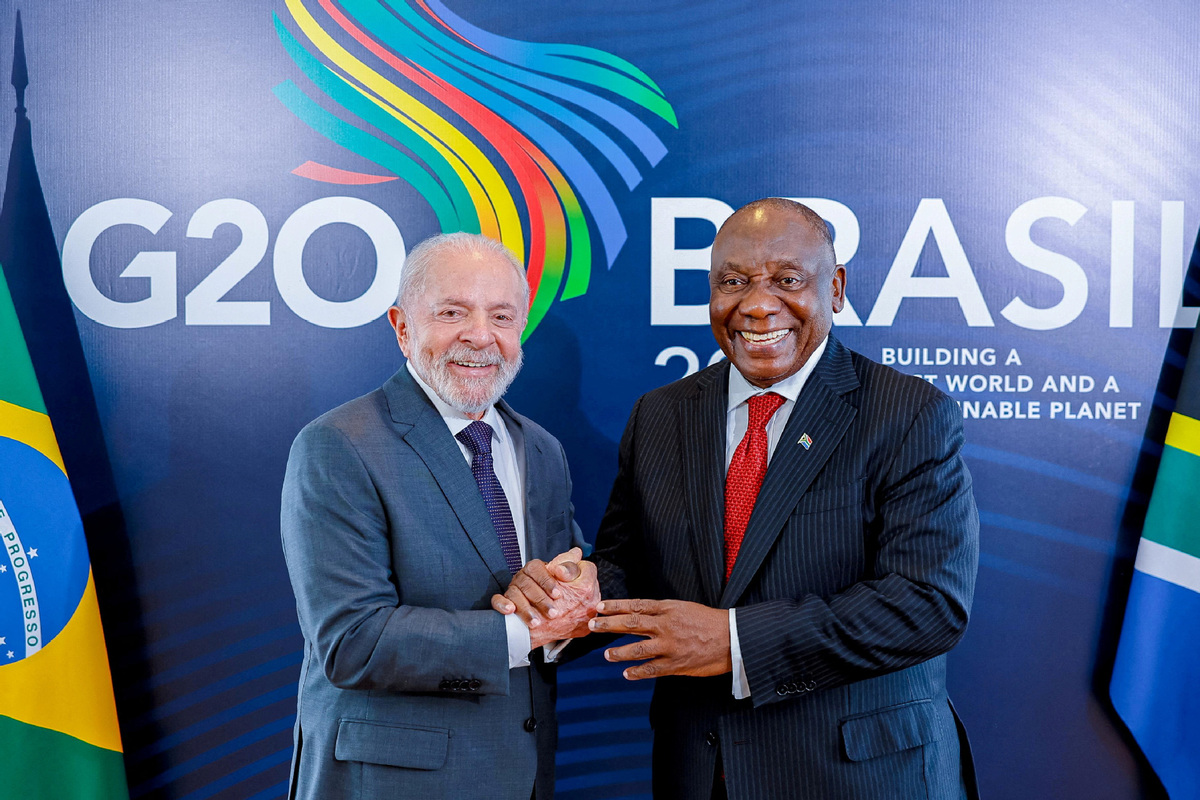
The international community expects the G20 Summit, to be held in Rio de Janeiro, Brazil, on Monday-Tuesday, to address rising global economic challenges. The existing global economic governance system is faltering against the growing tide of trade protectionism and unilateralism. The World Trade Organization's dispute resolution mechanism is nearly paralyzed, and reforms are stalled. Fragmentation is increasingly evident across the global trade system, which faces its greatest challenge since World War II.
Many hope the G20 Summit will address these issues and take a major step toward preserving a free and multilateral global order.
The rising trade conflicts, particularly those instigated by the United States and the European Union, are threatening global economic stability. Recent years have seen a proliferation of protectionist tariffs and sanctions, which are disrupting global production networks and fracturing industry, supply and value chains.
The US, a major instigator of trade wars, has continued to escalate tensions not only in trade but also in other areas. Since 2018, when the then US president Donald Trump launched a trade war against China, Sino-US trade relations have deteriorated.
The Joe Biden administration has not only continued with the Trump-era tariffs but also increased them. In particular, this year has seen the US administration impose a series of new tariffs on Chinese products.
On May 14, the administration invoked Section 301 of the US Trade Act of 1974, announcing new tariffs on China's strategic industries. These tariffs include raising the current tariffs on steel and aluminum from 0-7.5 percent to 25 percent, on electric vehicles from 25 percent to 100 percent, on lithium batteries and battery components from 7.5 percent to 25 percent, on solar panels from 25 percent to 50 percent, and on semiconductors from 25 percent to 50 percent.
The EU recently joined the fray by imposing tariffs of up to 45.3 percent on Chinese-made electric vehicles, raising tensions between the two major economies and threatening to destabilize international trade and stall global economic growth.
The WTO's latest report highlights how global trends — geopolitical competition, regional conflicts and trade sanctions — have eroded the stable foundation of world economic growth over the past 30 years, leading to the fragmentation of the global trade system. According to WTO data, in 2023, the export of global goods was $23.8 trillion, down 4.6 percent after two years of growth. This downturn represents the slowest growth rate in five decades — not counting global recessions.
Punitive tariffs imposed by the US on Chinese products have disrupted the normal flow of trade, investment and technologies, resulting in severe misallocation of resources and damaging global value and supply chains. The strain on the global industry is palpable; for instance, according to China Federation of Logistics and Purchasing, in July, the global manufacturing Purchasing Managers' Index fell to 48.9 percent, marking its fourth consecutive month below the 50 percent threshold, indicating contraction.
History shows that prolonged trade tensions weigh heavily on global economic growth. During the Great Depression, in 1929, then US president Herbert Hoover imposed tariffs on agricultural imports, and one year later Congress worsened the situation by passing the Smoot-Hawley Tariff Act, which raised duties on more than 20,000 items, with rates reaching nearly 60 percent. This prompted more than 40 countries to impose retaliatory tariffs on US goods, igniting a global trade war that reduced the world trade volume by 66 percent and global industrial output by 33 percent in 1934, bringing the global economy to the brink of collapse.
If the tariff wars continue to escalate today, the global economy could suffer a similarly devastating blow. If the US continues to maintain or even impose more high tariffs on Chinese goods, such moves will drag more economies into a tariff-driven economic struggle, making each one of them a potential victim of the trade war.
Preserving the global multilateral trade system has become a shared challenge for countries supporting free trade. In the face of rising protectionism and unilateralism, the G20-founded as a coordination mechanism to help the world overcome financial crises — must adopt a rules-based multilateral approach.
The G20 has played a crucial role in overcoming financial crises and improving the global trade and investment systems.
The G20 Summit will convene in Rio de Janeiro under "exceptional circumstances". Addressing trade conflicts and reinforcing the G20's role as a primary channel for international economic cooperation are complex challenges to overcome. With the increasing presence of the African Union and other Global South coalitions trying to participate in the G20, there is a pressing demand for the summit to deliver a robust and inclusive solution to global economic problems and improve global trade governance. The G20 must champion a vision for globalization that is fair, equitable and beneficial to all.
The views don't necessarily represent those of China Daily.
The author is deputy director of the Institute of American and European Studies at the China Center for International Economic Exchanges.
If you have a specific expertise, or would like to share your thought about our stories, then send us your writings at opinion@chinadaily.com.cn, and comment@chinadaily.com.cn.





