


Stabilizing Sino-US ties emphasized
Summit: Red lines must not be challenged, Xi says







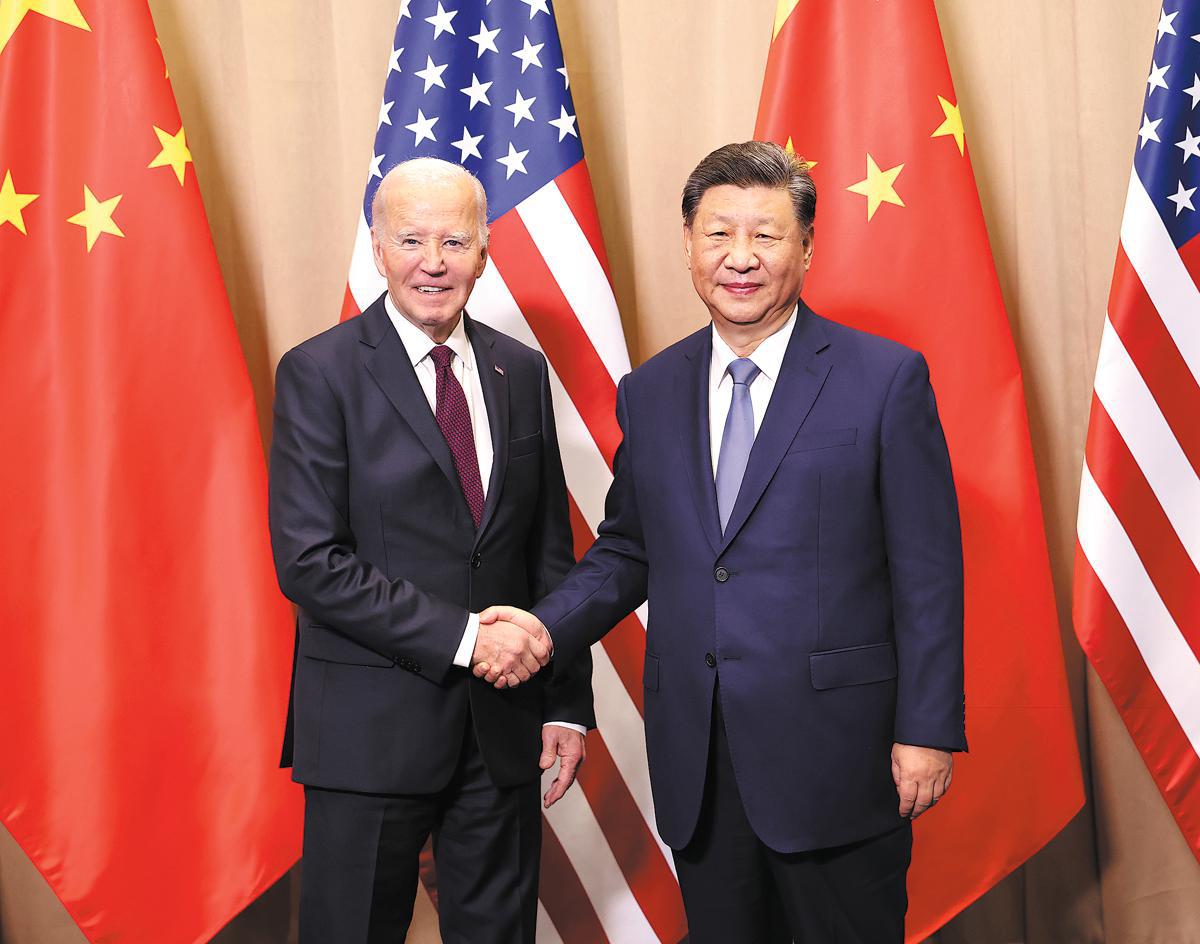
Charting a smooth transition of China-US ties, taking stock of the policy legacy and underlining Beijing's policy consistency were highlights of the third summit between President Xi Jinping and United States President Joe Biden, observers said.
Prior to their meeting on Saturday in Lima, Peru, Xi and Biden had met face-to-face in Bali, Indonesia, in 2022 and in San Francisco last year.
On Saturday, Beijing and Washington agreed to "continue to stabilize China-US relations, and ensure a smooth transition of the relationship", the Foreign Ministry said.
Both leaders said they believe that "their meeting has been candid, profound and constructive, and they expressed their willingness to stay in contact", the ministry added.
Xi and Biden agreed to maintain the momentum of communication and strengthen macroeconomic policy coordination.
They also reviewed the important progress since their San Francisco meeting in dialogue and cooperation on counternarcotics, climate change, artificial intelligence and people-to-people exchanges.
Diao Daming, a professor of US studies at Renmin University of China's School of International Relations, said, "The third Xi-Biden summit further plays the role as a navigator and a stabilizer for the ties, and taking stock of the policy legacy and lessons over the past four years and beyond is part of Beijing's clear, constructive solution for driving the relations' growth in the future.
"Whoever takes charge of the US' China policy should respect lessons from the past, face up to the US' international duties, act on the very interests of the American people and respond to global expectations for better well-being," Diao said.
Xi's underlining of Beijing's consistency in US policy will help respond to the potential uncertainties that may be brought about by Washington in the future, he added.
On Saturday, Xi said that China and the US should keep exploring the right way for two major countries to get along well with each other, realize long-term, peaceful coexistence, and inject more certainty and positive energy into the world.
Xi also said that neither decoupling nor supply-chain disruption is the solution, and "small yard, high fences" is not what a major country should do.
Citing the lessons from the two countries' diplomatic ties over the past 45 years, Xi said that if the two sides regard each other as rivals and pursue vicious competition, they "will roil the relationship or even set it back".
He identified four red lines for China that must not be challenged: the Taiwan question, democracy and human rights, China's path and system, and China's development right.
"Major-country competition should not be the underlying logic of the times; only solidarity and cooperation can help humanity overcome current difficulties," Xi said.
Biden said the US-China relationship is the most important bilateral relationship in the world, not just for the two peoples, but also for the future of the world.
He underscored that the US does not seek a new Cold War, it does not seek to change China's system, its alliances are not targeted against China, it does not support "Taiwan independence", it does not seek conflict with China, and it does not see its Taiwan policy as a way to compete with China.
The US will stay committed to the one-China policy and is prepared to enhance communication and dialogue with China during the US' presidential transition period to have a better perception of each other and responsibly manage differences, he said.
He added that the two sides support each other's host roles for 2026 — China will host the APEC meeting that year and the US will host the G20 meeting — demonstrating "what we can do for the two peoples when we work together".
On specific policy agenda items, Xi stated China's positions on Taiwan, economic and trade ties, science and technology, cybersecurity, the South China Sea, the Ukraine crisis and the Korean Peninsula.
It is crucial for the US to handle the Taiwan question with extra prudence, unequivocally oppose "Taiwan independence", and support China's peaceful reunification, Xi said.
In the South China Sea region, the US should not get involved in bilateral disputes over the relevant islands and the reefs of the Nansha Islands, and neither should it aid or abet making provocations, Xi said.
China does not allow conflict or turmoil on the Korean Peninsula, and it will not sit idly by when its strategic security and core interests are under threat, Xi said.
In Lima, the two presidents reiterated — and stated readiness to further uphold — the seven-point common understanding on the guiding principles for China-US relations.
Worked out under the two leaders' instructions, the principles are treating each other with respect, finding a way to live alongside each other peacefully, maintaining open lines of communication, preventing conflict, upholding the United Nations Charter, cooperating in areas of shared interest, and responsibly managing competitive aspects of the relationship.
Anthony Moretti, department head and an associate professor of the Communication and Organizational Leadership Department at Robert Morris University in the US state of Pennsylvania, said, "The US and China remain the best partners when it comes to solving vexing challenges like climate change, food insecurity, preparing to fight the next pandemic and more.
"But Washington must adopt a respectful tone in its rhetoric," Moretti added. "China has made clear time and again that mutual respect, peaceful coexistence and win-win cooperation are at the heart of its global agenda. The US can — and should — endorse a similar philosophy."
Analysts noted that over the past four years, the China-US relationship, which went through ups and downs, remains stable on the whole.
More than 20 communication mechanisms have been restarted or established, and positive achievements have been made in areas such as diplomacy, security, economy, trade, fiscal affairs, finance, military, counternarcotics, law enforcement, agriculture, climate change and people-to-people exchanges.
In Lima, Xi underscored that "it is worthwhile to review the experiences of the past four years and draw inspirations from them".
He listed seven items as lessons that should be learned: to have a correct strategic perception, to match words with actions, to treat each other as equals, not to challenge red lines and paramount principles, to conduct more dialogue and cooperation, to respond to the expectations of the people, and to step forward to shoulder the responsibilities of major countries.
Xiaohua Yang, a professor of international business and founding director of the University of San Francisco's Center for Business Studies and Innovation, said that Xi made it clear at the Lima summit that China continues to believe the relationship is pivotal to the peace and prosperity of the whole world.
"Xi set a forward-looking tone in the US-China relationship — a stable and cooperative US-China relationship benefits the whole world, not just these two countries; decoupling, building up walls and being confrontational is not the solution," she said.
Contact the writers at zhangyunbi@chinadaily.com.cn





