Assistance improves healthcare imbalance
Sending experts to less well-off areas ensures better medical outcomes







A series of programs have been launched to this end, such as establishing paired assistance between top-tier, urban hospitals and county-level medical institutions, and dispatching experienced medical professionals to the countryside and less developed areas through various channels.
"Some 40 percent of clinical departments designated as having national key specialties are located in cities that are not provincial capitals, signifying that the current policies are oriented toward evening out healthcare services across regions," Lei said.
Luo, the neurologist from Beijing, said that the monthslong medical aid program he took part in yielded fast and long-term improvements.
"I received a patient who had been waiting for a local doctor capable of carrying out carotid stenting for a long time. Without our arrival, he would have had to travel to Changchun in Jilin province to receive the surgery and leave his small farm behind for months," he said.
Luo said that most patients rendered bed-bound by this type of stroke would be able to stand up and walk one to two days after surgery and check out from the hospital a week later.
During his stay, Luo completed about 150 thrombolysis therapies at the banner hospital. More importantly, he trained three doctors to be capable of performing the operation independently.
"Hands-on guidance is significant. Because I was by their side all the time, we were able to sort out various questions together, such as how to devise treatment plans tailored to a patient's blood vessel size and time of disease onset," he said.
Besides giving lectures to his local proteges, Luo also asked them to make morning rounds with him and lead discussions of updates on patients' clinical conditions and laboratory results during seminars.
"This approach helped them better absorb knowledge," said Luo.
In addition to offering convenient and affordable access to quality medical services, China has also been striving to ramp up total medical service capacities in recent years, according to Lei.
Since 2017, Lei said that China has established 13 national medical centers specializing in different fields, as well as 125 regional medical centers.
National medical centers are aimed at carrying out the diagnosis and treatment of rare and severe cases of specific disease categories. They also play a leading role in researching and promoting advanced therapies.
Regional medical centers aim to provide patients with quality medical treatment closer to their homes.
Lei added that 114 provincial-level medical centers have also been established.
"Through the construction of these projects, China's overall medical resources and medical service capacities have leaped forward and their distribution is more balanced across the nation," he added.
In Jinjiang, a county-level city in the eastern province of Fujian, a regional medical center was set up in partnership with the Shanghai Sixth People's Hospital Affiliated to Shanghai Jiao Tong University in June 2021. The center is based at the Jinjiang Municipal Hospital.
As of recently, the hospital in Shanghai has sent 46 experts and its management team to the hospital and six of its well-known experts have set up their own offices there.
One of the beneficiaries of the collaboration mechanism is a 17-year-old boy who four years ago was diagnosed with idiopathic scoliosis, a type of scoliosis that causes the spine to develop an abnormal curve.
Progression of the disease in recent months prompted his parents to consider taking him to Shanghai to undertake an extremely complicated, invasive spinal surgery. "Upon hearing that Shanghai experts were coming here, we decided to have the operation in our hometown," said his father.
Zheng Yongqiang, a local orthopedic surgeon, said that the family has so far paid about 50,000 yuan ($7,000) out of pocket. "If they went to Beijing or Shanghai, it would probably cost them several hundred thousand yuan, adding medical expenditures, travel and accommodation expenses together," he said.
Zheng said he also valued the opportunity to personally observe the surgery. "For us, watching highly experienced surgeons performing and explaining procedures is an important addition to reading textbooks or research papers," he said.
Qin Wei, Party chief of the Jinjiang Municipal Hospital, said that the partnership has introduced 159 novel technologies locally, and the number of outpatient visits, hospitalizations and surgeries have doubled compared to the past.
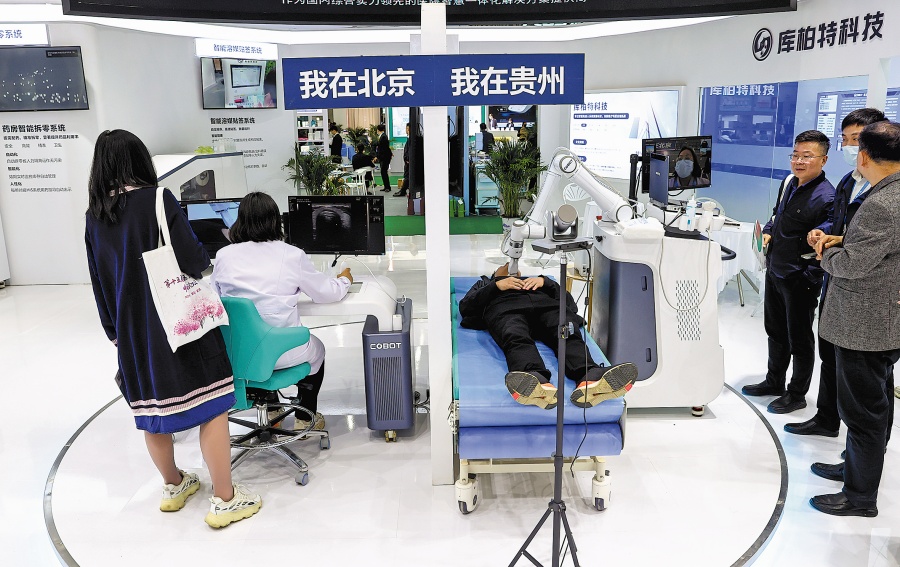
To further bridge the gap between urban and rural medical institutions, Lei said that 5G technologies and other advanced information technology tools have been used to facilitate remote diagnosis and treatment.
China has set up 3,340 online hospitals that together provide over 100 million consultations online each year.
"We will also guide and regulate the development of private hospitals so that they can complement the network of public hospitals," he said.
As the nation is aiming to make its medical services more diversified to meet the varying demands of residents, Lei said that authorities have announced recently to allow the establishment of wholly foreign-owned hospitals in Beijing, Shanghai and seven other areas.
Deng Jiahui contributed to the story.
Contact the writers at wangxiaoyu@chinadaily.com.cn