



Larger vision for Global South







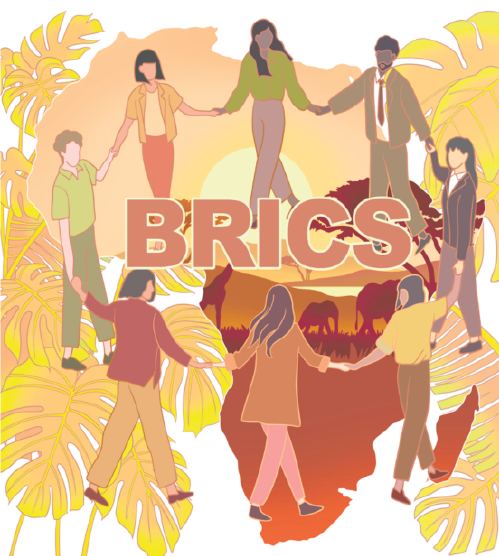
BRI and greater BRICS cooperation can promote Africa's development by reducing external risks, coordinating members' relations and improving mechanism construction
BRICS countries represent the emerging powers among developing nations, and Africa is the continent with the highest concentration of developing countries. Since the 21st century, Africa's actual GDP grew at an average annual rate of 5 percent from 2000 to 2008, which is more than double the growth rate in the 1980s and 1990s. The continent, together with the BRICS states, forms an interconnected growth of the Global South. As the joint construction of the Belt and Road Initiative and the BRICS cooperation mechanism keep developing and improving, Africa is not only increasingly becoming a key player in Global South cooperation but also bringing sustained momentum to its own economic growth.
Over the past 11 years, 52 African economies have signed memorandums of understanding for Belt and Road cooperation with China. In terms of infrastructure connectivity, China and Africa have continuously promoted an interconnection layout integrating land, sea, air and cyberspace, completing a number of landmark projects such as the Mombasa-Nairobi Railway in Kenya, the Addis Ababa-Adama Expressway, and the Lekki Deepwater Port in Nigeria.
China has implemented zero-tariff policies for 100 percent of the tariff items from 33 least-developed African countries, signed bilateral agreements to protect investment with 34 nations, and inked double-taxation avoidance agreements with 21 states. Under the joint guarantee of "soft" and "hard" connectivity, China has maintained its status as Africa's largest trading partner for 15 consecutive years. Trade between the two sides rose 5.5 percent year-on-year to 1.19 trillion yuan ($166 billion) in the January-July period this year, setting a new historical high.
Africa is also an important direction for the bloc's expansion. The most recent expansion took place during the 15th BRICS summit in Johannesburg, South Africa, in 2023 when Egypt, Ethiopia and three other countries were invited to join as new members. Committed to expanding the "BRICS+" model by building broader partnerships through mechanisms such as the New Development Bank, more than 30 countries including Algeria, Morocco, Nigeria and Senegal have expressed interest in applying for or have formally proposed joining various BRICS cooperation mechanisms.
Participating in the joint construction of the Belt and Road and BRICS cooperation mechanisms aligns with Africa's actual development needs. Due to great challenges brought about by geopolitical conflicts such as the Ukraine crisis and the Israeli-Palestinian issue, the African region faces systemic difficulties including food shortages, surging energy prices, increased debt repayment pressures, and contracting global trade. The International Monetary Fund estimated that the growth rate for sub-Saharan Africa would fall from 4 percent in 2022 to 3.3 percent in 2023, and there was a slim chance to realize all-round poverty eradication by 2030.
However, it is also important to recognize that African countries generally have significant economic potential. According to the African Development Bank's Africa Economic Outlook 2024, the region's economic growth will rebound to 3.7 percent this year, higher than the global average of 3.2 percent, and is expected to further rise to 4.3 percent in 2025.
Among the world's 20 fastest-growing economies, 11 are in Africa. This indicates that the region is poised to become an important engine for global economic growth and brings new opportunities for the quality enhancement and upgrading of the BRI and BRICS mechanisms.
The BRI and "greater BRICS cooperation" are both important platforms for coordination among the Global South countries, boasting fundamental conditions for coordinated, complementary and joint development. The BRI involves a wide range of areas, but its cooperation mechanisms need to be further improved. The BRICS has already established a multi-sectoral, multi-level and multi-stakeholder mechanism, which can serve as a platform to provide a solid foundation for the BRI and African development. Specifically, the BRI and greater BRICS cooperation can coordinate to promote African development at three levels.
The first is to reduce external risks. In recent years, the monetary policies of developed economies such as the United States have brought about the issues of currency devaluation, capital outflows and financial market turbulence for developing countries. This has prompted countries to accelerate efforts to reduce their dependence on the US dollar. BRICS nations can build upon the local currency settlement infrastructure already established by China, Russia and India to promote the interconnection of settlement systems and invite more African countries to join. Considering the urgent liquidity needs of some African members such as Ethiopia and Egypt, it is timely to promote the revision of the Treaty for the Establishment of the BRICS Contingent Reserve Arrangement, and to update the regulations on the eligibility and usage methods of the emergency reserve arrangement in a prompt manner, providing a more robust financial safety network for African development.
The second is to coordinate its members' relations. China's Belt and Road projects in Africa mainly rely on Chinese investment, technology and personnel. Meanwhile, BRICS countries such as Brazil, Saudi Arabia and India also have cooperation platforms targeting Africa, which overlap with the BRI to some extent. This is not only conducive to coordinating all parties to avoid overlapped projects but also enhances diversified financing and the sharing of project costs. Furthermore, dialogues on rules and standards under the BRICS cooperation framework can be held to form new rules and norms that are recognized by all parties, especially Africa. This also benefits the high-quality and sustainable development of the BRI.
The third is to improve mechanism construction. The cooperation with Africa under the BRICS framework is a pioneering step, which can lay the foundation for future Belt and Road and Global South mechanism construction. After the expansion, the bloc also faces issues such as innovation in mechanism and system, regulation of cooperation scale, and expansion of cooperation fields. It also confronts the pressure of competition from international rules and norms dominated by Western countries. Priority can be given to fields where African states have urgent needs, such as trade, energy, and food, to promote the coordinated interaction between the BRI and greater BRICS cooperation, to consolidate the Global South's consensus on mechanism construction and its participation in global governance, and to strengthen internal and external support for African development.
The authors are associate researchers at the Institute of World Economics and Politics at the Chinese Academy of Social Sciences. The authors contributed this article to China Watch, a think tank powered by China Daily.
The views do not necessarily reflect those of China Daily.
Contact the editor at editor@chinawatch.cn.





