


Ancient palace art reveals spread of culture







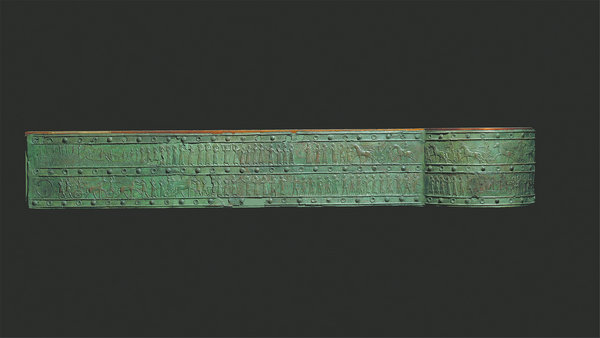
In the royal palaces of Assyrian kings, art served one ultimate purpose — to awe. And not a single square inch was spared.
Take for example a bronze band measuring about 30 centimeters in width and 185 cm in length. Once attached to the wooden gate of the palace of Assyrian king Shalmaneser III, who ruled between 859 and 824 BC, this decorative piece teems with details — man and horses, boats and chariots. Together, they tell of Assyria's dominance over Phoenicia, a collection of city-states along the eastern Mediterranean whose strategic coastal location and maritime trading prowess made it too valuable for the expanding Assyria to ignore.
Throughout much of Assyria's control over Phoenicia, which extended from the 9th century to the 7th century BC and involved multiple military actions and sieges, Phoenician city-states like Sidon and Tyre operated largely as the empire's vassals, paying regular tributes to avoid destruction. That's the story told by the bronze band, on the far left side of which a Phoenician king and queen watch, perhaps with a brooding sense of reluctance, as boatloads of valued local products are ferried by their men to the mainland. Once there, they are carried by processions of men to King Shalmaneser III, who, standing under a parasol holding a bow, occupies the mid-to-left section of the band.
The bronze band, within the precious Assyrian collection of the British Museum, is on display at the Suzhou Museum in Suzhou city, East China's Jiangsu province, in the exhibition I Am Ashurbanipal: King of Assyria, which runs until August next year.
"Widely considered the last great king of Assyria, Ashurbanipal (669-631 BC) was separated from his ancestor king Shalmaneser III by two centuries, but the latter's military expansions helped lay the groundwork for a powerful empire for which the former eventually inherited and brought to its peak in the 7th century BC," says Zhang Fan, the exhibition's project manager.
According to Zhang, the tribute likely included a labor-intensive purple dye made from the secretion of predatory sea snails. Produced in the port city of Tyre in modern-day Lebanon, the dye, commonly known as Tyrian purple, may have given the land of Phoenicia its name — in ancient Greek, the word phoinix could mean purple.
Other highly prized tributary items that had arrived at the Assyrian palaces from Phoenicia were ivory carvings and colored glass made by Phoenician artisans who were known for combining multiple cultural influences — Egyptian style, for example — in their creations.
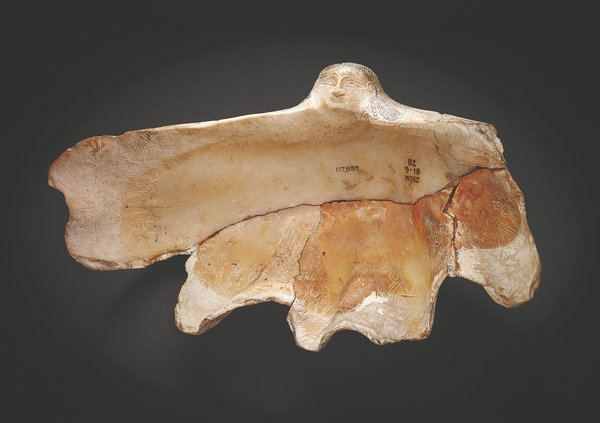
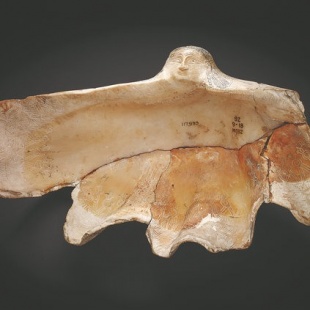
Examples of both can be seen at the Suzhou Museum, alongside a shell cosmetic container also attributed to Phoenician artisans whose design features a winged siren with a head carved out of the shell's hinge.
"The expansion of the Assyrian empire revived the manufacture and trade of luxury goods. It also led to the exchange of visual culture, technology, people and ideas across the ancient Mediterranean and Middle East," reads the exhibition's catalog.
One place to observe such exchange was at the king's banquet, where tableware decorated with motifs from across the empire can be found. Even the vast amount of food and drinks served were recorded in texts that describe their place of origin as being associated with particular products of outstanding quality.
Despite the enormous pain they inflicted upon the conquered people, Assyrians, eager adapters and adopters, were instrumental to cross-cultural pollination, their influence much more far-reaching than the Assyrian kings ever imagined.
One of the recurring images in the Suzhou Museum exhibition is the lotus flower, which made its way onto the outer border of a carved stone slab that once served as the threshold of Ashurbanipal's throne room in his North Place in Nineveh in modern-day Mosul, Iraq. Directly associated with Assyrian kingship, the lotus flower also made a famous appearance on a big stone relief depicting a banquet presided over by Ashurbanipal and his queen Libbali-sharrat. Reclining on a couch, the king holds a cup in his right hand and a lotus blossom in his left.
"Although its origins and transmissions are difficult to trace with any certainty, the lotus flower motif was part of an iconographic tradition shared and re-imagined across the Middle East, Egypt, the Mediterranean and Asia," says Sebastien Rey, curator of the British Museum that is behind the current exhibition.
The stone slab featuring lotus flowers on its outer border also has an inner border made up of rosettes, a decorative design that resembles the shape of a rose. According to Rey, the rosette is often associated with the great Mesopotamian goddess Ishtar who was worshiped by the Assyrians. Being a warrior goddess whose protection Assyrian kings had prayed for before going into battle, Ishtar also represented love, beauty and fertility. This dual nature could have held a mirror to Ashurbanipal who, judging by all evidence, constituted a complex and multifaceted personality.
One section of the exhibition is titled The Scholar King, for good reasons. "Unlike his predecessors, Ashurbanipal mastered the scribal arts and could solve complex mathematical problems and debate with expert scholars," says Zhang.
Taking great pride in these academic achievements, the king created in his capital city Nineveh the largest and most comprehensive library the world had ever seen before filling it with inscribed clay tablets.
While many bore divination texts, others were given to the recording of Mesopotamian literature, including The Epic of Gilgamesh, the earliest version of which dates back to around 2100 BC.
Noted for its complex narrative structure, poetic language and exploration of universal themes such as friendship and loss, the epic is regarded as a foundational work in the tradition of heroic sagas, with Gilgamesh forming the prototype for later heroes like Heracles and the epic itself serving as an influence for Homeric epics.
One broken piece of clay that bears part of the epic story in cuneiform has arrived at the ongoing exhibition from the British Museum, which had previously sent its own team of conservators and technicians for the installation of all exhibits. After the initial installation, this particular piece, dating to a time period between 680 and 630 BC, was repositioned when a visitor noted that its orientation didn't allow for easy reading.
That level of audience engagement could have given great satisfaction to Ashurbanipal, whose immense pride and desire for a lasting legacy matched the size of his empire.