Intl giant panda conservation cooperation to build on successes







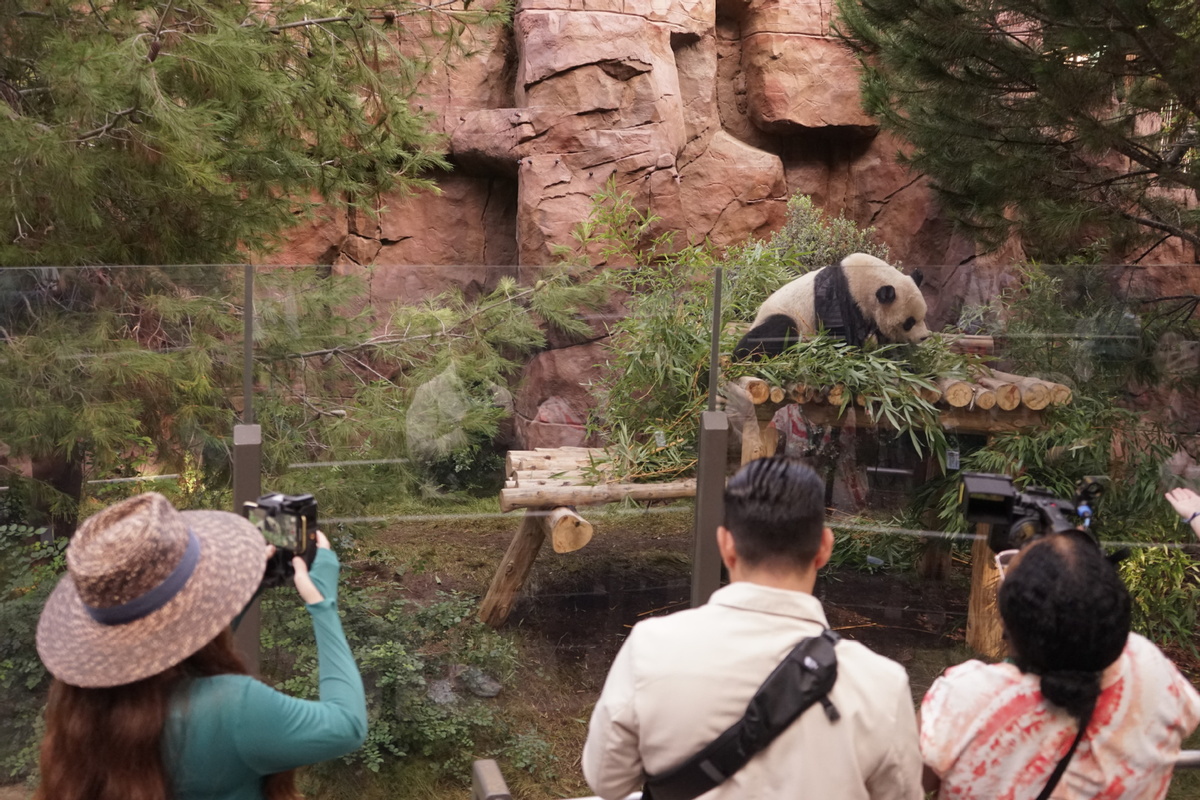
This month, as giant pandas Bao Li and Qing Bao arrived at the National Zoo in Washington DC, and a pair of pandas get ready to depart for Australia in December, China has initiated a new round of international cooperation on giant panda conservation.
Pandas Yun Chuan and Xin Bao arrived in San Diego in June, and Jin Xi and Zhu Yu flew to Madrid in April.
Since 1994, China has engaged in giant panda conservation research cooperation with 26 institutions in 20 countries, during which 68 cubs have been born overseas.
"Over 50 pandas born abroad have returned to China to participate in breeding programs. Among the 728 captive pandas globally, the offspring of those who participated in international exchange cooperation account for nearly 25 percent, making significant contributions to the captive population." said Li Desheng, chief scientist at the China Conservation and Research Center for the Giant Panda in Chengdu.
Protecting giant pandas involves addressing the challenge of increasing population numbers and genetic diversity. Subsequently, the three major challenges — difficulty in estrus, breeding and cub survival — were resolved in around 2000, Li said.
"International cooperation contributed greatly in this process. With collaborative efforts of domestic and foreign scientists, the reproductive capacity and offspring quality of giant pandas have been significantly enhanced," he said.
Success has been had in cooperation with the National Zoo in Washington DC on panda semen collection and preservation, genetics and ecological research, as well as with the San Diego Zoo on panda behavior, artificial milk development, artificial cub rearing and disease prevention. Cooperation with Wakayama Adventure World wildlife park in Japan on panda feeding and cub rearing has also had an important influence in giant panda conservation.
This month, The New York Times published an article that cited outdated, biased and false information to attack China's efforts in the captive breeding and artificial insemination of giant pandas, expressing concerns about the conservation of its wild populations.
This ignored an important fact that ex-situ conservation is widely accepted by scientists as playing an important role in the protection of endangered and critically endangered wildlife species.
From the 1970s to the 1980s, the wild giant panda population in China plummeted from 2,400 individuals to 1,100.
Realizing the seriousness of the rapid population decline, translocation conservation efforts, in which the endangered animals were introduced into conservation centers for better care and breeding, at that time provided a backup for the wild population, and garnered support and recognition from many experts, said the National Forestry and Grassland Administration.
"Early on, due to the limited number of captive individuals, fewer giant pandas could participate in breeding. Most males were unable to naturally mate, and females had short estrus periods, necessitating artificial insemination to ensure genetic diversity," Li explained.
Allegations that some giant pandas have been harmed during artificial breeding, made in The New York Times article, have been refuted.
"The process of semen collection is safe. Before collection, the giant pandas are anesthetized, and the voltage used during collection typically ranges from 2 to 6 volts, a level that humans can barely perceive. Artificial insemination can usually be completed within half an hour."
The voltage of a standard AA battery is 1.5V.
"This technology has been applied to pandas since the late 1990s, and there have been no instances of health damage due to electric stimulation during semen collection, nor is there any scientific evidence suggesting that electric stimulation during semen collection negatively affects the giant pandas' health," he added.




- East China conference pools Maritime Silk Road development wisdom
- Mainland warns DPP against sacrificing Taiwan interests for US favor
- Chinese vice-premier calls for applying Green Rural Revival Program experience to advance rural revitalization
- Mayors, city planners explore Nanjing
- New center in Shanghai targets medical tourism
- Flying hospital now ready for eye and ENT surgeries