Tea connects China, Russia, Xi tells Putin







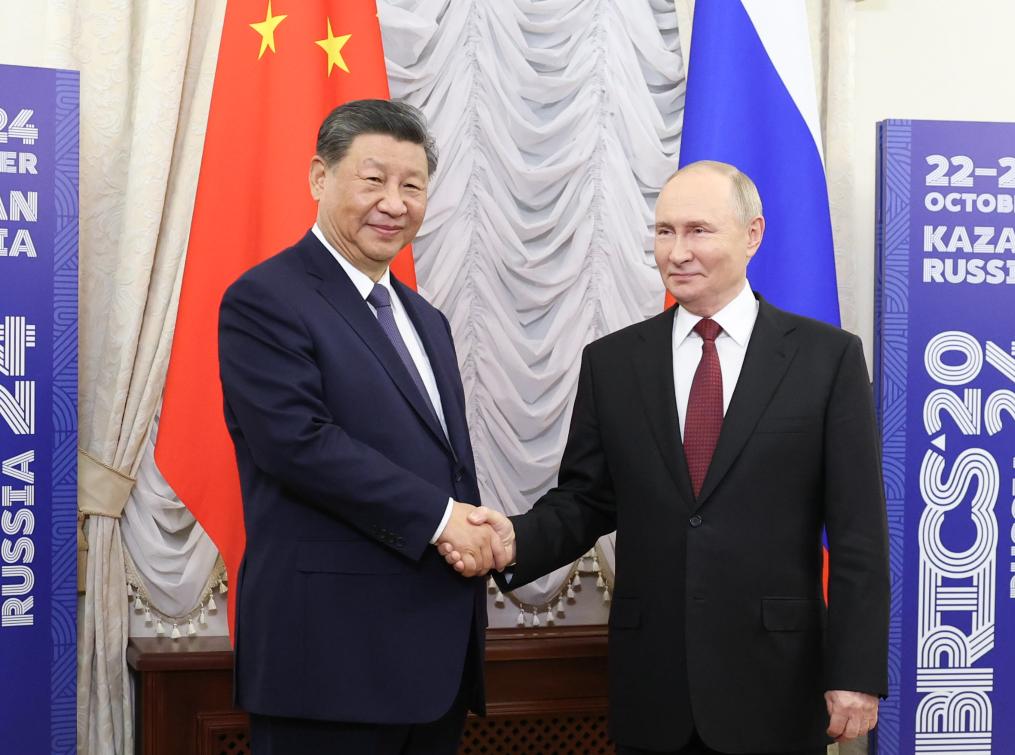
KAZAN, Russia -- "Around 400 years ago, the Great Tea Road that connected the two countries went past Kazan, through which tea leaves from China's Wuyi Mountain region found their way into many Russian households," President Xi Jinping said to Russian President Vladimir Putin on Tuesday.
Xi recalled the history in his meeting with Putin on the sidelines of the 2024 BRICS summit in Kazan, the fifth-largest city of Russia with historical and cultural significance.
Xi's remarks highlighted the long-standing bond between China and Russia forged by the centuries-old tea trade. Several centuries ago, tea was introduced to Russia, quickly becoming popular and giving rise to a unique tea-drinking culture.
In the 18th century, Russians created the samovar, a distinctive device for brewing tea. Today, enjoying tea alongside snacks and desserts is still a cherished social activity in Russia.
In the mid-19th century, Russian traders flocked to Yangloudong in central China to establish mills for processing brick tea. They eventually relocated to Hankou, where they harnessed steam engines and hydraulic presses to produce brick tea tailored for the Russian market.
This shift significantly boosted tea exports through Hankou, a port in Central China's Hubei province, which accounted for over 60 percent of China's total tea exports by the end of the 19th century.
Scattered across Hankou district, Wuhan city, are sculptures and Russian-style architecture built by former tea traders, which have borne witness to the once flourishing tea trade.
Chinese tea has had a huge impact on the Russian way of life and its culture, partly replacing kvass, beer and home-brewed alcohol, and the custom of tea drinking is now deeply ingrained in Russian culture, said Sergey Kalashnikov, chairman of the Russian Association for International Cooperation.
Centuries on, the bond between China and Russia has gone far beyond the scope of tea: two-way trade exceeded $240 billion in 2023 and robust people-to-people exchanges have been burgeoning.
In 2023, the two leaders agreed to make 2024 and 2025 the China-Russia Years of Culture, hence hundreds of cultural exchange activities, including artifact exhibitions, film screenings, among others.
On top of that, the two sides have made impressive strides in educational cooperation, with over 200 Russian universities offering Chinese courses and around 90,000 students learning the Chinese language, alongside more than 40,000 Chinese students studying in Russia.
China and Russia have found the right way for neighboring major countries to get along with each other, said Xi.
Xi's talk of tea during meeting with Putin is the continuation of the importance that he attaches to the tea industry. He has visited tea plantations in Zhejiang and Fujian provinces, where he worked as a local official, and encouraged local farmers to improve their livelihood through the tea industry.
In a letter of congratulations on a series of activities marking the first International Tea Day in 2020, Xi said China, a major producer and consumer of tea, is willing to work with all sides to nurture the sustained and healthy development of the global tea industry, deepen cultural exchanges on tea, and allow more people to relish lives accompanied by tea.
As a symbol of Chinese culture and hospitality, tea has been used by Xi on many diplomatic occasions.
In January 2017, after an official meeting at the Great Hall of the People in Beijing, Xi had a tea break with Vietnam's late ruling party chief Nguyen Phu Trong, during which they talked about the tea culture that the two countries share.
Speaking at the College of Europe in Bruges, Belgium, in 2014, Xi used tea and beer as a metaphor for the coexistence of Eastern and Western cultures.
"The Chinese people are fond of tea and the Belgians love beer," Xi said. "To me, a moderate tea drinker and a passionate beer lover represent two ways of understanding life and knowing the world, and I find them equally rewarding."
"When good friends get together, they may want to drink to their heart's content to show their friendship. They may also choose to sit down quietly and drink tea while chatting about their life," Xi added.