



Celebrating multilateralism
At its forthcoming summit in Kazan, BRICS will once again reiterate that it was founded for shaping an international order that is more fair, just, inclusive, equitable and representative







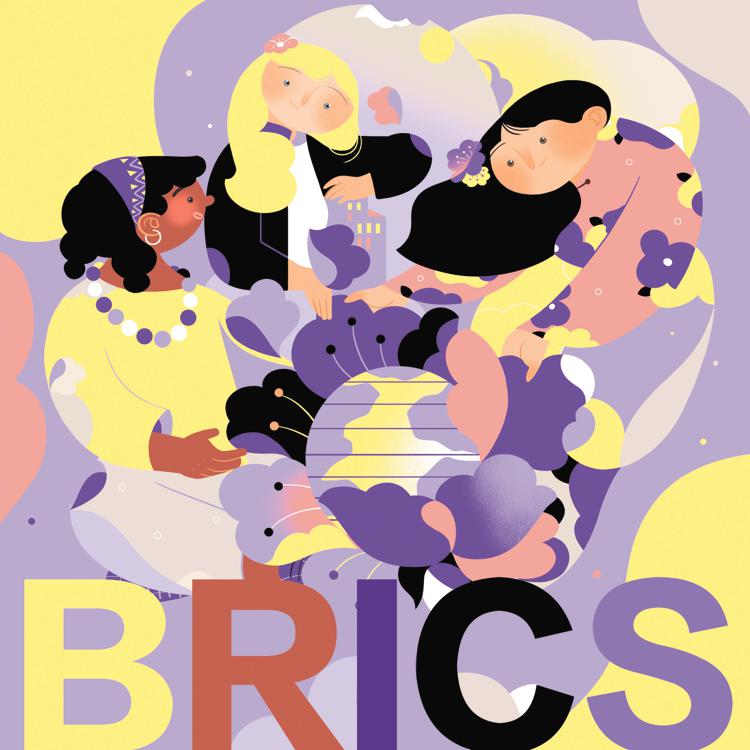
Since its inception, the BRICS has had a positive effect on the international system and BRICS countries have individually emerged to assume higher economic rankings. In the run-up to the summit in Kazan, Russia, from Oct 22 to 24, the BRICS continues to actively implement measures to enhance intra-BRICS cooperation under three pillars — political and security, economic and financial, cultural and people-to-people exchanges — to speed up the implementation of the United Nations' 2030 Sustainable Development Agenda, further broaden and deepen the cooperation among BRICS members and elevate the influence of developing nations in global affairs.
In fact, during the BRICS foreign ministers' meeting in New York on Sept 26 on the margins of the 79th United Nations General Assembly, the ministers discussed major global and regional issues, as well as various UN agendas covering topics such as politics, security, economics, finance and sustainable development, strengthening multilateralism, as well as working toward real reform of global governance institutions.
The BRICS can be proud of its cooperation achievements which are multi-sectorial and multi-faceted. The progress that has been recorded is due to the collective commitment of all BRICS members to ensure the effective implementation of all its decisions which are based on consensus.
The BRICS now represents about 45 percent of the global population (3.5 billion people) and accounts for 36 percent of the world's GDP, which totals approximately $29 trillion. The bloc's collective share of global oil production stands at 44 percent, giving it massive leverage in energy security and global economic discussions.
In fact, based on the many achievements of the BRICS, it goes without saying that the BRICS platform represents one of the most significant developments in global governance. Over the past decade, the BRICS has increasingly demonstrated the ability to embark on innovative measures aimed at addressing the deep imbalances afflicting the world.
In principle, not a single serious global issue can be effectively decided today by a single power, no matter how large or confident it is, especially through the unacceptable infringement on the interests of other countries. That is why the theme for this year's summit is "Strengthening Multilateralism for Equitable Global Development and Security". Chair Russia and its partners regard the BRICS as a champion for a multipolar world, the development of which all BRICS members are endeavoring to contribute to in the name of a brighter and more harmonious future for all its people.
Furthermore, the BRICS is not guided by the "bloc principle", but on the principles of mutual respect, a sovereign choice of development path and the implementation of the fundamental principle of the UN Charter, among others, the sovereign equality of states.
The upcoming BRICS summit is taking place against the backdrop of an increasingly changing and uncertain world with problems and challenges such as weak leadership, inadequate economic growth, unilateralism, protectionism, hegemonism, power politics and the fueling of geopolitical tensions which affect world peace and stability. Although these issues are all interlinked, the responses by the international community to these global challenges have sadly been woefully inadequate and fragmented.
These new realities call for a fundamental reform of the institutions of global governance so that they may be more representative and better able to respond to the challenges the world faces.
The Global South is a major force on the global stage as it represents 85 percent of the global population; the fastest growing global economies today are also from the Global South. The latest round of BRICS expansion shows the desire of Global South countries to claim their share in economic development and take a leading role in global governance. The BRICS is a force to be reckoned with and is poised to shape the global order. Countries of the political West, in particular the United States and the European Union, will increasingly have to re-evaluate their model for cooperation and development with the Global South to avoid "losing" these countries as crucial partners in a world order that is increasingly marked by fragmentation and competition.
The accession of new countries such as Egypt, Iran, the United Arab Emirates, Saudi Arabia and Ethiopia, and the interest shown by a growing number of countries to develop ties with the BRICS are strengthening the BRICS' international standing.
Proposals on how to accommodate new partner countries will therefore be on the agenda of the Kazan summit.
The Global South is increasingly providing leadership and China is working with the African continent and other BRICS members to shape a new world order of hope, inclusivity and the building of a community with a shared future.
BRICS leaders continue to express their support for infrastructure development in Africa and its industrialization. The BRICS has undertaken to support Africa's efforts to accelerate the diversification and modernization of its economies, through infrastructure development, knowledge exchange and support for increased access to technology, enhanced capacity-building and investment in human capital, urban development, green energy, the modernization of agriculture and food security.
The BRICS countries are the largest trading partners of Africa. In fact, the BRICS has nourished Africa's economic emergence and elevated the continent's contemporary global relevance.
Joining the BRICS in 2010 was a milestone in South Africa's quest to advance its own national development priorities by forging stronger ties with the important emerging economies of China, Brazil, Russia and India. BRICS is of immense strategic importance to South Africa. In the 14 years since it joined the grouping, South Africa has enhanced its position as an important emerging economy and strengthened its activism on the global stage, particularly around the reform and strengthening of multilateralism.
South Africa's priority in the BRICS remains to ensure the economic growth of the countries in the association, Africa and the Global South.
Since its inception 16 years ago, the BRICS has become a positive, stabilizing and constructive force with rising international influence and appeal on the international stage, and has always been closely linked to the destiny of emerging markets and developing countries.
Contradicting all expectations in the West of the eventual weakening of the group, BRICS member countries work in a committed fashion toward strengthening cooperation. Critics of the BRICS, who thought the formation would end up being another talk shop, have been proven wrong. The BRICS is a goal-oriented formation with continuity, concrete and tactical actions.
It is anticipated that at its forthcoming summit in Kazan, the BRICS will once again give concrete and practical content to the core principle on which it was founded, namely one of shaping an international order that is more fair, just, inclusive, equitable and representative.
The author is a senior research fellow at the Institute of African Studies at Zhejiang Normal University and a former senior diplomat in the South African Department of International Relations and Cooperation. The author contributed this article to China Watch, a think tank powered by China Daily. The views don't necessarily reflect those of China Daily.
Contact the editor at editor@chinawatch.cn.





