



Powering today's emerging designers







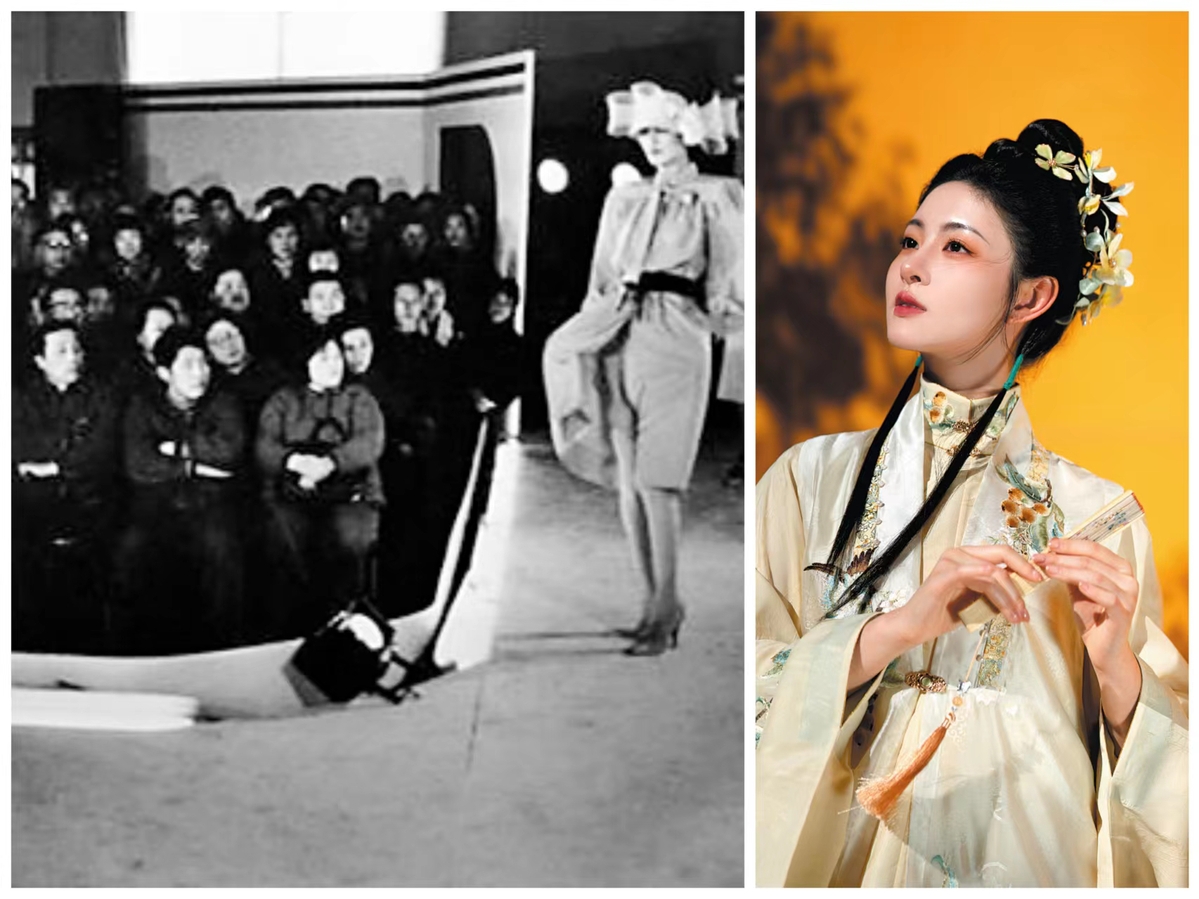
In November 1978, French fashion designer Pierre Cardin (1922-2020) visited China, the first of any Western fashion designers to do so since 1949. His trip marked not only the beginning of his influence on the Chinese fashion scene, which came to a peak in the 1980s and early 90s, but also a significant moment in Chinese fashion history at a time when the country was on the cusp of change.
"Cardin wasted no time entering the Chinese market upon the country's reform and opening-up, following the end of the 'cultural revolution' (1966-76)," says Liu Wei, who taught at Beijing's Fashion Institute of Technology.
While the French designer had foreseen the immense buying power about to be unleashed by hundreds of millions of Chinese consumers, he was also poised to shock audiences with his first-ever fashion show in the chilly spring of 1979.
Held on a makeshift stage inside Beijing's Cultural Palace of Nationalities, the show saw a parade of French and Japanese models in front of a packed audience, which hosted news agencies and reporters holding cameras, all left flabbergasted.
For his Chinese viewers, Cardin's bold, futuristic looks were mind-blowing, to say the least, but the event had a motivating effect. By the end of 1980, China published its first fashion magazine and debuted its first modeling team under the publicly-owned Shanghai Municipal Fashion Company, whose 19 members were chosen from 30,000 candidates.
"The 1979 show generated intense interest for the brand that Cardin introduced to China, ever so cleverly, through licensing," says Liu, referring to an arrangement whereby all Cardin fashion items sold on the Chinese mainland were locally designed and manufactured under strict quality control.
"Apart from bringing down costs, this practice also allowed the brand to adapt to local preferences, which, at that time, were nowhere near the geometric and structural creations Cardin was known for. In a sense, Cardin's business acumen was even more inspiring for a generation of Chinese designers who were awakening to the power of fashion branding, me included," continues Liu, who worked for the Beijing-based Chinese brand Botao between the late 1990s and early 2000s.
In 1998, Botao held a grand runway show inside a historical building in Beijing that once served as the imperial ancestral temple between the 15th and early 20th century, with models milling about in heavy makeup, fanciful hairstyles and vibrant, body-conscious designs constructed on Western sartorial principles, yet radiated a clear Chinese stylistic influence.
"The location choice and the clothes themselves hinted at an effort to maintain the brand's cultural roots, yet Western influence was obvious," says Liu, who would travel to Paris during its iconic fashion weeks.
Among the notoriously hard-to-get-in shows Liu attended were John Galliano for Dior and Alexander McQueen for Givenchy, stunning him for "the kind of creative extremes they were willing to pursue in order to shape an image for the brand".
For those who couldn't behold the spectacles in the French fashion capital, there was a hunger for the images, which spawned a business. "There were 'image-vendors' in those days who were able to buy show pictures from fashion photographers before selling them to us, at a price that was anything but cheap," recalls Liu.
He had a throwback while visiting the Botao office not long ago, where a shelf lining the wall was filled with video cassette tapes, one labeled "Chanel", another "Dior". "They contain transcribed show footage from the fashion weeks in Paris, London, Milan and New York," says Liu.
Partly to fulfill that longing for information, in 1995, the Hong Kong Trade Development Council, which had been promoting Hong Kong designers on the Chinese mainland through fashion shows and other events, set up a fashion library inside the Beijing institute in partnership with the college and the China Fashion Association, the latter founded in 1993.
In 1997, the association hosted the first China International Fashion Week in Beijing, followed by the first edition of Shanghai Fashion Week six years later, which have become major platforms for Chinese designers.
Back in the early 2000s, Yang Jie was a fashion student who had frequented the library. He now teaches at the college. "To get the card for this particular library, one needed to pay a 200 yuan ($28.35) deposit. The books, which included imported fashion magazines, were not only expensive but also precious — they allowed me my first glimpses into international fashion," he says.
But change was already in the air. A little more than a year after Yang entered the institute as an undergraduate in 2000, China joined the World Trade Organization on Dec 11, 2001. The accession opened international markets for Chinese fashion and textile products. At the same time, the influx of global fashion brands meant more exposure to international trends and more competition for both domestic fashion companies and foreign brands already established, including Pierre Cardin.
"Since the early 2000s, the Cardin brand continued to lose its cachet with Chinese customers who, having seen for themselves the world's top fashion brands, were no longer content with buying licensed designs," says Liu.
In 2001, Shanghai, the rising fashion hub, hosted the 9th APEC Economic Leaders' Meeting. Participants of the event, which signaled the country's increasing prominence on the global stage, were required to wear a tailor-made Tang suit, named for the Tang Dynasty (618-907), a period of social prosperity and inclusivity. Made of fine silk and characterized by its distinctive standing collar and knotted buttons, the suit was widely seen as a symbol of cultural diplomacy — China's way to showcase its rich fashion heritage.
"For the next two decades, that heritage has managed to capture the imagination of China's younger generation who entertain themselves with historic attire that often includes multilayered flowing robes with wide sleeves," says Liu.
"Behind the phenomenon, there's a fascination with beauty and a growing cultural confidence, as well as a desire to stand out rather than blend in as their parents and grandparents often preferred to do," he continues.
Yang recently flew to Milan Fashion Week for the spring/summer 2025 season held from Sept 17 to 23. "Approximately 50 kilometers north of Milan there is a small city called Como, well-known among international travelers for its stunning lake views, historic architecture and silk production, which can be traced back to the 15th century," he says. "Many of the workshops and archives in Como hold historical collections, which include samples of ancient silk fabrics. Some of the samples came from China via the Ancient Silk Road, which was first established in the 2nd century BC and reached its height during the Tang Dynasty," he continues.
"Vision and history — what's behind the success story of Chinese silk is what's needed today for Chinese fashion to really emerge and thrive globally."


- Nation intensifies crackdown on telecom, online fraud
- Fudan University president suggests 'Lego thinking' to transform academic disciplines
- Mainland criticizes Taiwan official's visit to Japan
- Emirates resumes daily Dubai-Hangzhou flights
- F1 fan festival opens in Shanghai
- NPC deputy promotes ethnic unity education in Xinjiang school





