Expert: Developing countries look to not take sides in conflicts








An African expert on renewable energy expert said developing countries "don't want to take a side", calling for global collaboration instead of rising conflicts and competition.
"There's a lot of talk and discussion about what's happening between the US and China. But there's an African saying I like to refer to: 'When two rhinos fight, it's the grass that gets hurt,'" Wangari Muchiri, Africa director at the Global Renewables Alliance, said at a panel discussion on Wednesday.
Amid the ongoing trade wars and supply chain conflicts, "We really don't want to take a side," said Muchiri, who also represents the Global Wind Energy Council. Their membership includes the top five original equipment manufacturers from China and the West.
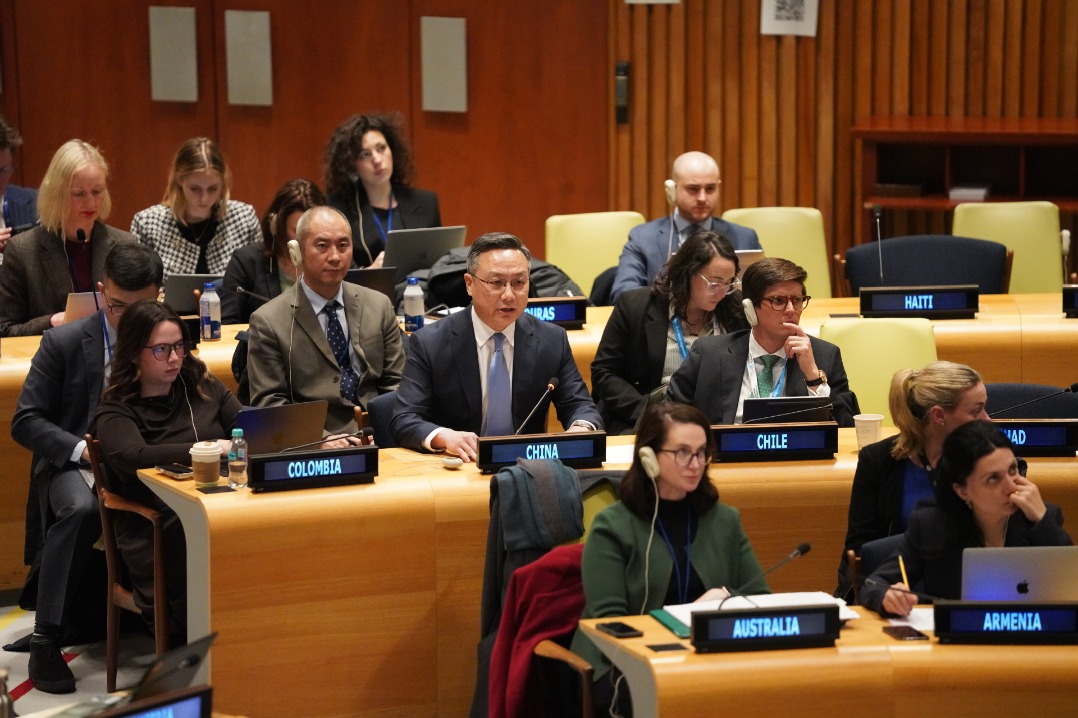
China Daily moderated a panel discussion on "Renewable Energy — Powering a Safer Future" at the SDG Media Zone on the sidelines of the 79th Session of the UN General Assembly in New York.
The SDG Media Zone, organized by the UN Department of Global Communications, is a media program that aims to accelerate action on the 17 Sustainable Development Goals (SDGs).
The discussion occurred a day after the Global Renewables Summit on the sidelines of the General Assembly. The summit emphasized the goal of the UAE Consensus: to triple global renewable energy capacity by 2030 to keep the 1.5 C target within reach.
"When I speak from an African perspective, it's not just about tripling — it's about multiplying renewables fivefold. If we're aiming for five times the renewable energy capacity, we don't have time for disagreements on policy or comparing approaches," Muchiri said.
"If we're trying to deliver five times the renewables, we don't have time to fight," she said. "We don't have time to differ on policy."
To gain more accessible renewable energy technology, Muchiri called for global North-South and South-South collaboration.
"Coming from a developing country myself, when I try to import a solar panel into Kenya, I have to pay 30 percent more in capital costs, then I have to pay all the import duties, and finally, wait for the solar panel to arrive so I can deploy it in a solar farm," she said, adding that the process needed to be faster and ensure easier access.
"That means diversifying our supply chains, working through global North-South and South-South collaboration to transfer technology," she said.
The concern about diversifying clean-energy supply chains stems from the concentration of critical mineral production — such as cobalt, lithium, and rare earth elements (REEs) — in a few regions, posing risks to supply chain stability.
For instance, the Democratic Republic of Congo supplies 70 percent of the world's cobalt, and China provides 60 percent of REEs. Australia and Chile dominate lithium mining.
China also refines 90 percent of REEs and 60-70 percent of lithium and cobalt, while leading the global output of materials like crude steel, cement and aluminum, though much of it is used domestically, according to a report by the International Energy Agency (IEA).
"Now, to reach the target of a tripling of new renewable energy by 2030, we are going to need a significantly larger amount of critical minerals. We need to create the opportunities for these resource-rich developing countries to really draw the benefit through value addition and industrial development, and investments," said Ditte Juul J?rgensen, co-chair of the UN Secretary-General's Panel on Critical Energy Transition Minerals.
J?rgensen, who is also the director-general for energy at the European Commission, called for diversifying the supply chain.
Muchiri called for changes in intellectual property laws to facilitate the sharing of technology.
"We need some movement around IP laws to figure out how we can share. Remember, China wasn't always a leader in supply chain production," she said.
Many of the technology experts in Chinese manufacturing companies were educated in Australia, which once played a leading role in the development of renewable energy technologies, and "it's no longer a manufacturing hub for renewables" — China learned the technology, worked with counterparts in Australia and other parts of the world, and now they're able to scale and deploy those technologies," Muchiri said.
"Why can't we replicate that in other regions of the world? Why can't we bring technology transfer to other areas in Latin America or the Global South?" she said.
China was responsible for more than 50 percent of the 510 gigawatts of newly installed renewable energy capacity globally in 2023, according to data from China's National Energy Administration.
By 2028, China is projected to account for nearly 60 percent of the new renewable capacity expected to be operational worldwide. The IEA said that this positions China as a key player in the global effort to triple renewable energy capacity by 2030.
Francesco La Camera, director-general of the International Renewable Energy Agency, said at the panel that time is the most crucial factor in fighting climate change, as "the physics of climate doesn't allow us to delay. If we don't act now, we'll pay for the damage later."
minluzhang@chinadailyusa.com