



Product replacement efforts bearing fruit
Measure helping boost consumption, rejuvenate economy, realize green goals







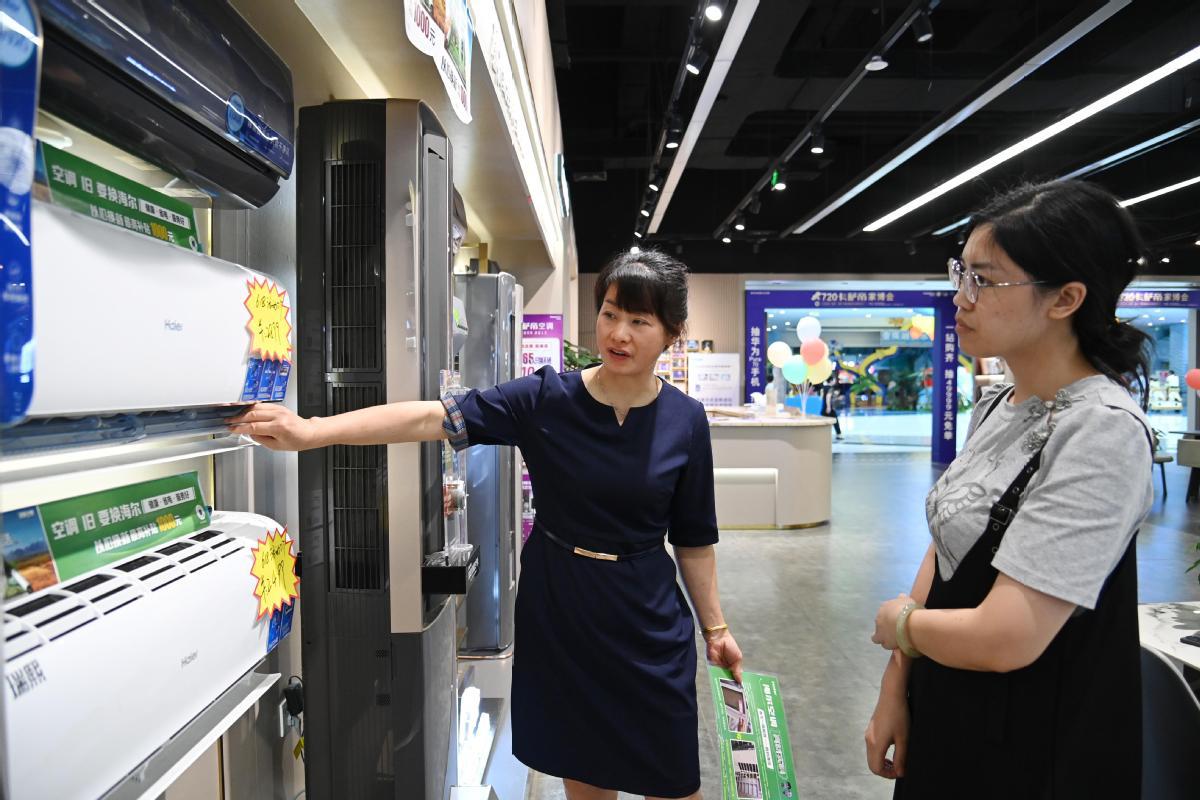
With China providing financial incentives to encourage consumers to trade in their old home appliances for new ones, both foreign and domestic manufacturers said this initiative will drive consumers to buy more energy-efficient products, while boosting the country's economic growth.
The Chinese government introduced a policy measure in late August to promote the trade-in of old appliances and electronics. Consumers can receive subsidies for eight categories of high-energy-efficiency appliances, including refrigerators, washing machines, televisions, air conditioners and computers. These subsidies will cover 15 percent of the final sale price of the new products.
Each individual consumer can receive a subsidy for one item in one category and the subsidy for each item cannot exceed 2,000 yuan ($283.36), said the Ministry of Commerce.
The move, focusing on stimulating market vitality, will promote product upgrades through government subsidies, said Wang Zhenfei, senior vice-president of BSH Home Appliances (China) Co Ltd, a country branch of Germany's BSH Home Appliances Group.
"At the same time, it will encourage manufacturers to continuously introduce innovative products, providing the market and consumers with eco-friendly smart home appliances, co-creating refreshed home environments with consumers and driving green innovation in the home appliance sector," said Wang.
Eager to seize more market share, the German company's two major brands — Bosch and Siemens — offer a wide range of home appliance product selections in China this year, providing consumers with more choices for upgrading.
The National Bureau of Statistics said retail sales of goods in China reached 3.44 trillion yuan in August, up 1.9 percent year-on-year.
The effectiveness of the trade-in program for consumer goods continued to be clear last month. Retail sales of home appliances shifted from decline to growth, rising 3.4 percent year-on-year.
"We strongly encourage our corporate members to understand and explore these new policies to benefit from them. We also recognize that competition is fairly intense in China," said Jens Eskelund, president of the European Union Chamber of Commerce in China.
Therefore, foreign firms need to invest, stay at the forefront of technology and bring the best products to China. In some cases, they should even develop products locally for the Chinese market, said Eskelund.
Sharing similar views, Hanneke Faber, CEO of Logitech International SA, a Swiss manufacturer of computer peripherals and software, said that with supportive policies aimed at boosting consumption and the growing trend of computer peripherals that combine both software and hardware, China has emerged as an innovative and rapidly expanding market.
"We will enhance our position in the area of supplying keyboards and webcams within the country," she said.
Supported by more than 2,400 workers at its factory in Suzhou, East China's Jiangsu province, Logitech also ships products manufactured at this plant worldwide.
As part of China's efforts to boost domestic demand and support economic growth, Xu Xingfeng, director of the market operation and consumption promotion department at the Ministry of Commerce, said the consumer goods trade-in program will not only boost spending in the home appliances sector and contribute to overall economic growth, but also encourage manufacturers to produce and market more advanced and eco-friendly products.
This certainly will drive innovation and enhance the competitiveness of Chinese manufacturers in both domestic and foreign markets in the next step, said Xu.
Bai Lin, vice-president of Chinese home appliance manufacturer Midea Group, noted that trade-in programs for consumer goods are more than just product replacements.
Such programs stimulate consumer demand, thus energizing domestic consumption and reinforcing economic recovery. For businesses and industries, this presents a significant growth opportunity, Bai said.




















