



Delivering development







BRI investments have been a boon for the much-needed development of infrastructure in Africa
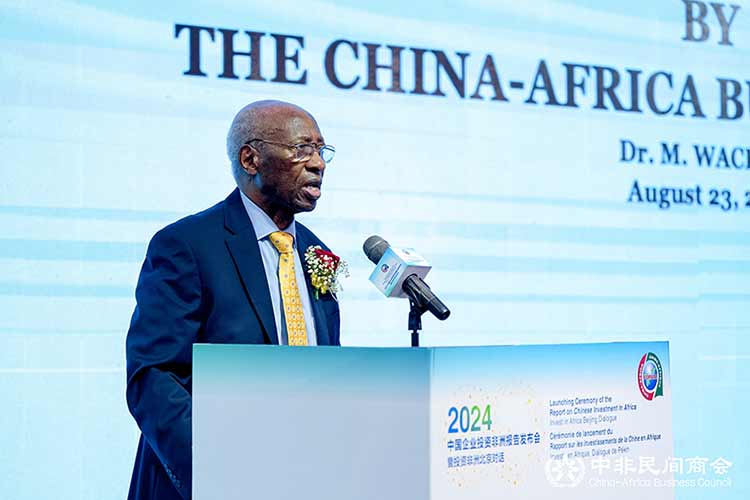
"Looking back at the Belt and Road Initiative over the years, the first thing that strikes you is the projects, especially the infrastructure projects. In many cases, they have become symbols of development in most of the African countries," says former World Bank economist Mwangi Wachira, who recently shared his insights into the BRI's impact on Africa in an exclusive interview with China Daily.
Wachira emphasized that it is hard to understand what Africa has achieved over the last 20 years without talking about the BRI. As he put it, "The initiative has gone to the heart of development issues in most countries". BRI projects have not only paved the way for Africa's economic growth but have also become significant markers of China-Africa cooperation.
According to the Report on 2024 Chinese Investment in Africa released by the China-Africa Business Council on Aug 23, as of 2023, a total of 52 African countries have signed memorandums of understanding with China under the framework of the BRI. Trade between China and Africa reached $282.1 billion in 2023.
As one of the authors of the report, Wachira said China has had a stellar record supporting the development of an integrated African market with infrastructure projects, such as Algeria's El Hamdania Central Port, Kenya's Standard Gauge Railway, Ethiopia's Eastern Industrial Zone, and the African Union headquarters, among others.
One of the key projects financed by China is the iconic Mombasa-Nairobi Standard Gauge Railway, which connects the two largest cities in Kenya. Wachira, who served as an advisor to the Kenyan president and was involved in the final evaluation of the Mombasa-Nairobi Railway, said that the old railway had long been a bottleneck for cargo transport in the region. Built in the 1890, the out railway was prone to frequent breakdowns and had a maximum speed of only 40 kilometers per hour. It was known for a long time that it needed updating, but "we simply did not have the resources put together to fix the railroad," Wachira said.
A 2013 United Nations Trade and Development organization (UNCTAD) report identified poor transportation infrastructure as a major constraint on economic progress in Kenya and other African countries. It said poor transportation hampered the ability to efficiently move goods and services, thus limiting economic growth and development opportunities.
The situation has dramatically changed with the completion of the Mombasa-Nairobi Railway. "Today, goods can land in Mombasa and reach Naivasha in four days and Kampala in Uganda in six days, a significant reduction from the previous almost two-month journey," Wachira said. "The saving of time is the essence of development."
Now, the railway has become a major driver of economic growth in Kenya and East Africa and is paving the way for regional economic integration. In this respect, BRI infrastructure projects are paying the way for others to invest during the later stages of development.
Addressing the claims of the United States and some of its allies that such BRI projects are debt traps, Wachira stressed, that "most of Africa's debt is not owed to China but to Western institutions. It's the West which has trapped the Africans in debt." He pointed out that African nations are well aware of the significance of these infrastructure projects.
Based on the International Debt Report 2023 released by World Bank, commercial bonds and multilateral debt accounted for 66 percent of Africa's total external debt in 2022, while China-Africa bilateral debt made up only 11 percent.
Wachira further compared Chinese and Western aid for African development, noting that China's aid is more foundational, addressing the root causes of development issues in African countries.
"The need for roads, ports, and railroads has existed for many years. Yet, it took China coming to Africa to start working on some of these infrastructure projects," he said. Taking communication and telecommunications infrastructure as an example, he noted that China has been working in this sector in Africa since the 1990s. To date, 70 percent of the telecommunications infrastructure has been built by China.
He said if such projects were funded or implemented by a Western country, they would come with a long list of conditions or requirements, complicating Africa's development and effectively amounting to a form of re-colonization.
In addition to large-scale projects, Wachira emphasized the significance of small and media-sized Chinese enterprises operating in Africa. These businesses are deeply embedded in daily life and have transformed local lifestyles and perceptions of China. In a small town in Kenya, one is more likely to find a small Chinese business than one from any other country.
"Those small traders make up the face of China to many Africans," he said, noting that the positive relationships between Africans and these smaller Chinese businesses contribute to the overall favorable view of China in Africa.
Wachira is optimistic about the future of China-Africa relations, highlighting that the BRI has injected new vitality into African development through iconic projects and small private enterprises. "As long as this cooperation continues," he said, "it will bring mutual benefits, shared prosperity, and a bright future for Africa-China relations."
The author is a writer with China Daily. songping@chinadaily.com.cn
Xie Yuqi and Zhou Yishu contributed to this story.
The views do not necessarily reflect those of China Daily.
Contact the editor at editor@chinawatch.cn.





