



Building work
China is a key partner for Africa not just for infrastructure development, trade and investment, but also for skills and technology







In an era of economic and trade protectionism, neoliberalism and geopolitical confrontations, developing countries are increasingly becoming geopolitical and economic pawns in the zero-sum game of great power competition. To protect themselves from the zero-sum game, countries in Africa need to deepen relations with powers that focus on generating tangible win-win outcomes for all parties involved. Through a number of initiatives such as the Belt and Road Initiative and the Forum on China-Africa Cooperation, both China and Africa are attempting to strengthen their ties to deepen the strategic win-win engagement.
The FOCAC, established in 2000, promotes solidarity and cooperation between China and African countries based on the principles of equality, mutual benefit and win-win cooperation. Through regular FOCAC engagements, both Africa and China have opportunities for collective dialogue within the framework of South-South cooperation, and this has guided well the strengthening of China-Africa cooperation. China's strong economy and technological expertise have driven the development of the win-win situation, with China as a key partner for Africa in different socioeconomic sectors such as infrastructure development, trade and investments, as well as capacity building.
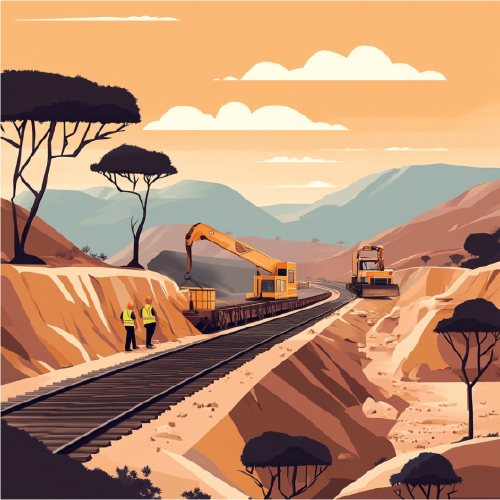
Through initiatives such as the BRI, China has invested in building roads, railways, ports and energy facilities across the continent. The Tanzania-Zambia Railway that connects Zambia to the port in Tanzania has been extensively rehabilitated. The Kenyan government took an advantage of the commencement of the BRI to construct a standard gauge railway from Mombasa to Nairobi, coupled with modernized road networks. These projects not only facilitate trade and economic growth but also contribute to Africa's long-term connectivity infrastructure development.
The Mombasa-Nairobi-Malaba Standard Gauge Railway serves as a prime example of the connectivity infrastructure that brings myriad economic benefits to the East Africa communities. For example, through this railway, the Kenyan sea port at Mombasa has been connected to Eastern Uganda; and further construction from Uganda to Rwanda and Eastern part of the Democratic Republic of Congo would cut the transportation costs for imports from these countries.
For Malawi, a landlocked country, railway infrastructure development projects are a priority as they promote strategic economic connectivity. Under the BRI cooperation, a railway has been rehabilitated from Marka at the boundary with Mozambique in the southern part of Malawi up to Blantyre and Nacala Port in Northern Mozambique. Another stretch of railway from Salima to Mchinji has also been rehabilitated and is operational now. Projects of this nature are very important from an economic point of view because they contribute toward reducing transportation costs of imports and reducing fuel pump prices. For instance, in the past three weeks, a train-load of diesel arrived in Malawi for the first time after 21 years, essentially giving hope that the fuel shortages have come to an end.
For the past two years, Lilongwe was in discussion with Beijing to consider financing the construction of a railway that would connect Lilongwe to Mbeya in Tanzania. Taking practical steps toward providing funds on this project, the Malawi government recently signed a 2.4 trillion kwacha ($1.37 billion) agreement with the Chinese government. This important step signals the commencement of a rail network in Malawi connecting Lilongwe to East Africa through an ocean port at Dar es Salaam in Tanzania which is expected to reduce the cost of imports. It is also important to mention that the new railway to be constructed will position Malawi as a connection passage to Zambia and the Democratic Republic of Congo.
In addition to infrastructure development, China has also been investing in supporting African countries develop their human resources and institutional capacities by placing a strong emphasis on training African students and senior government technical officials in Chinese universities, thereby promoting and enhancing skills and technological transfer in its engagement with Africa. For example, in an area of education infrastructure development as linked to skills and knowledge transfer, the Chinese government has supported construction of the Malawi University of Science and Technology where national and international students are being trained in geological engineering and climate change management. Currently, this university is establishing a special economic zone based on the experiences of the zones China has established in Guangzhou, Shanghai and Shenzhen. Further to this, Malawi University of Science and Technology is now able to assemble drones that are being used to respond to natural disasters such as floods.
In the agricultural sector, the Chinese government has supported Malawi to develop and construct irrigation schemes under the presidential greenbelt initiative. At the moment, this is expanding to include mega-farm development financed by China, thereby contributing to the strengthening of Malawi's food security and increasing the country's agricultural exports. In a number of areas, China is supporting micro-projects too so as to spread its win-win initiatives with local and national communities. This is more evident in Thyolo and Mulanje where micro-irrigation schemes have been supported by China.
In conclusion, both the FOCAC and the BRI have been core Chinese engagement mechanisms through which China has been effectively redesigning and strengthening the architectural construction of China-Africa relations. By implementing a number of infrastructure projects that promote and enhance the connectivity of regional economies in Africa, China is pursuing win-win cooperation, an approach that is building a community with a shared future.
The future direction of the FOCAC requires that it encourages deeper engagements on policy dialogue, coordination and collaboration. Supported by regular and timely disbursements of funds for various projects under FOCAC commitments, Africa is on track to register tangible progress in infrastructure development, and in skills and technology transfers. It is therefore incumbent upon both Africa and China to effectively implement projects that generate win-win outcomes. Joint reviews, monitoring and evaluation of projects under FOCAC and the BRI should be prioritized and guided by technical think tanks on China-Africa relations.

The author is a parliamentarian of Malawi Congress Party and an adjunct research fellow and lecturer at Malawi Institute of Management. The author contributed this article to China Watch, a think tank powered by China Daily.
Contact the editor at editor@chinawatch.cn.





