


Sands of time reveal secrets








Creating the bond
As the study of the Greater Yuezhi made important progress, Chinese archaeologists began to pay closer attention to the Fergana Valley in 2019 — the valley runs through parts of present-day Uzbekistan, Kyrgyzstan and Tajikistan. It has yielded evidence of Dayuan, the Chinese name of an important Hellenistic state in Central Asia that existed during the time of the Han Dynasty. Ancient documents say that Dayuan is the birthplace of Ferghana horses, one of China's earliest imports from the state, which are famous for their speed, toughness and endurance.
That year, Wang invited scholars from the three countries to Xi'an for a seminar to discuss archaeological work in the Fergana Valley, which led to an agreement on future multilateral cooperation.
In September 2019, the first joint archaeological exploration and academic exchange activities regarding the valley were held in Kyrgyzstan, and a second round was held in Uzbekistan last year.
The sessions were essential because they not only helped resolve academic issues, but also promoted people-to-people connectivity.
During the second event, Abdulkhamidjon Anarbaev, an archaeologist from Uzbekistan met an old classmate, Bakyt Amanbaeva, an archaeologist from Kyrgyzstan, by accident.
"They were classmates as they pursued doctorates in the former Soviet Union in the 1970s," Wang says. "They hadn't met each other for three decades. They cried on each other's shoulders when they met again. It was deeply touching."
Wang says that the Chinese and foreign archaeologists pay attention to respecting each other, and to promoting mutual understanding while working in Central Asia. They highlight the protection of the sites once they have been excavated, and refill them when the excavation ends.
In 2019, while his teammates were excavating the Serkharakat Site in Uzbekistan, they discovered that a bulldozer from a nearby brickyard had accidentally dug up some buried artifacts.
Anxious about any further destruction of the then unknown site, Wang and his colleague Muttalib Hasanov, a researcher at the Institute of Archaeology, Academy of Sciences of Uzbekistan, stood in front of the bulldozer to force the driver to stop, and immediately contacted cultural heritage officials.
As a result of their efforts, the brickyard suspended work to make way for excavations, leading to the discovery of the Chinar-Tepa Site, an important site dating from the Kushan Empire (1st-4th century), which contained the remains of a small city and tombs that were excavated this year.
Tang Yunpeng, a member of Wang's team, also highlights their friendship with local residents when they work in Central Asia. He cites the example of Djasur Navbatov, a driver from Uzbekistan, who has worked with them every year since 2017.
"Since we often work in remote areas with inconvenient transportation, we always rent his car for months at a time. He often offers us help, like allowing us to deposit our goods and materials at his home, or providing us with tools. We have celebrated each other's birthdays, and he has learned some Chinese and even some archaeological techniques from us," Tang says.
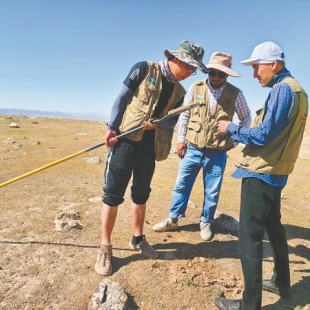
He says that some issues are a matter of scholarly debate. For example, China has different research methods for stratigraphy (the study of layers and sediments) and typology, to Central Asian countries. At first, Central Asian colleagues had doubts about the use of the Luoyang Shovel (a curved spade Chinese archaeologists use to identify soil structure), but when field work proved the effectiveness of this method, they gradually accepted it.