As the summer vacation goes on, museums are hogging the spotlight, with throngs of visitors eager to immerse themselves in rich traditional culture.
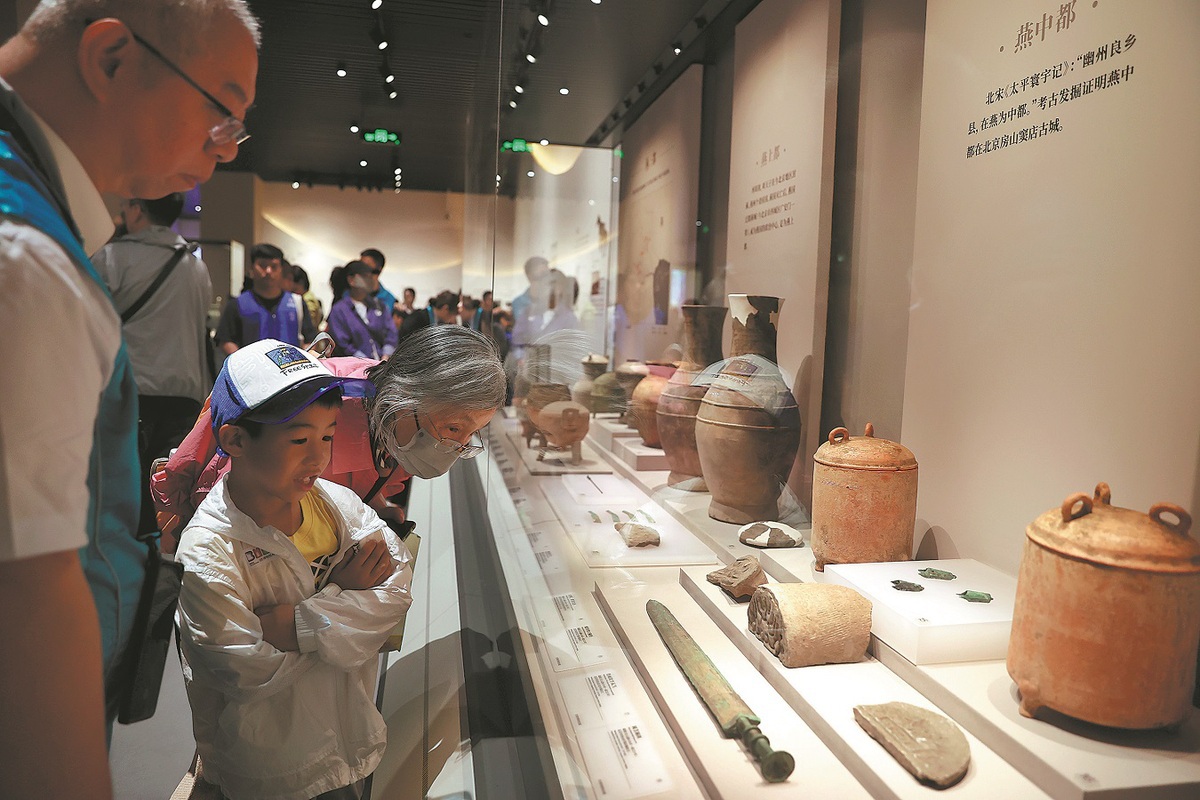
At Beijing's Grand Canal Museum, visitors have formed long lines on weekends, eagerly waiting to view Sanxingdui artifacts from the prehistoric Shu civilization, which thrived more than 3,000 years ago in present-day Sichuan province. The museum reported that the daily peak number of visitors in July exceeded 33,000.
In Shanghai, museum enthusiasts are finding it nearly impossible to get tickets for the Shanghai Museum's exhibition on ancient Egypt. According to the museum's booking system, all tickets for August have sold out.
The popularity of museums reflects a significant rise in people's passion for culture. It came as a result of President Xi Jinping's consistent promotion of traditional Chinese culture and his call for museums to bring cultural relics to life, as well as his emphasis on mutual learning between civilizations.
A resolution adopted last month by the third plenary session of the 20th Central Committee of the Communist Party of China highlighted the prosperous development of Chinese culture. It also promoted the inheritance of fine traditional Chinese culture and called for refining the supply of cultural services and products.
"We will promote cultural prosperity, enrich the intellectual and cultural lives of our people, and enhance China's cultural soft power and the appeal of Chinese culture," it added.
Xi has emphasized on many occasions that China's fine traditional culture is the "root and soul" of the Chinese nation, and he has called, during visits to museums and cultural sites across the nation in the past few years, for a better utilization of cultural relics and for making them "alive".
Since the 18th National Congress of the Communist Party of China in 2012, Xi has visited more than 100 historical and cultural sites and issued many instructions concerning cultural relics and archaeology. The sites of his visits have included the Mogao Grottoes in Gansu province, the Yungang Grottoes in Shanxi province, the Yinxu Museum in Henan province and the Chinese Archaeological Museum in Beijing.
Liu Shuguang, head of the Chinese Museums Association, said the support from the nation's top leader has injected vitality and momentum into the development of museums.
"Museums are making efforts to offer attractive and interesting services to answer our leader's call. Their appealing services have thus won crowds of visitors," said Liu.
A decade ago, Liu could not have imagined the surge in museum popularity. Back then, the majority of visitors were elderly, but now, young people and parents with children make up the bulk of the crowd.
To bring relics to life is to attract more people to museums. Many institutions have transitioned from their role as only collectors and protectors of artworks and antiques to also becoming cultural service providers, added Liu.
From concerts and digital immersive experiences to children's plays, museums and cultural institutions are conceiving innovative ways to entertain as well as educate the public.
Henan Museum in Zhengzhou, the capital of Central China's Henan province, hosts concerts for museum visitors that feature musicians playing ancient pieces of music with traditional instruments that are replicas of antiques collected by the museum — some of which were used more than 2,000 years ago. The clothing styles of the musicians are in line with the dynasties during which their specific instruments were originally played.
Ma Xiaolin, director of Henan Museum, said the idea for the concerts came about from the antique musical instruments in the museum's collection. He said that to display them in an exhibition is not as interesting as playing them and bringing them to life.
During Spring Festival in February, the museum welcomed about 100,000 visitors, and concert tickets were hard to obtain.
The Mogao Grottoes in Dunhuang, Gansu province, home to some of China's finest Buddhist art, set up a virtual reality center in September last year to offer an immersive experience. Wearing headsets, visitors can explore a digital cave — a replica of a cave seldom opened to the public for preservation purposes — and admire murals up close in high definition, and they can immerse themselves in the stories depicted in the artwork.
When Xi visited the Mogao Grottoes in 2019, he stressed that "the protection of world cultural heritage should be placed above tourism as our top priority".
Lei Zhengguang, a member of the promotional team at the Dunhuang Academy, said the virtual reality center is a good way to serve the dual purpose of preservation and enhancing visitors' experience.
As the peak season hits its stride, the daily visitor cap has been expanded to 18,000, but demand remains insatiable. "For those who can't get in, the digital immersive experience is a captivating alternative," said Lei.
The Liaoning Provincial Museum in Shenyang, the capital of Northeast China's Liaoning province, attracts children and teenagers by staging innovative shows to help them better understand what they are taught at school. Last year, it hosted shows that narrated the stories of renowned ancient poets, drawing from the institution's extensive collection of artifacts from the poets' eras.
The museum has also started a new project to get young visitors more involved. Children are invited to act out roles, recite poems and experience what daily life was like for the poets.
Dong Baohou, the institution's deputy director, said: "It's a great time for museums. People are more interested in culture than ever. To meet this demand, we need to work hard and come up with innovative ways to improve our services."
In a letter replying to experts at the National Museum of China in 2022, President Xi urged the museum workers to make contributions to the development of China's museums and to the building of China into a country with a strong socialist culture. He emphasized the importance of exchanges and mutual learning between civilizations, and called for better preserving, passing on and showcasing the fine accomplishments of Chinese civilization.
Cultural exchanges were also emphasized in Xi's report to the 20th National Congress of the CPC in 2022. "We will deepen exchanges and mutual learning with other civilizations and better present Chinese culture to the world," he said.
In the past two years, museums have taken steps to boost cultural exchanges between different civilizations.
In mid-April, Beijing's Palace Museum, also known as the Forbidden City, and the Palace of Versailles in France held a show in Beijing featuring exchanges between China and France in the 17th and 18th centuries. The widely anticipated exhibition featured around 200 cultural artifacts and drew many visitors.
Also in April, an exhibition showcasing the art and culture of two mysterious states in Central China's Hubei province 2,000 years ago was presented to a US audience at the Asian Art Museum in San Francisco, the biggest archaeological show from China since 2020.
Jeremy Zhang, lead curator of the Asian Art Museum show, that he could feel the strong support from the Chinese government for cultural exchanges. Thanks to that support, Zhang's museum will have further chances in the future to work more deeply with key Chinese museums, including the Palace Museum.
On July 17, the Shanghai Museum opened its largest-ever themed exhibition featuring 788 artifacts from various periods of Egypt's history, which it said is Asia's largest showcase of ancient Egyptian civilization.
dengzhangyu@chinadaily.com.cn