



Integration propeller







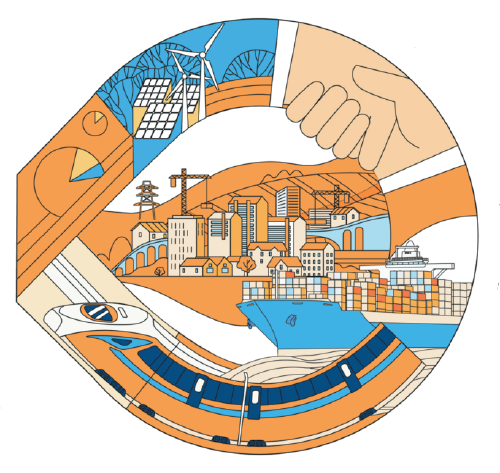
The Belt and Road Initiative is a dynamic driver of Africa's development
Last year marked the 10th anniversary of the launch of the Belt and Road Initiative. The initiative, which aims at boosting connectivity, trade and cultural exchanges among the Belt and Road countries, was inspired by the ancient Silk Road of over 2,000 years ago, that linked China with Europe, up to the shores of the Mediterranean Sea.
President Xi Jinping gave the ancient Silk Road routes a new lease on life when he proposed the building of the Silk Road Economic Belt and the 21st Century Maritime Silk Road in 2013. All countries are welcome to participate in the realization of this grand vision of connectivity. The aim is to boost connectivity in order to promote modern development in multiple fields, including: manufacturing, new technologies (such as batteries), renewable energy, trade-enabling infrastructure (including pipelines and roads), the information, communication and technology (data centers, for instance), resource-backed deals (for example mining, oil and gas), and high visibility or strategic projects (among them railways), as listed by the Green Finance and Development Center, a Fudan University-based independent think tank. Since then, the BRI has become a flagship program of international development cooperation.
Sub-Saharan Africa is one of the fastest growing areas for BRI engagement, making it a good example of South-South cooperation.
The BRI has no hidden agenda in its bilateral and multilateral implementation in Africa. Unlike the West with its Cold War mentality, the initiative does not seek to carve a "zone of influence" in which "other competitors have to be driven out".China only comes in as a partner, not a colonial master. The BRI only fits in or aligns itself with the agenda Africa itself has already laid out or with strategies African countries have already formulated themselves.
For instance, Africa, through its continental organization, the African Union, has formulated the "African Union Agenda 2063: The Africa We Want". This project stipulates the aspirations of Africans and its implementation mechanisms to realize them, which includes integrating Africa by solving the infrastructure deficit. As the BRI has embraced Africa as partner and African Union's Agenda 2063 takes integration as the means for the African renaissance, there are some common elements between these two grand initiatives. The alignment of the BRI with African Union's Agenda 2063 will bring more vitality to African development.
Take another case: the African Continental Free Trade Area, which is one of the flagship projects of the African Union's Agenda 2063. The AfCFTA is the world's largest free trade area creating a single, continent-wide market that unites 54 countries with a combined GDP of $3.4 trillion. The aim is to enable the free flow of goods and services across the continent and boost the trading position of Africa in the global market. Since you can't have an integrated continental market without an integrated continental infrastructure network, China's proposed but not imposed BRI offers itself as a solution that leads to Africa's political and economic integration. As we know, Africa is still divided into French-speaking Africa, English-speaking Africa and Portuguese-speaking Africa, which is a legacy of Western colonialism.
And this legacy is the main factor behind or the root cause of the most deadly conflicts in Africa. Some African countries still jump on the bait that Western powers throw at them as part of their efforts to "divide and rule", a tenacious neocolonial practice that still proves effective for some African countries today. The proxy wars which Western powers wage in the Democratic Republic of the Congo and for the control of strategic minerals needed for a new high-tech and green economy speak for themselves.
Ten years on, every African who takes an objective view cannot fail to see that China's BRI is offering a way out for Africa to free itself from this kind of neocolonial stranglehold. After supporting the liberation struggle in Africa, China, through such initiatives as the BRI is supporting Africa's economic liberation, proposing a win-win partnership to achieve shared development and common prosperity.
Africa needs unity, peace and development. To achieve this, Africans need to beat their swords into ploughshares by turning the colonial borders inherited from colonialism into highways and railways. And China is very good and very efficient at building such things. The Tanzania-Zambia Railway, China's first flagship free-loan infrastructure project in Africa, built from 1970 to 1975, was built with this in mind. It alleviated the isolation in which the British colonizers left the region and opened it up to trade.
Moreover, the BRI's implementation in Africa is very inclusive. It does not just target areas rich in natural resources in the continent. It is in the framework of the BRI that naturally resourceless countries such as Ethiopia have had their national infrastructures highly modernized. In contrast, if you consider for instance the decision of the United States and the European Union to finance the reconstruction of the Lobito Atlantic Railway Corridor, which stretches across Angola to link the Katanga mining regions in the Democratic Republic of the Congo and the Zambian province of Copperbelt, it is in order "to challenge China's dominance in key African trade corridor".That is clearly not paving the way toward shared development and common prosperity. This kind of the resurgence of Cold War mentality, bloc confrontation, politicization and weaponization of economic and trade relations should be rejected. We must all uphold win-win cooperation which initiatives such as the BRI stand for.
The author is a professor of international politics and strategies at Joseph Kasa-Vubu University in the Democratic Republic of the Congo and a senior visiting research fellow at Peking University's Institute for Global Cooperation and Understanding. The author contributed this article to China Watch, a think tank powered by China Daily.
The views don't necessarily reflect those of China Daily.
Contact the editor at editor@chinawatch.cn.





