



Melted opportunities







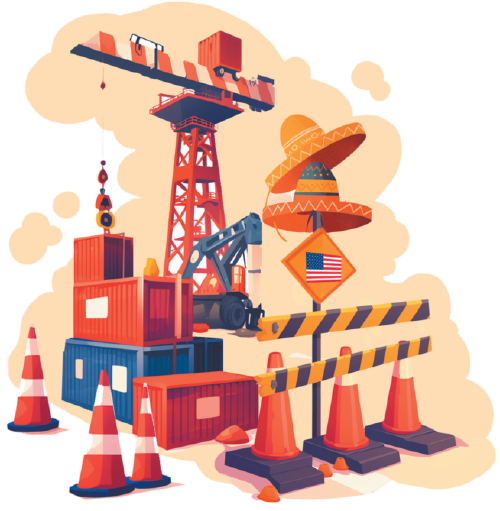
US decision to impose high tariffs on steel and aluminum imports from China is likely to damage Mexican industrial output
On July 10, the governments of the United States and Mexico announced a new series of actions against Chinese steel and aluminum products entering the North American market. Specifically, any product that is not documented as having been "melted and poured" in the US, Mexico or Canada, will face a 25 percent tariff for steel, or 10 percent tariff for aluminum.
This action is chiefly driven by US domestic politics and confrontational ideology. Thus, it is poorly related to the logic of trade and commerce. On the one hand, the measure promoted by the Joe Biden administration echoes a similar one against the proposed acquisition of US Steel by Japan's Nippon Steel last April. This draws attention as Japan is one of the closest US trade partners from Asia and a country that benefited from the "tariff rate quota" of the Section 232 of the US Trade Expansion Act of 1962 that partially removed the 25 percent tariff imposed on Japanese steel products, effective from April 2022.
On the other hand, in 2023, China accounted for 11.3 percent of Mexican imports of steel products, ranking fourth behind the US (32.5 percent), the Republic of Korea (15.5 percent) and Japan (14.9 percent). Of these four trade partners, only Chinese steel products do not benefit from the "tariff rate quota" mentioned above. Therefore, when one reads between the lines that the product must be "melted and poured" in any North American country, it effectively states that the product must not be melted and poured in China. Politics and ideology are strongly manifested in the case of aluminum because the 10 percent Section 232 tariffs specifically states that aluminum products imported from Mexico to the US market shall not contain primary aluminum smelt or cast in China, Russia, Belarus or Iran. The last three countries are practically absent in Mexican steel products imports data.
Besides, it is important to recall that aluminum and steel form the basis of global production chains, as they are necessary to produce important low-level technology goods, such as tools or spare parts, as well as to produce high-level technology commodities. In the 21st century, all economic cutting-edge sectors — biotechnology, aeronautics, green energies — require aluminum and steel.
Global demand for steel products is expected to rise to 1.81 billion tons in 2025. In this context emerging economies such as Mexico and India are experiencing a stronger increase in steel demand compared to industrialized countries. Additionally, China, as a top producer, has been reducing its finished steel production, with a reduction of 6.9 percent year-on-year in January. The US decision to impose a 25 percent tariff on steel imports from China is likely to damage Mexican industrial output, due to the global trend of increasing steel prices caused by lower steel production from the top producers and the growing demand for steel in emerging economies, such as Mexico.
In the long run, the tariffs may hinder global market trends and they are likely to damage one of the US' most important trading partners. These tariffs were initially promoted by the previous Donald Trump administration, and there is no guarantee that the "tariff rate quota" for Japanese and ROK steel products will be maintained if Trump is reelected. This is due to the rise of protectionism and economic nationalism in US domestic politics and the presidential race. For example, the opposition to Nippon Steel's acquisition of a US company is reportedly a bipartisan political stance, similar to the tone of the strategic competition against China.
In order to avoid these "melted opportunities", in the short run, Mexico should explore steel and aluminum joint ventures with Chinese companies to comply with Section 232. In the long run, Mexico urgently needs to diversify its trade and, together with China, advance in the innovative frontiers of the steel and aluminum trade.
Unfortunately, ideology and politics are also influencing the Mexican political sector's worldview. The Mexican Minister of Finance Rogelio Ramirez de la O supported the US government measures by declaring that China-Mexico trade is "not reciprocal" and North America is "very dependent" on Chinese imports. This perspective is profoundly related to the Cold War mentality, particularly the perception that world trade is a zero-sum game.
In the first quarter of 2024,82.7 percent of Mexican exports were to the US; that is $118.9 billion, and exports to China totaled $2.2 billion this quarter, the lowest since 2018 and 5.7 percent lower than the previous year. Besides, imports from the US were 60.6 billion and $30 billion of Mexican imports came from China. Thus, the real dependence is the one that Mexico has on the US. However, in the mind of both the political elites of Mexico and the US, world trade is viewed as a geopolitical arena. That is why there is a whole effort to strengthen the North American region against China.
In the end, the augmentation of tariffs will undermine any geopolitical intention or regional integration efforts, as it will only increase production costs and slow down regional exchanges. Furthermore, it will harm Mexican industrial output and, consequently, negatively impact Mexican development. The US is pressuring Mexico to side with it against China in the strategic competition era, and as a result, Mexico is set to pay a heavy price.
The author is an associate professor and researcher at the Politics and Culture Department of the Metropolitan Autonomous University, and a member of the Mexican Eurasia Studies Group. The author contributed this article to China Watch, a think tank powered by China Daily.
The views do not necessarily reflect those of China Daily.
Contact the editor at editor@chinawatch.cn.





