Reality debunks West's claims on Xinjiang








During a recent trip to China's Xinjiang Uygur autonomous region, I had the opportunity to witness the first-hand large-scale socioeconomic and cultural development of the region. Xinjiang may be among the least-developed regions of China, but it has made remarkable progress in poverty alleviation and economic development thanks to the efforts of both the central and local governments.
Xinjiang is a core area of the Silk Road Economic Belt, which along with the 21st Century Maritime Silk Road makes up the Belt and Road Initiative, and China's door to Central Asia and Europe. Numerous examples in Xinjiang bear witness to the country's comprehensive approach to improving people's living standards, by mainly creating jobs and bolstering infrastructure.
The cotton industry is just one example of how effective China's efforts in creating new jobs have been. China has become the world leader in cotton production, with Xinjiang being the country's largest cotton-producing region. The establishment of farming cooperatives and large-scale mechanization of cotton farming, which covers everything from planting to harvesting, has increased the incomes of farmers by up to 40 percent.
Uygur farmers who previously engaged in labor-intensive cotton production on small family plots can now lease their land to the cooperatives. In addition to the payment for the leased land, they also get an annual dividend for the crop yield on their land. And if they wish, they can seek employment in the cooperatives for a monthly salary or take any other job, for example, in one of Xinjiang's cotton processing or textile companies. Monthly wages start from 4,000 yuan ($548) for a 40-hour working week. That the salary is good can be gauged from the fact that the cost of living for a family of three in Xinjiang's countryside is about 2,000 yuan per month.
Xinjiang's Yili Valley is home to China's largest lavender cultivation area, and produces 95 percent of China's lavender-related products. Lavender fields in the Yili Valley have turned the place into a national and international tourist destination, helping create employment for the local people.
The Shaya county photovoltaic power plant in the Taklamakan Desert, China's largest desert and the world's second-largest shifting desert, apart from generating renewable energy has also helped develop a people-friendly environment by preventing further desertification, and created innumerable jobs. About 100,000 saxaul trees, and rows and rows of straws have been planted to reduce the effects of sandstorms, while the afforestation drive has brought wild animals such as deer and foxes back to the area.
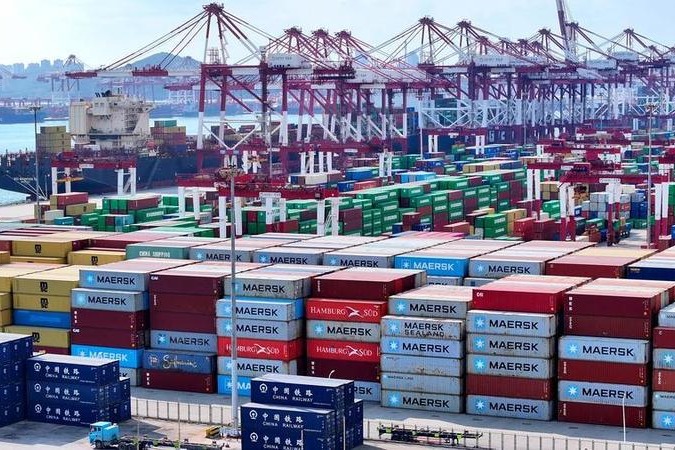
Xinjiang's economy is integrated with the Belt and Road Initiative, and the Urumqi International Land Port Area has developed into an important hub of China's international trade, with the comprehensive capability of other hubs, such as Khorgos Land Port, steadily increasing in terms of the number of freight trains plying between China and Europe.
More important, Khorgos Jinyi International Trade Group Co Ltd, which operates out of Khorgos Land Port, exports about 300,000 tons of fresh fruits and vegetables grown by more than 3,000 farmers in Xinjiang to countries in Central Asia, Europe and Russia.
So rapidly have China's relations and connections with Central Asia grown that the Xinjiang Branch of Beijing Children's Hospital is building an international medical service department, which will start providing top quality pediatric treatment for children from Kazakhstan, Kyrgyzstan, Tajikistan and other neighboring countries by the end of this year.
As a matter of fact, through its remote diagnosis center, the Xinjiang Children's Hospital is in regular contact with over 100 hospitals and clinics across China. And an increasing number of children from neighboring countries received pediatric care in the Xinjiang Children's Hospital.
However, in collusion with Western mainstream media, governments in Europe and North America have baselessly accused China of using forced labor in Xinjiang's cotton fields and mills, and suppressing Uygur culture and the believers in Islam, in a bid to smear the Chinese government and debase Xinjiang's socioeconomic and cultural development. The reality I saw debunks these allegations.
Since the founding of the People's Republic of China in 1949, the Chinese government has invested in the protection and promotion of ethnic minority groups, their culture, language and religion. It's because of such efforts that Muqam, a traditional Uygur musical and dance performance, was one of the first cultural practices to be recognized by UNESCO as intangible heritage of China.
Founded in 1987, the Xinjiang Islamic Institute serves as a center for religious and academic education for Muslims in China. In September 2017, a new campus funded by the government was inaugurated in downtown Urumqi, capital of Xinjiang, complete with a library with about 49,000 books, including translations of the Quran in Mandarin, the Uygur language and other ethnic minority languages.
Governments in the West have a lot to learn from China's sustainable socioeconomic and ecological civilization. Not only has China lifted about 800 million people out of poverty in the past more than four decades, but also it has boosted local economies, promoted ethnic cultures, created a people-friendly environment, and built international trade and people-to-people relations based on mutual respect and solidarity. People in Europe and North America have only to gain by learning from and cooperating with these endeavors.
The author is a Swiss-based sociologist and co-founder and editor-in-chief of Switzerland's independent community-based press organization Neue Presse. The views don't necessarily represent those of China Daily.
If you have a specific expertise, or would like to share your thought about our stories, then send us your writings at opinion@chinadaily.com.cn, and comment@chinadaily.com.cn.