Workers see progress in efforts to eliminate invasive plant







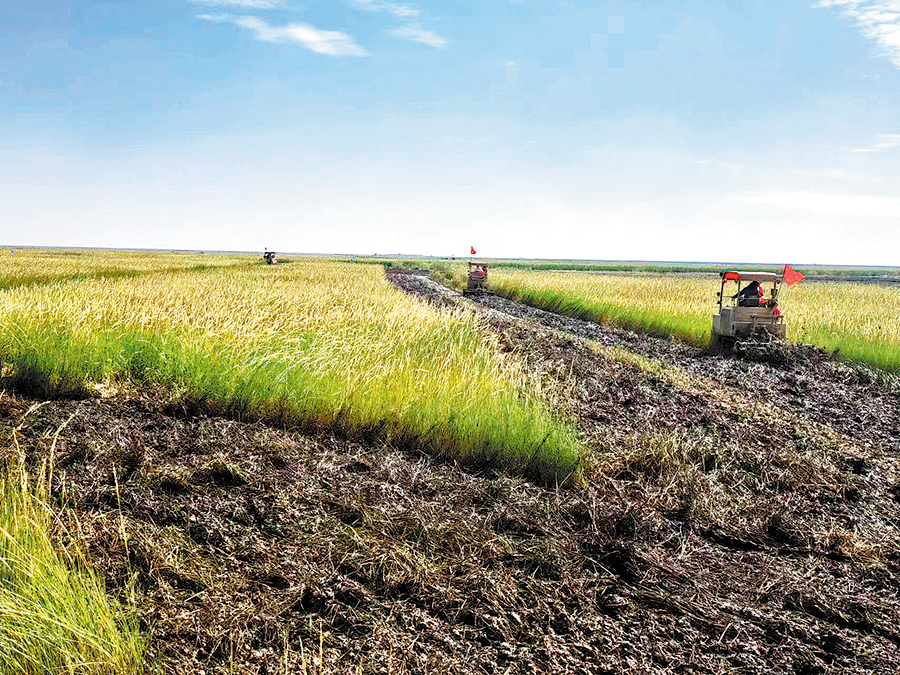
After four years of control, monitoring and maintenance efforts, a national nature reserve at the Yellow River estuary has cleared up the majority of an invasive species from the United States plaguing the area, in an effort to transform a "green desert" into a place where native plants can thrive.
"The entire coastal zone appeared to be lush and green, but it was actually a deceptive green desert where most of the native flora and benthic organisms had died. The soil smelled foul whenever roots were dug out," said Zhou Licheng, head of the planning and construction department in the Shandong Yellow River Delta National Nature Reserve in Dongying.
Zhou attributed the bleak scene to the invasion of smooth cordgrass, or Spartina alterniflora, a perennial herb native to the US Atlantic coast and a dominant plant in coastal intertidal wetlands due to its tolerance of fluctuating water depths and salinity.
Its strong vitality and reproductive capacity have also made it a feared invasive species in coastal areas.
In 2010, smooth cordgrass began to expand its coverage in the nature reserve at a speed of 20 percent per year, eventually reaching 8,733.3 hectares with a density of 200 to 500 plants per square meter. It can grow up to 2 meters above the ground, with roots extending to a depth of 1 meter, Zhou said.
The rampant expansion of the species not only encroached on the growing space of native plants, but also deprived animals of food resources and habitats, leading to significant damage to local biodiversity.
"Senior staff workers told me about the presence of swans in the nature reserve, but I have never seen them," said Zhao Yajie, deputy director of the ecological monitoring center in the nature reserve, adding that the roots of plants other than smooth cordgrass seemed to be withered.
Realizing the severity of the situation, the nature reserve has worked with the Chinese Academy of Sciences to explore control methods for smooth cordgrass since 2016, and these methods began being implemented in 2020.
Given the plant's adeptness at both sexual and asexual reproduction coupled with its robust survival traits, the nature reserve has implemented a comprehensive control strategy.
All above-ground vegetation is trimmed before seed maturation to prevent seed dispersal. Subsequently, the designated area is enclosed with a special film to capture and contain as much as 60 centimeters of seawater. The water is used to effectively eradicate the root system by forcing it to endure a high-salinity environment over a 90-day period.
In addition, continuous plowing has also proved to be effective after the roots are fragmented into 10-cm pieces and buried in cement, Zhou said.
Because of the muddy terrain, workers need to spend three to four hours using transportation modes such as boats, self-made all-terrain vehicles and excavators to reach the work site. Upon arrival, they often opt to extend their stay to maximize efficiency.
In addition, whenever there are stormy and windy conditions, workers must promptly evacuate to one of 50 safety platforms in the area, he recalled.
The restoration of native plants such as Suaeda salsa and seagrass beds has also been implemented in the area, which has contributed to biodiversity conservation and soil quality improvement, Zhou said.
Presently, more than 99 percent of smooth cordgrass has been removed from the reserve, leading to the return of some creatures that had been absent in the area for years, he said.
However, he emphasized that eradication has not been achieved. The nature reserve will continue real-time monitoring and regular maintenance and promote control efforts so that the area will not revert to a "green desert".
He added that the reserve's experience in controlling smooth cordgrass may provide a lesson for other coastal areas in China, which are also plagued by similar problems.





- Nobel winner speaks to youth in China: what makes a great research question?
- China's first reusable liquid rocket test offshore platform set for operation
- Chinese mainland reaches 2.29m high-value invention patents in IP quality pursuit
- Xi says China's high-quality development to provide more opportunities for cooperation with Brazil
- China Coast Guard rescues 13 Filipino sailors in the South China Sea
- Xi holds phone talks with Lula