



The selfish intervener
US' harmful approach to global trade is aimed at shaping a system that excludes China







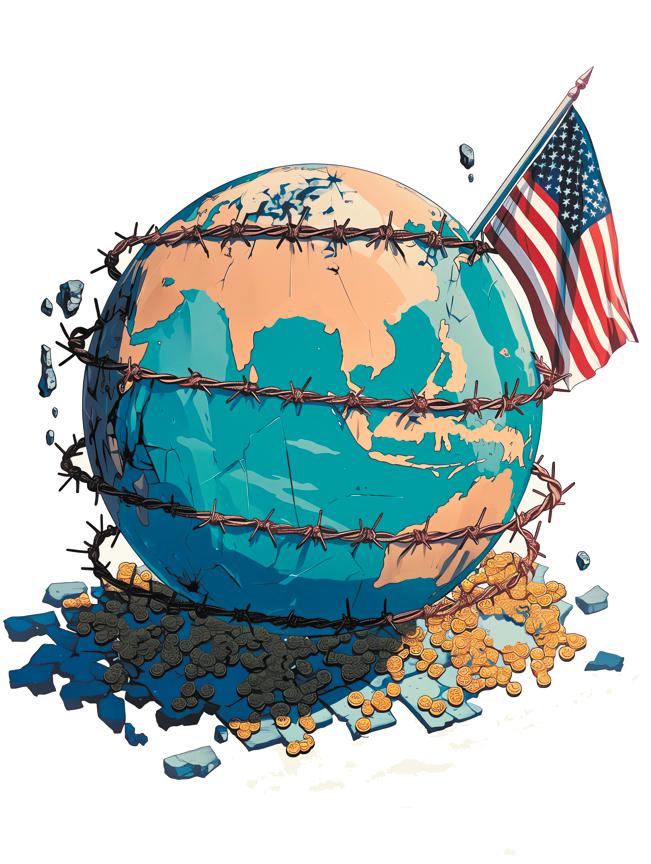
Step by step, the United States is shifting the way it cooperates with others in the economy and trade. It has set up a variety of new frameworks, including regional comprehensive agreements such as the "Indo-Pacific" Economic Framework for Prosperity, the US-EU Trade and Technology Council, and the Americas Partnership for Economic Prosperity; as well as alliances or agreements in specific key sectors, such as the Next G Alliance, the Semiconductors in America Coalition, and the Minerals Security Partnership.
In total, the US has spearheaded 37 agreements in high-tech, infrastructure investment, minerals, pharmaceuticals, and aerospace, involving 80 countries and regions. As more agreements have been signed, their characteristics and purposes have become increasingly clear.
In general, the US is striving to build groups that exclude China, from fostering allies in Europe, the Americas, and the "Indo-Pacific", to assembling the Quad comprising the US, Japan, India and Australia, and establishing regional exclusive agreements or cooperation frameworks such as the IPEF. In particular, the "Indo-Pacific" region has a central role in the US strategy toward China and the IPEF is specifically designed to exclude China.
There are three main approaches that the US is using to try to squeeze China out of the global system. This includes reshaping regional supply and industry chains, especially in the chip and semiconductor sector; conducting multiple rounds of negotiations in digital trade and the digital economy, in order to lead the formulation of digital economy rules in the "Indo-Pacific" region; doubling down on infrastructure investment in the "Indo-Pacific" region and encouraging nongovernmental forces to collectively resist the Belt and Road Initiative, so as to construct a strategic coalition against China.
However, the US' way of international economic and trade cooperation is unlikely to achieve its intended goals. With limited benefits being offered, if any, some countries are reluctant to take sides. While the US model aims to compete for relative benefits, other countries' policies are based on a different set of principles and goals: They seek absolute gains and call for economic cooperation through market access and other commonly used approaches.
Moreover, without market access and tariff negotiations, it is difficult to assess the benefits of the new US model compared to traditional free trade agreements. Its direct impact is certainly less significant due to the lack of tariff reductions. It is also foreseeable that, in the short term, these agreements will generate much less trade creation than trade diversion, because trade and value chains have been transferred unnaturally as a result of government intervention in the business decision-making process, which will inevitably distort the market.
The US' changes in international economic and trade cooperation will also have a negative impact on the global economic and trade system and rules.
Globally, this new US model will exacerbate the division of the international system into blocs. Unlike a multilateral arrangement for a globalized world, the US model is based on selective minilateralism, covers a small group of countries, and is aimed at reshaping the global trade system and rules centered on the World Trade Organization. Highly targeted and exclusive, the model selects partners mainly from the European Union, the Americas, and the Asia-Pacific region, with the overt aim of marginalizing China.
In the Asia-Pacific region, the Association of Southeast Asian Nations and India are rising in the economic and trade system, and cooperation in the region continues to fragment. Since the Asian financial crisis in 1997, countries in the Asia-Pacific region have actively promoted regional economic cooperation, eventually forming the Regional Comprehensive Economic Partnership. On top of that, there are a lot of other trade pacts in the region, including the IPEF, which is in the negotiation process, the effective Comprehensive and Progressive Agreement for Trans-Pacific Partnership led by Japan, as well as numerous bilateral free trade agreements and subregional cooperation. With a "spaghetti bowl" of cooperation frameworks that are hard to integrate, the Asia-Pacific region can expect more challenges in economic integration with more fragmented economic and trade cooperation patterns.
With this all-around transformation of the international economic and trade cooperation model underway, the US, once a powerhouse of economic globalization since the end of the Cold War, has abandoned its principle of advancing global trade integration by reducing tariff and lifting non-tariff barriers. Instead, it has adopted other flexible framework agreements, with the aim of establishing a set of international economic and trade rules designed to ensure the security of its own supply chains and contain the development of countries such as China.
Looking ahead, the US may eventually succeed in shaping a "secure" international economic and trade system in certain key areas where it has dominant influence. Given the size of the US and its allies, this new model will impact not only the trade benefits of other countries, but also the existing international economic and trade system and rules.
Meanwhile, global industry chains and China's participation in them may also fall under the influence of the change, shaking China's high-tech industries and lower-end manufacturing, as well as the bilateral economic and trade ties between China and the US as a whole.
Su Qingyi is a senior fellow of the Institute of World Economics and Politics at the Chinese Academy of Social Sciences and director of the Department of International Trade at the CASS. Gui Zihao is a graduate student of the School of International Politics and Economics at University of Chinese Academy of Social Sciences. The authors contributed this article to China Watch, a think tank powered by China Daily. The views do not necessarily reflect those of China Daily.
Contact the editor at editor@chinawatch.cn.





