



An ongoing endeavor







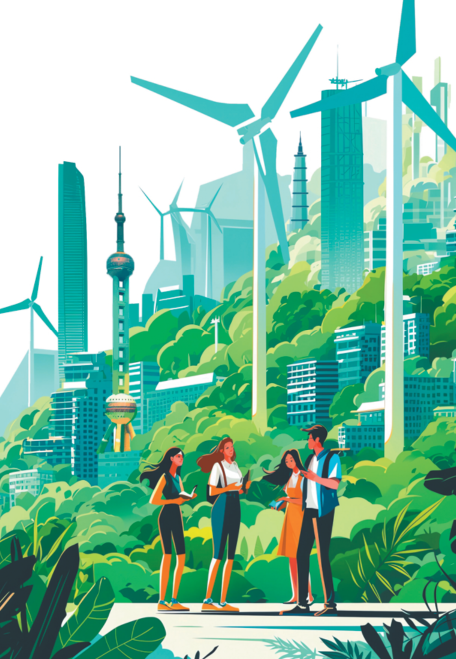
China will continue to cooperate under the South-South Cooperation framework for global implementation of the UN 2030 Agenda
The United Nations 2030 Agenda remains an ambitious and uniting framework for global sustainable development. Yet, none of the 17 Sustainable Development Goals are on track to be achieved by 2030, and only an estimated 16 percent of the SDG targets are progressing, according to the 9th edition of the Sustainable Development Report released on June 18,2024, by the UN Sustainable Development Solutions Network.
Global sustainable development is at a crossroads. The world faces great global challenges, including rising poverty and hunger, dire ecological crises, widening inequalities, disruptive technologies, worsening conflicts and deglobalization, to name just a few.
Since its adoption in 2015, China has attached great importance to the implementation of the 2030 Agenda and has been pursuing development in line with the economic, social and environmental goals of the agenda. The following are some of the highlights.
China has placed development front and center. Its macroeconomic fundamentals have remained stable, and the Chinese economy has proved to be highly resilient. From 2015 to 2023, China's economy grew at an average annual rate of 5.8 percent, contributing more than 30 percent to global economic growth. The leading role of technological innovation has been enhanced. China ranks 12th among the 132 economies featured in the Global Innovation Index released by the World Intellectual Property Organization in 2023.
China has adhered to the people-centered development philosophy. It has achieved poverty reduction, and the maternal and child health targets of the 2030 Agenda ahead of schedule. The income level of the poor has increased significantly, the level of protection in such areas as education, medical care and housing has been remarkably improved, so has infrastructure in roads, electricity and the internet. The net enrollment rate in primary schools and the gross enrollment rate in junior high schools reached almost 100 percent.
China has followed green and low carbon development. It continues to control pollution and has launched three campaigns against air, water and soil pollution. The air quality in cities at and above the prefecture level continues to improve, making China the country with the fastest improvement of atmospheric environmental quality in the world. The energy consumption per 10,000 yuan ($1,377) of GDP fell by 15.5 percent compared with 2015, the fastest decrease in energy intensity in the world. China also plays a vital role in global renewables manufacturing. Solar batteries, lithium-ion batteries and electric vehicles have replaced apparel, home appliances and furniture to become the new "three major ones" underpinning China's exports.
China, as the largest developing country, is also committed to global development cooperation and the global implementation of the 2030 Agenda. The Belt and Road Initiative and the Global Development Initiative are both aimed at accelerating the implementation of the 2030 Agenda. The BRI has stimulated investments worth nearly $1 trillion, launched more than 3,000 cooperation projects, created 420,000 jobs for participating countries, and lifted nearly 40 million people out of poverty. The GDI Group of Friends now has more than 80 members, and its project pool has more than 200 projects. The Center for International Knowledge on Development has also launched the Global Development Report and the Global Knowledge Network for Development to serve as platforms for promoting knowledge and experience sharing among the Global South countries.
The 2030 Agenda has a bearing on the building of a community with a shared future and has passed the halfway point. All countries should deliver on their responsibility to make as much progress as possible on all SDGs up to 2030. Some of the Chinese practices are worth further consideration in translating the concepts of the 2030 Agenda into actions.
First, incorporating systems thinking about SDGs and the national decision-making and policymaking process can boost progress on the 2030 Agenda. The SDGs are indivisible, meaning progress on all 17 goals is necessary for building a sustainable future. Because many of the goals are interlinked, one or a handful of goals may have the capacity to "push progress" and make development more sustainable across many or even all the goals. The interplay between the goals matters. Systems thinking can help set priorities for actions on the SDGs by showing interactions, both synergies and trade-offs between the goals. For instance, China has striven to maintain a balance between development and protection, between overall and local interests, and between the present and the future. The country has worked to coordinate industrial restructuring, pollution control, eco-environmental conservation and climate response. It has endeavored to cut carbon emissions, reduce pollution, expand green development and pursue economic growth.
Second, China has adopted a holistic approach, by implementing integrated development strategies, cross-sector coordination, whole-of-society participation, as well as pilots of innovative solutions. For instance, the 2030 Agenda is integrated in the country's 13th (2015-20) and 14th Five-Year (2021-25) plans. China has established an inter-agency coordination mechanism involving 45 government departments. The 17 goals and 169 targets were divided and assigned to different departments according to their administrative responsibilities. The Progress Report on Implementation of the 2030 Agenda for Sustainable Development, which the Center for International Knowledge on Development releases every two years, is itself an outcome of inter-agency coordination and participation, demonstrating the importance and effectiveness of an implementation mechanism.
Third, innovative local solutions based on local conditions should also be encouraged. China has adopted the National Innovation Demonstration Zone for Sustainable Development since December 2016. Shenzhen in Guangdong province is the most dynamic metropolis. Taiyuan, Shanxi province, is a resource dependent city seeking transformation. And Guilin in Guangxi Zhuang autonomous region is known for its natural scenery. These cities were the first three to explore sustainable development-tailored development paths. For example, Taiyuan, where coal is the backbone of the economy, has been focusing on air and water pollution solutions and the circular economy since being chosen as a national pilot for resource-based cities. So, China has approved 11 cities as pilots to form a series of replicable innovative demonstration models.
Sustainable development is an ongoing endeavor. China is still confronted with an uphill battle for development in the shift of growth drivers as well as structural adjustment and upgrading. China is determined to keep pushing development forward in a more efficient, equitable and sustainable way. Sustainable development is also a joint human endeavor. China will continue to actively participate in international development cooperation under the South-South Cooperation framework and make more contributions to the global implementation of the 2030 Agenda.
The author is vice-president of the Center for International Knowledge on Development. The author contributed this article to China Watch, a think tank powered by China Daily.
The views don't necessarily reflect those of China Daily.
Contact the editor at editor@chinawatch.cn.





