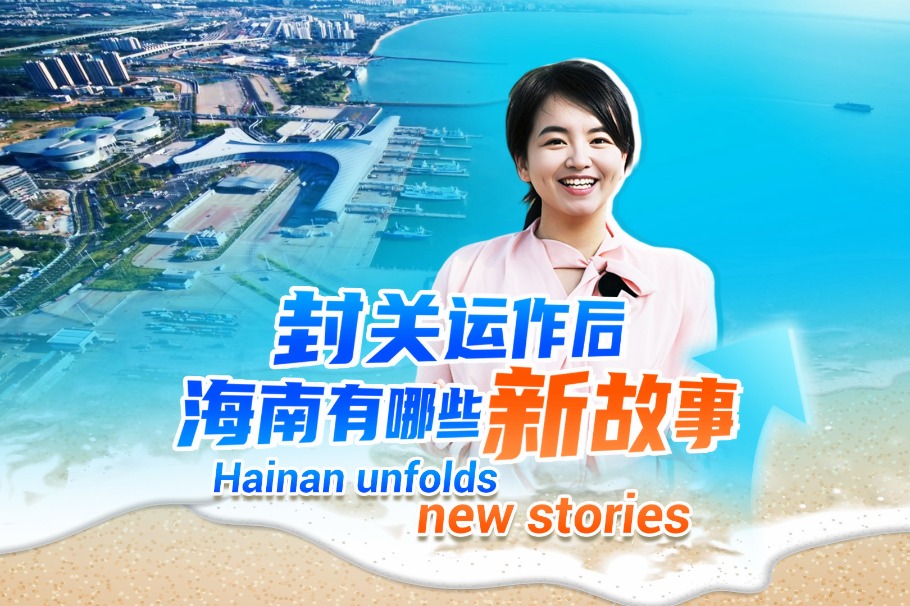
FTZs help foreign firms thrive
FTZ: Innovation holds key to facilitating better trade, investment environment







In 2018, Zeeshan Qasim Khan, a Pakistani student who had just graduated from Hainan Medical University, was planning to start an international trade venture in Guangdong province, China's leading economic powerhouse.
Khan's initial plans, which focused on importing Pakistani rice, carpets and handicrafts to China, and exporting Chinese electronics, medical equipment and marbles to global markets, changed course following a pivotal announcement by President Xi Jinping.
During the celebration of the 30th anniversary of the founding of Hainan province and the Hainan Special Economic Zone in April 2018, Xi unveiled ambitious plans to transform the entire island into a pilot free trade zone and eventually establish a free trade port with unique Chinese characteristics.
This announcement convinced Khan that he should remain in Hainan and capitalize on the emerging opportunities.
Six years later, the decision was fully vindicated, Khan said, highlighting the preferential corporate and individual income tax policies as primary advantages of the Hainan Free Trade Port.
"The tax benefits are substantial, and we get more benefits in our businesses," Khan noted, referring to the 15 percent corporate income tax rate for enterprises in encouraged industries within the FTP, which is significantly lower than the usual 20 percent to 25 percent.
Khan's company, located in the Haikou Fullsing Internet Industrial Park, is among the numerous foreign businesses that have benefited from China's growing openness to the global market and from sound supply and industrial chains, as the nation develops a network of free trade zones.
In September 2013, China launched its first FTZ in Shanghai, marking a significant milestone in the country's reform and opening-up.
The Shanghai FTZ introduced the first negative list for foreign investment, which was a radical departure from the previous method of listing sectors where foreign investment was encouraged. A negative list indicates the areas in which investment is prohibited or restricted; all other areas are presumed to be open.
President Xi, who has been at the helm of these reforms, emphasized the importance of FTZs in driving the nation's economic agenda.
"On this new journey, we must build higher-level free trade zones based on a comprehensive summary of the past decade's experience," he said in an instruction in September, urging continued innovation and exploration in broader and deeper areas.
During the annual session of the National People's Congress, the nation's top legislature, in 2014, Xi stressed the need for FTZs to align with international investment and trade rules, enhance the institutional system and regulatory model, and balance market-driven resource allocation with effective government intervention.
He called for boldness and innovation, aiming to develop replicable and scalable new systems to facilitate investment and trade, ensure efficient regulation and establish a standardized legal environment.
China has so far established 22 FTZs, which contributed to about 18.4 percent of the nation's total import and export volume in 2023. The Hainan Free Trade Port has introduced over 120 innovative policies to date.
Some analysts underlined Xi's vision for the FTZs, which served as a springboard for bold experimentation and systemic reform.
Gu Xueming, president of the Chinese Academy of International Trade and Economic Cooperation, wrote in a co-authored report in November, "The achievements of the past decade in the pilot FTZs prove that these zones have become pioneering forces of high-level openness, trailblazers of deep-seated reforms, models of high-quality development, and important platforms for serving national strategies."
He explained that the FTZs in China have come up with pioneering initiatives making them bold leaders in the country's reform and opening-up, including the implementation of negative lists for market entry and cross-border trade in services.
The FTZs were also home to China's first wholly foreign-owned public fund management company and its first wholly foreign-owned automobile manufacturing enterprise.
In the realm of deepening reforms, China's FTZs have consistently embraced bold experimentation and innovation, achieving significant breakthroughs in trade, investment, finance and government functions, he said.
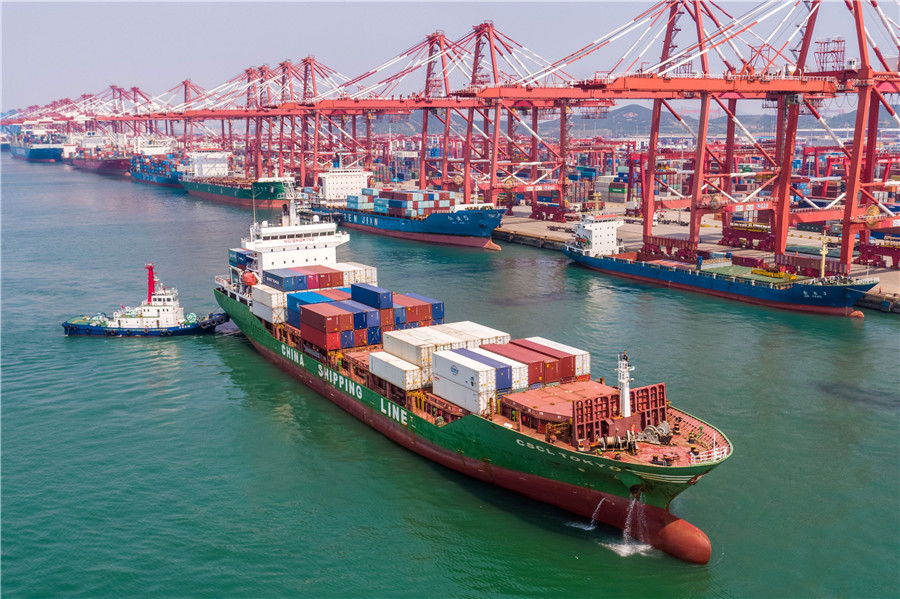
In Shandong province, the establishment of an FTZ has significantly spurred the inflow of foreign investment and boosted efforts to improve the business environment.
Cui Linxian, an executive with SITC International Holdings Co, a Hong Kong-based shipping logistics company, highlighted the alignment of the zone's innovative spirit with the company's entrepreneurial ethos.
The robust port infrastructure in Qingdao, the second-largest foreign trade port in China, provides an ideal environment for business growth, he said.
He added that the Shandong FTZ aims to establish a world-class business environment, which has underpinned the company's efforts to enhance its core competitive edge.
"The authorities in the FTZ have continually simplified procedures and improved efficiency, adhering to a proactive service approach that shortens the path for enterprises to conduct their business," Cui said.
"By focusing on the needs of businesses as both the starting point and ultimate goal, multiple departments have collaborated to promote the integration of services into a unified one-stop."
Khan, the Pakistani national, also praised the introduction of favorable policies and one-stop services designed to attract and support foreigners living and working in Hainan, particularly those eager to engage in business activities despite language barriers.
"These measures simplify crucial processes such as work permits, visas and residency requirements, enhancing overall convenience and efficiency," he added.
Khan said he believes that, as one of the world's largest free trade ports, the Hainan FTP will attract more young talent to the island province, promoting local economic and trade development.
He has shared information about the preferential policies and vast opportunities in the Hainan FTP with friends in Pakistan and other countries, many of whom are considering relocating to Hainan to work and invest.
Wang Ying, a researcher at the Beijing-based University of International Business and Economics' Academy of China Open Economy Studies, underscored the importance of the FTZ strategy in China's high-level opening-up agenda going forward.
Xi, also general secretary of the Communist Party of China Central Committee, said in his report to the 20th National Congress of the CPC in October 2022 that the nation will work faster to develop the Hainan Free Trade Port, upgrade pilot FTZs, and expand the globally-oriented network of high-standard free trade areas.
Wang said the nation's FTZs will take on an even greater historical mission by coordinating deep reforms and high-level openness. "The focus of FTZs should be on exploring deeper and broader reforms in key areas such as trade, investment, finance and cross-border data flows," she said.
By expanding the scope and depth of pioneering reforms, the FTZs will enrich the application of free trade policies and amplify their benefits, Wang added.
By advancing institutional openness through rules, regulations, management and standards, FTZs will serve as comprehensive experimental platforms for reform and opening-up, which will support China's accession to high-standard international trade agreements such as the Comprehensive and Progressive Agreement for Trans-Pacific Partnership, she added.