


Where art meets motion, there's a science to success
Newtonian principles are as integral to breaking as pulsating hip-hop music







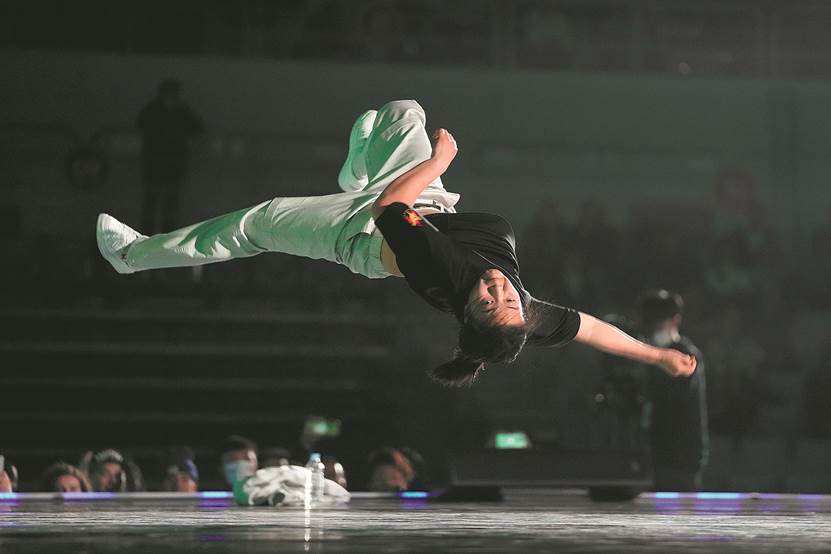
Two athletes square off for an intense dance battle. The DJ starts spinning tunes, and the athletes begin twisting, twirling and seemingly defying gravity, respectfully watching on and taking turns to try and one-up each other.
The athletes converse through their movements, speaking through a dance that celebrates both athleticism and creativity. While the athletes probably aren't consciously thinking about the physics behind their movements, these complex and mesmerizing dances demonstrate a variety of different scientific principles.
Breaking, also known as break-dancing, originated in the late 1970s in the New York City borough of the Bronx. Debuting as an Olympic sport at the 2024 Summer Olympics, breaking will showcase its dynamism on a global stage. This urban dance style combines hip-hop culture, acrobatics and expressive footwork.
Since its inception, breaking has evolved into a competitive art form. An MC narrates the movements, while a DJ mixes music with a pulsating beat and heavy bass. The Olympics will feature two events: one for men, who are called B-boys, and one for women, called B-girls. In these events, athletes will compete in one-on-one dance battles.
Athletes earn points for creativity, personality, technique, variety, performance and musicality. Success in this sport requires combining dance moves from three basic categories: top rock, down rock and freeze.
Standing moves
Top rock moves are performed while standing up, focusing on fancy footwork and hand movements. These movements are reminiscent of hip-hop dancing.
Top rock moves rely on having lots of friction between an athlete's shoes and the floor.
This friction allows the athlete to take very quick steps and to stop abruptly. The dancers must intuitively understand inertia, or the fact that their bodies will continue in the direction they're moving unless they are acted upon by an external force. To stop abruptly, athletes need to engage their muscles, getting their shoes to grip the ground to stop themselves from continuing forward.
Floor moves
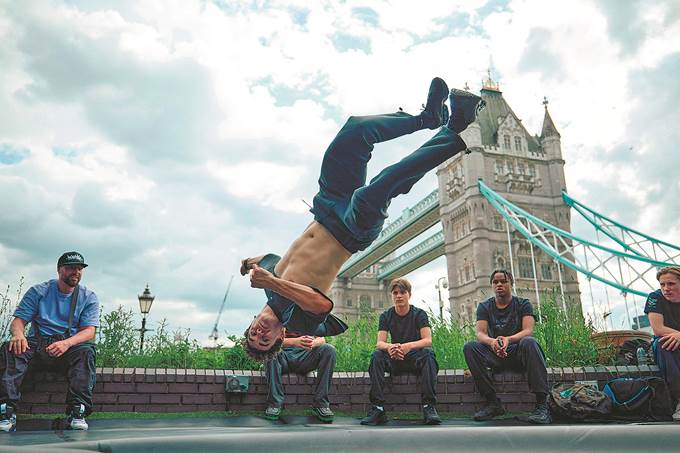
Down rock moves are performed while on the floor. Athletes may spin in circles with their head, back, elbows or shoulders touching the ground and their feet in the air. B-boys and B-girls rely heavily on an internal knowledge of physics to complete these moves.
Consider the physics of a backspin. A backspin occurs when the athletes are on their back with their feet lifted in the air, rotating around a specific area of their back.
Sitting on the floor, the athlete's left foot stays in contact with the ground while they spread their right leg wide, gathering linear momentum as they sweep their right leg toward their left foot in a wide arc. Then, they release their left leg from contact with the ground and roll onto their back.
Now that only their back is in contact with the ground, the linear momentum from their leg turns into angular momentum, which rotates the athlete around an axis that extends upward from their back's contact point with the ground. This move turns magical when they bring their legs and arms inward, toward the axis of rotation. This principal is called conservation of angular momentum.
When an athlete brings their mass in more closely to the axis of rotation, the athlete's rotations speed up. Extending their legs and arms once again, and moving their mass away from the axis of rotation, will cause the competitor to slow their rotation speed. Once they slow down, they can transition to another move.
Stopping in a pose
Freeze occurs when athletes come to a stop and pose, often occurring in time to the music and in an upside-down position. To freeze effectively, the athlete must have full control over their center of mass, placing it right above the point of their body that is in contact with the floor. The center of mass is the average position of all the parts of an athlete, weighted according to their mass. The "balance point", where the entire mass of the athlete seems to be concentrated, is the center of mass.
Athletes are most stable when their center of mass is as close to the ground as possible. You will see many competitors freeze with arms bent in an effort to lower their center of mass. This reduces their distance from the floor and minimizes the tendency of their body to rock to one side or the other due to torque.
Torque is a twisting force, like the force used to turn a wrench. The torque depends on two things: the amount of force you apply, and how far from the pivot point you apply the force. With an athlete's center of mass closer to the ground, the athlete decreases the distance between the pivot point — the ground — and where the force of gravity is applied — the athlete's center of mass.
Athletes need great strength to halt their motion mid-movement because they have to apply a force to resist the change in inertia.
Finding the right outfit
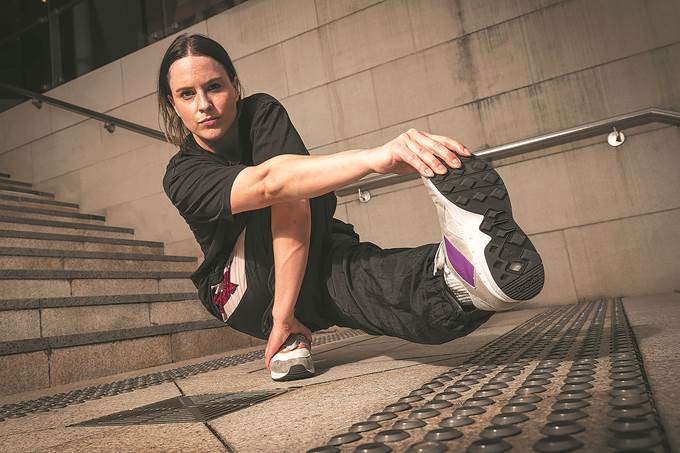
Many sports require a specific uniform. Breaking doesn't — an athlete can wear whatever they want — but the right outfit will maximize their chance of success.
The athlete wants a shirt that minimizes the friction between their body and the ground during a spin. Lettering or images on the back of the shirt will add friction, which hinders an athlete's ability to perform some down rock moves. An athlete may choose to wear long sleeves if they plan to slide on their elbows, as bare skin in contact with the floor also provides friction.
Athletes also have to think about the headgear they wear. While there are many different styles of hats made specifically for breaking, the athlete gets to choose whichever fits their dancing style best. They need to make sure that their hat provides some padding for their head while minimizing the friction between their head and the floor.
The back, elbow and head are axes of rotation during down rock moves, so the athlete wants gear that minimizes friction at all these places, but they also need to make sure their shoes have grip to maximize friction while they're doing top rock footwork. Athletes also want to make sure their hands aren't sweaty or slick, so they can use friction from their hands to control how fast they're rotating during down rock spins.
By the time the beat drops and the stage lights up in Paris, each competitor will have spent years experimenting with their own unique formula for success and composing their own perfect equation of motion, aesthetics and skill. Equally, they will all be hoping, like the alchemists of old, that they can turn "bass" materials into gold.
AGENCIES VIA XINHUA


Most Popular
- Nation's Winter Paralympics squad is its biggest ever
- China to send 70 athletes to Milan-Cortina Paralympic Winter Games
- China announces largest-ever delegation for 2026 Winter Paralympics in Italy
- Chinese men's basketball team beats Japan
- Grassroots soccer hits fever pitch in 'wild stadium'
- Team China excels on and off the field at 2026 Games