



Shared conundrum







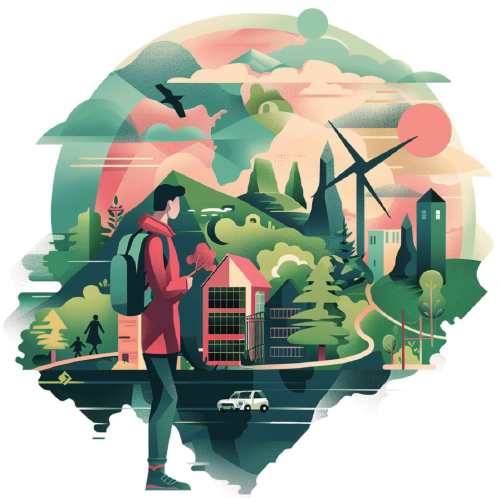
China and the Gulf states are pursuing a just energy transition without compromising their human development agendas
In the face of escalating climate challenges and the pressing need for sustainable development, the partnership between China and the Middle East — and in particular the Gulf Cooperation Council countries — offers a beacon of hope and progress. By leveraging the pragmatism of key Gulf powerhouses, such as the United Arab Emirates, and China's formidable political will and scale, these regions can drive forward the global human development agenda while accelerating a just and equitable energy transition. This synergistic relationship is not only strategic but essential for fostering a sustainable future that leaves no one behind.
All economies are dependent on energy. The Gulf is one of the main sources of oil for China. Indeed, energy is the bedrock for Sino-Arab economic cooperation, forging a solid foundation over the past two decades that is only strengthening. Trade between China and the Gulf states nearly doubled in the five-year period to 2022, reaching more than $500 billion. In 2020, China replaced the European Union as the Gulf Cooperation Council's largest trading partner.
At the same time, both sides are committed to fighting climate change. China leads the global renewables market. The nation was expected to install a record 230 gigawatts of wind and solar power last year, more than double the number of installations in the United States and Europe combined, and it dominates the clean energy supply chain, as it seeks to peak carbon dioxide emissions before 2030 and achieve carbon neutrality before 2060. Gulf nations, experiencing temperatures of 50 C, rising sea levels and coastal degradation, have been preparing for the post-oil era for the past two decades. Led by the United Arab Emirates, the Gulf states are proud to have spearheaded some of the world's largest solar-energy projects, to have the potential to become a world-class carbon capture hub due to the abundance of industries, and to be developing a large-scale green hydrogen industry.
This alignment of market dynamics in China and the Gulf Region, combined with bold national visions to achieve net zero emissions, gives us a shared experience, and a shared conundrum. We are countries in the midst of building our economies and opportunities for our thriving societies. We are pursuing a just energy transition that embraces a greener evolution of our energy systems without compromising our human development agendas. We see both as two sides of the same coin, with the edge of this coin conducive energy policies to drive sustainable progress for all.
Our collective experiences lay bare the interconnectedness of the challenges the world faces: decarbonizing the global atmosphere through massive emissions reductions, while ensuring equitable growth opportunities for the billions of people who are yet to be afforded them. Together, we can meet this challenge and unlock immense opportunities.
The omnipresent nature of climate change and the interconnectedness of global goals demand a holistic and coordinated response. The convening capabilities of Gulf nations, combined with the political willpower and unmatched scale of China, can bring nations together and advance a just transition.
The UAE's success in leading COP28, which culminated in a landmark agreement called the UAE Consensus, has proved three things. First, the UAE is a globally trusted and visionary actor that can unite nations to act and deliver for the betterment of humanity and our habitat. Second, the fight against climate change must be inclusive and acknowledge the interconnectedness of global goals if it is to be successful. And finally, the ability to foster dialogue and collaboration is critical in driving the human development agenda and ensuring that sustainable development goals are met. To that end, the inaugural COP28 Business and Philanthropy Forum saw more than 1,300 CEOs and foundation heads from over 80 countries convene to accelerate progress around net zero goals, including $7 billion in new climate action commitments.
China, for its part, is making its presence felt in every corner of the world. Its successful trade and investment policies — which include major investments in sustainable energy projects — have solidified its role as a global powerhouse with ambitious goals to connect the world and the capacity to act on them.
More than bilateral cooperation, the partnership between the Gulf Region and China is both a model for and a driver of global progress, fostering sustainable development, providing unique blueprints for successful economic diversification and innovation, and promoting regional stability and peace, through economic interdependence and collaborative development projects.
By leveraging our combined strengths, we can jointly play a pivotal role in advancing the global agenda. Together, we can foster a sustainable future, not only for our own regions but also for the entire world.
The author is the CEO of United Arab Emirates-based Crescent Enterprises, a diversified business operating across nine industry sectors in 15 countries, including in energy. He is also the UAE's special envoy for business and philanthropy and the COP28 special representative for business and philanthropy. The author contributed this article to China Watch, a think tank powered by China Daily.
The views do not necessarily reflect those of China Daily.
Contact the editor at editor@chinawatch.cn.





