Biden's remarks on China flout basic facts








When US President Joe Biden suggested recently that China's economy is on the brink, he appeared to overlook the fact that his previous "ticking-time-bomb" characterization from August last year had fizzled, given the persistent improvement in the world's second-largest economy.
In a recent interview with the TIME magazine, the US president conveyed his opinions on China in a sarcastic tone. He accused China of xenophobia and disparaged the Belt and Road Initiative (BRI).
All of these negative remarks blatantly disregard basic facts and serve as rhetoric aimed at belittling others to elevate oneself and garnering support from the voters.
Last year, China achieved an annual economic growth rate of 5.2 percent, surpassing other major economies. In the first quarter of this year, the Chinese economy grew by 5.3 percent year on year, contrasting sharply with the US annual rate of 1.3 percent during the same period. In late May, the International Monetary Fund raised its projection for China's 2024 growth from 4.6 percent to 5 percent. With China advancing new quality productive forces and planning major reform measures, more vitality will be unleashed to sustain the economy's high-quality growth. So, where is this supposed brink?
Xenophobia should not be used to describe contemporary China. The country's economic success can be attributed in part to its opening-up policy over the past decades. China remains committed to broadening its global engagement, aiming for mutual development by reducing restrictions on international firms, fostering a law-based international business environment, and encouraging domestic companies to expand overseas.
China's actions align with its words. It continues to enhance high-level openness in industry and information technology, introducing measures to eliminate restrictions on foreign investment access in the manufacturing sector and piloting initiatives to further open up in value-added telecommunications services. In the January-March period, China granted over 1.98 million foreign travelers visa-free entry, up 266.1 percent year on year.
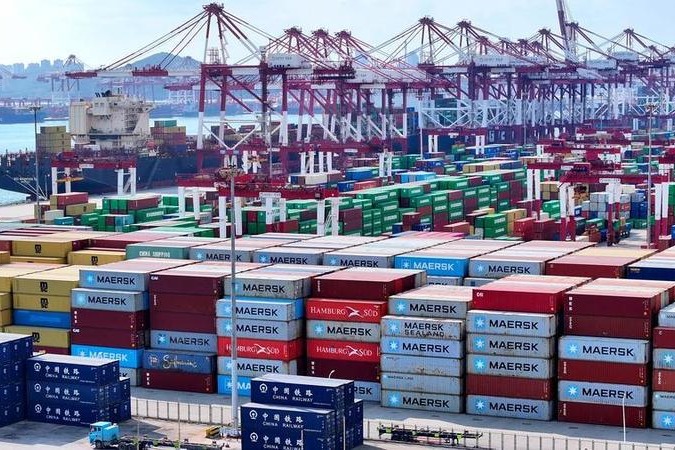
In the first four months, the tally of newly established foreign-funded companies surged by 19.2 percent year on year to reach 16,805. In late May, Tesla commenced construction on a large-scale factory in Shanghai aimed at producing its energy-storage batteries, known as Megapacks, a development lauded by the company as a significant "milestone."
In light of such trends, the question arises: If the Chinese are indeed xenophobic, how can one account for the notable growth in foreign investors and travelers flocking to China?
As a matter of fact, it is the United States, not China, that is witnessing a surge in xenophobic sentiment. Issues deeply entrenched in exclusion and discrimination against immigrants, coupled with recent substantial tariff increases on imports of Chinese goods spanning from electric vehicles to medical equipment, serve as a testament to the escalating xenophobia, protectionism and isolationism within the United States.
In his remarks on Belt and Road cooperation, Biden dismissed it as a "nuisance graveyard initiative." The BRI, pioneered by China, has spurred the development of ports, railways and industrial parks across partner nations, catalyzing substantial enhancements in local infrastructure and the generation of hundreds of thousands of employment opportunities. Through a plethora of flagship projects and meticulously designed people-centric programs, the initiative ushers in convenience and vitality on a global scale.
The overwhelming participation of over 150 partner countries underscores the initiative's resonance and acclaim as a global public good. Amid this widespread acclaim, one may wonder: Where does the notion of "nuisance" emerge?
What the US president said exposes the true mindset of the United States. It is perhaps really a nuisance to the United States in the sense that it has facilitated the independent development of other nations, thereby potentially impacting traditional US interests. In essence, the BRI boosts the ascendance of countries in the Global South, a development that the United States appears apprehensive about confronting.
Actually, the reason for the president's intentional denigration of the BRI might be found in a congressional testimony by Daniel F. Runde, a senior vice president at the Washington-based Center for Strategic and International Studies, on May 16. Admitting that the BRI is an ambitious and hopeful project that speaks to the aspirations of partner countries, Runde said the United States needs an alternative positive narrative as the BRI threatens to constrain "America's ability to project power."
Employing the "China card" has become a common tactic for US politicians seeking to garner votes during election cycles or divert attention from domestic issues. However, distorting facts to mislead the public and tarnish the reputation of others in international affairs is highly irresponsible, unethical and detrimental. In particular, such behavior is unbecoming of a major global power.