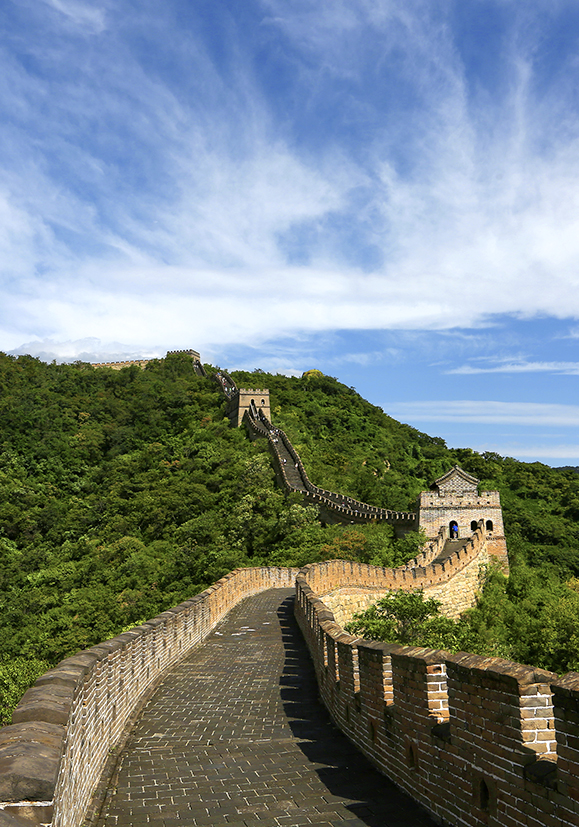
The Mutianyu Great Wall, renowned for “being uniquely outstanding among the vast Great Wall”, is located in Mutianyu village, Bohai town, Huairou district of Beijing. It is 73 kilometers away from downtown Beijing. The Mutianyu Great Wall stretches for 5,400 meters, making it the longest section of the Great Wall and one of the Sixteen Scenic Spots of Beijing. In 1368, the first year of the Hongwu reign during the Ming Dynasty (1368-1644), the Mutianyu Great Wall was built on the ruins of the Great Wall of Northern Qi Dynasty (550-557) under the supervision of General Xu Da.
The Mutianyu section is the essence of the Ming Dynasty Great Wall. It connects Gubeikou Great Wall in the east and the Juyong Pass in the west, serving as an important military fortress that safeguards the capital since ancient times. Scenic spots in Mutianyu include the Zhengguan Pass, Da Jiaolou (No 1 Watchtower) and "Ying Fei Dao Yang" (Eagle Flying Upside Down). The structure of the Mutianyu section remains intact, well reflecting the ancient charm of the Great Wall, which thus holds a high historical and cultural value.
In 1987, the Mutianyu Great Wall was listed as a UNESCO World Cultural Heritage site. In 2000, the government of Huairou district decided to transform the Mutianyu Great Wall into a scenic spot. On May 25, 2006, the Great Wall, including the Mutianyu section, was designated by China’s State Council as part of the 6th batch of national key cultural relic protection units. In 2011, the Mutianyu Great Wall was rated as a 5A tourist attraction by the National Tourism Administration.
Dajiaolou (No 1 Watchtower)
Dajiaolou is located at the highest point on the east side of Mutianyu Pass. Also called No 1 Watchtower, it is now one of the famous landscapes of the Mutianyu Great Wall. In ancient times, Dajiaolou is the boundary between Jizhen Great Wall and Changzhen Great Wall. The east side was under the administration of Jizhen town, while the west side was administered by Changzhen town. Dajiaolou is also a relatively large watchtower of the Mutianyu Great Wall. Located at the highest point in the east, it holds significant militarily importance. To the west, it guards the Mutianyu Pass, providing clear visibility of internal and external situations, while to the east, it guards the Qilian Pass, serving as the only passage for advancement or retreat. Dajiaolou can be divided into upper and lower levels with the lower level being called “jinxing” (splendid path). A pavilion was once built on the passage, which was conducive to combat and served as a lookout. Three sides of Dajiaolou link to the Great Wall. The west side connects to the mountains of Badaling, the east side connects to Gubeikou, and the south side extends to the inward branch walls. Because from any angle along the Great Wall, it resembles a city corner, it is called Dajiaolou.
Zhengguan Pass
The Mutianyu Pass is also known as Zhengguan Pass, or Three Watchtowers. Built in 1404, the second year of the Yongle reign of the Ming Dynasty, Zhengguan Pass consists of three hollow watchtowers. The pass is strategically important. On one side lies the residence of the Xiongnu (a nomadic ethnic group to the north), on another side is the passage leading to the capital, and on yet another side is a shortcut to the imperial mausoleum. Mutianyu Pass is 40 meters long, 30 meters wide and 20 meters high, consisting of upper and lower levels. The lower level is interconnected with multiple rooms, suitable for storing provisions and stationing troops. Looking from the battlement, the view of both inside and outside the Great Wall is vast.
Judging by the scale of each hollow watchtower, the Zhenguan Pass is the most magnificent among the 22 hollow watchtowers on the Mutianyu Great Wall. Built at the lowest pass on the ridge line at an altitude of 486 meters, it controls the transport routes between the valleys in the north, the wide Huaisha River Valley in the south and the Huairou basin, making it strategically important. From Zhengguan Pass, the Great Wall ascends along the mountain ridge from east to west. Dajiaolou, located on the neighboring peak in the east, is within a few hundred meters at an altitude of 603 meters, over 100 meters taller than Zhengguan Pass. Dajiaolou consists of a central main tower and two annex buildings, forming a complex that can accommodate up to a hundred people. The dimensions of the main platform of Zhenguan Pass are 37.76 meters in length from north to south, 15.1 meters in width from east to west, and with a height of 14.15 meters (including the battlement).
Zhengguan Pass is a hollow structure, with a total of nine rooms on the top of the building. Among them, three buildings on the top of the left ear tower still retain the original “kang” bed structure (traditional bed-stove), indicating that these rooms were likely accommodations for guarding generals. A stone plaque with the words “Zhengguan Pass” is located on the wall of the south side of the Great Wall.
Additionally, there are two granite stone steps built on both sides of Zhengguan Pass, allowing border soldiers to ascend and descend the Great Wall. The gate of Zhengguan Pass is not located in the center of the tower, but is a rolling door set on the east side of the tower. Stairs are constructed along the steep slope to serve as a passage connecting the inside and outside. Such hollow watchtowers, unified as a complex, are rare along the Great Wall.
The Jiankou Great Wall
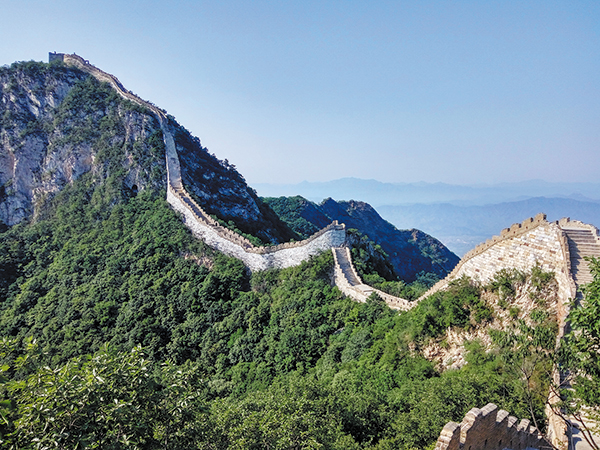
“The steepest part of the Great Wall is at Mutianyu, and the steepest part of Mutianyu is at Jiankou.” To the west of the Mutianyu Great Wall, there is a section that runs straight from the mountainside to the peak. After passing a defense tower built on the mountaintop, it descends sharply along the ridge back to the mountainside, then ascends again directly to a height of over 840 meters, forming a large curve. This shape resembles an ox horn, and thus it’s called the “Ox Horn Edge”. On both sides of the “Ox Horn Edge”, there is a section that, from a distance, looks like a bow. The lowest pass of the mountain resembles a notch when drawing a bow to shoot arrows. Therefore, this section is called “Jiankou”, which means "arrow's notch" in Chinese.
The Jiankou section of the Great Wall was initially constructed during the Northern Qi period of the Southern and Northern Dynasties (420-581), repaired in the late Tang Dynasty (618-907), and renovated and expanded in the Ming Dynasty (1368-1644). It is built along the steep ridge on the southern edge of Jundu Mountain, a natural barrier protecting Beijing. Jiankou section is praised as the most spectacular section of the Great Wall for its beautiful landscape and fabulous structure.
Ying Fei Dao Yang (Eagle Flies Facing Upward)
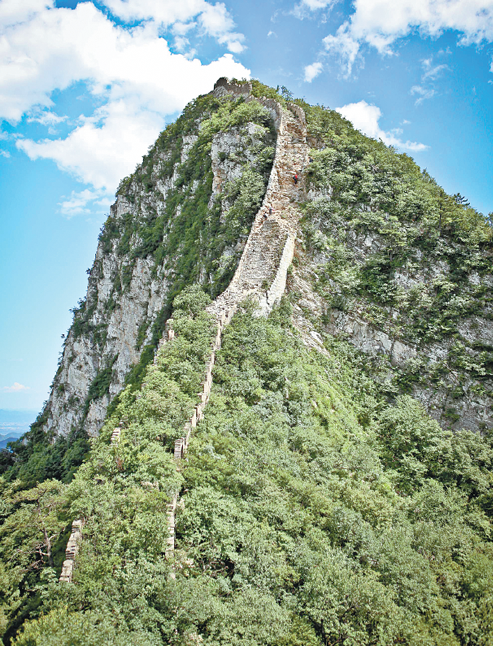
The "Eagle Flies Facing Upward" section of the Great Wall is a unique marvel of the Mutianyu Great Wall. The sheer cliffs and jagged peaks that the Great Wall traverses resemble the upturned beaks of eagles, towering and steep. The high mountains and fierce winds are so intense that they can flip eagles upside down, highlighting the perilous and rugged nature of this part of the Great Wall.
The Great Wall ascends over towering peaks, with the slopes on either side being extremely steep, making this section particularly dangerous. Resembling an eagle flying upside down, one side features a vertical cliff, while the other has a slope exceeding 70 degrees. The Great Wall climbs from one side of the peak to the top, and then descends vertically on the other side, with a height difference of ten meters. Each step is only a few fingers wide, barely accommodating a single foot. Therefore, it is described as even requiring eagles to fly upside down to pass through, hence the name "Eagle Flies Facing Upward", epitomizing its extreme danger.