ASEAN nations joining hands for AI literacy journey







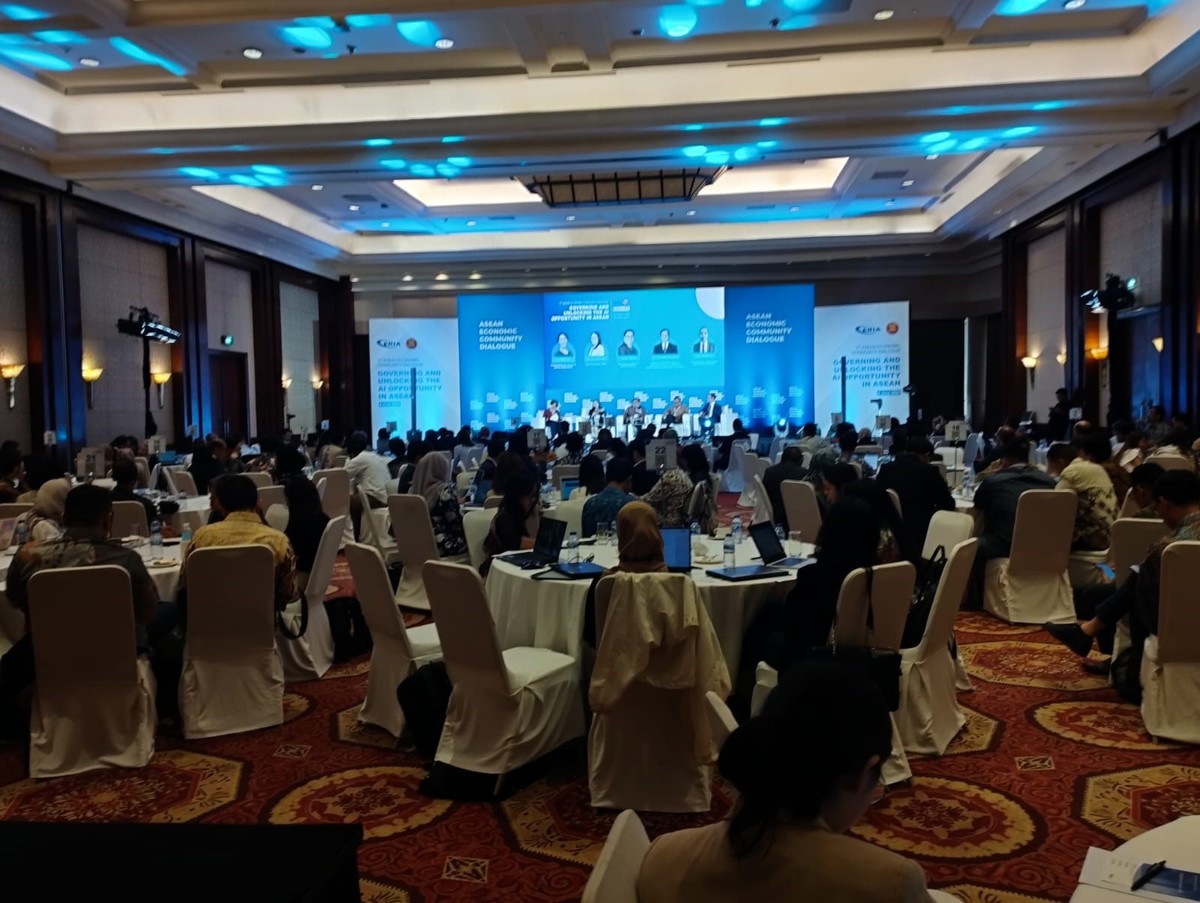
ASEAN countries need to build stronger collaboration and partnerships in developing AI literacy in the bloc's workforce, according to a dialog themed "Governing and Unlocking the AI Opportunity in ASEAN".
The 11th ASEAN Economic Community Dialog aims to provide a platform for the governments and business community to discuss AI opportunities in the region.
Tuesday's dialog participants aired a series of issues and challenges in developing AI literacy in ASEAN, such as investment in research and training courses, ethical development and security, interoperability of frameworks across jurisdictions, and public-private partnerships in AI development and practices.
Nararya S. Soeprapto, Deputy Secretary General of ASEAN for Community and Corporate Affairs, said in opening remarks that capability of the region's workforce needs to be increased so as to interact actively with the AI systems.
"Public and private agencies could collaborate to organize industry-specific AI courses," he said. Such collaboration would enable course participants to learn about the types of AI systems in the market and about how to increasingly play the role of operator of AI systems instead of manually performing tasks on their own.
"In this regard, several ASEAN member states such as Singapore, Malaysia, Indonesia, Thailand and Vietnam have collaborated with the industries and academic institutions to provide AI-related courses and training programs to develop AI talents," Soeprapto said.
Daisuke Nakayama, ERIA Digital Innovation and Sustainable Economic Center said that some ASEAN states are advancing AI laboratories while others in the region are lagging due to limited technology capabilities and lower investment in AI research and development.
He said that despite existing AI deployment, AI adoption by ASEAN startups remains in an early stage.
"Consequently, 80 percent of the (startup founders) have yet to increase their workforce in response to AI technologies," Nakayama said in the dialog's opening remarks session.
Also speaking in the opening session was Jasmine Begum, Regional Director of Government Affairs and Legal Microsoft ASEAN.
The first panelist session featured Larissa Lim, Infocomm Media Development Authority (IMDA) Singapore; Nyoman Adiarna, Secretary of Directorate-General of Informatics Applications, Ministry of Communications and Informatics of Indonesia; Fabian Bigar, CEO of MyDigital Malaysia; Lili Yan Ing, Senior Economist of ERIA; and Alex Hogback, Project Manager of International Telecommunication Union.
The second session of panelists presented Syed Kafee Ahmed, Associate Partner (Consulting, Digital & Emerging Technologies), PT Ernst and Young Indonesia; Andrew Cooke, Global Policy Lead, Worldwide Public Sector, Microsoft; Ahmad Kashfi Alwi, Village Capital; and Van Dang, CEO & Founder, Savvycom.
Sivoram Superamanian, head of the Digital Economic Division of the ASEAN Secretariat, summarized views and opinions aired in the dialog, saying that the gathering was just the beginning of ASEAN's AI journey.
"I think we also heard about how the adoption of robotics and AI has played a major role in other countries, especially in China, Japan and South Korea," Superamanian said.
Dang said AI solutions is all very new for both government and private sectors in her country, Vietnam, and in other ASEAN states.
"So we all want to learn from the beginning. We are humbled to learn more about it," Dang told this correspondent after the meeting of dialog.
When previously speaking in the panelist session, Dang said that government policies on AI should not aim at big companies only.
"I think sometimes the government obviously assumes the big company covers everything. I think we really need something to facilitate small businesses and startups," Dang told dialog participants.
Heru Sutadi, executive director of Indonesia ICT Institute in Jakarta, called on ASEAN countries to more clearly elaborate the positive and negative impacts of the AI usage.
He said the negative impacts would take the form of new crimes, humanity losses, and employment recession.
"Such impacts need elaboration as they could be horrible," Sutadi told this correspondent on Wednesday.
Sutadi said Indonesia needs to specially produce an AI law as currently the government has only issued a circular on AI. He called for ASEAN collaboration to seek best practices in addressing problems related to AI technology practices.
Felix Patrick, project officer at Global Strategy and Economic Diplomacy at the Indonesian Chamber of Commerce and Industry, said that ASEAN countries could better benefit AI technology capabilities either of China or of the United States. ASEAN policymakers need to respond to this issue, he told this correspondent on the sidelines of Tuesday's dialog meeting.
"We would face a deeper challenge namely our data and privacy protection. ASEAN has to make sure that foreign parties will not be able to undermine the region," Patrick said.
More than 650 leaders of startups, financial institutions, enterprises, non-governmental organizations and government agencies from ASEAN countries attended the meeting.
The event followed up on last year's agreement of the 10th ASEAN Economic Community Dialog that unpacks the world's first region-wide framework called the Digital Economic Framework Agreement. It is the world's first region-wide legally binding instrument on the digital economy.
The writer is a journalist for China Daily.