



'De-Sinicization' by West presents challenges







This year, there will be significant economic and political change globally. Influenced by the political cycle, with more than 70 countries and regions holding major elections this year worldwide, the United States economy is expected to decline. US economic growth was 2.5 percent in 2023 and we estimate the growth rate in 2024 will be around 1.7 percent.
Then, what will happen to the Chinese economy this year? It all depends on whether China's macroeconomic policies can be boosted, whether more measures to stabilize expectations, growth and employment can be introduced, and whether economic and noneconomic policies can be effectively coordinated and consistently assessed to bring economic development back to a reasonable range.
Since the outbreak of the global financial crisis in 2008, rule-based globalization has been in trouble, which marked an end to the golden era of global economic and trade growth over the previous 40 years.
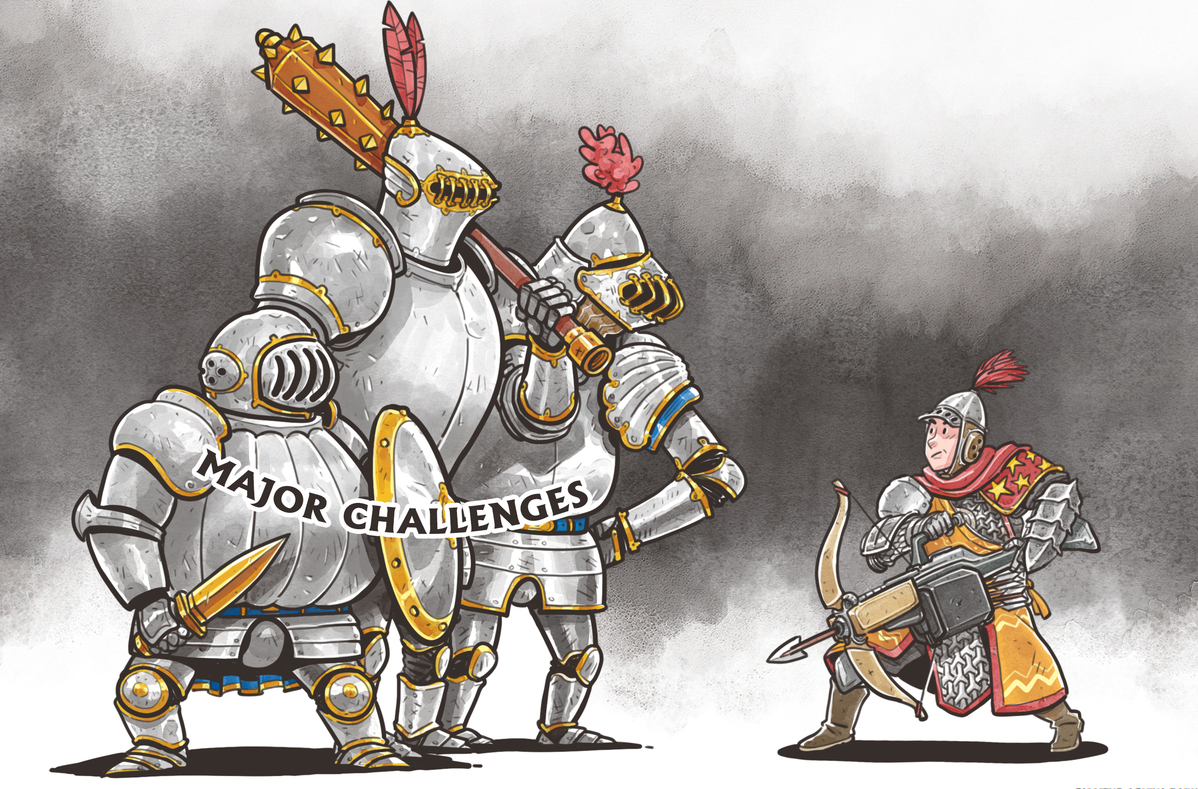
Now, major powers have introduced a series of new concepts, among which, the new globalization proposed by Western countries is essentially "de-Sinicization", which will pose certain challenges to the Chinese economy.
China's economy now faces three major challenges: the disruption and long-term negative effects of the COVID-19 pandemic to personnel exchanges and industrial and supply chains; rising geopolitical tensions; as well as competition among major powers that arise while fighting global climate change.
Faced with such challenges, China's foreign trade, foreign investment, foreign economic cooperation, outsourcing and foreign expertise have all undergone significant transformation and changes.
The past 45 years of reform and opening-up progressed amid economic globalization, new technological revolutions, and Sino-US economic and trade cooperation. In the future, however, it is likely that global economic and trade activities will be politicized to be aggressive behaviors in the digital technology sector.
Geopolitics is currently experiencing a tug-of-war, with one side being extremists who hope for "decoupling" and "de-risking", and the other advocating cooperation and eventually achieving a win-win scenario.
The US is promoting "decoupling" and the relocation of industries, and is competing with China in third-party markets. Europe emphasizes "de-risking" and reducing dependence on China's supply chains to achieve industrial "diversification".
The US is continuously changing the rules. Previously, the US promoted free trade globally, but now it believes that free trade benefits China and disadvantages the US. Therefore, the US has shifted away from free trade to initiatives like the Indo-Pacific Economic Framework, setting US rules and standards and aiming to align the countries around China with the US.
At the same time, the US has expanded its restrictions on foreign direct investment, which initially focused on semiconductors, microelectronics, AI and quantum information technology, and now includes new energy, biopharmaceuticals, medical device manufacturing and new materials.
Research on international industrial policies showed that after the outbreak of the financial crisis, there were only 34 industrial policies. But this number rose to 1,594 by 2021. The countries with the most industrial policies are Germany, Japan, Brazil, the US and Canada, with China ranking 11th. From this, it is clear who is using protectionist policies, industrial policies and government intervention.
In recent years, the US has significantly increased its industrial policies, protectionist measures and government intervention, leading to a continuous rise in manufacturing investment and a notable increase in investment from other countries.
Currently, the US' biggest problem is industrial hollowing-out. By simultaneously employing protectionist measures, over the past three to five years, the US has shown signs of manufacturing returning. Investments in manufacturing and capital equipment have been on the rise. A comparison of unicorn companies and AI companies in China and the US also reveals that the US has had a clear advantage in terms of development in this area.
On the other hand, it still needs to be clarified whether Europe intends to practice "de-Sinicization" or diversification. Research shows that more European companies prefer a normal diversification strategy, insisting on maintaining traditional economic and trade relations with Chinese companies.
Japanese companies do not dare to act like European and US companies, while South Korean companies tend to actively lobby to maximize exemptions. This leaves room for China to deploy more efforts to enhance strategic economic and trade relations.
Amid rising geopolitical tensions and the US' suppression of "new three" industries — new energy vehicles, lithium-ion batteries and photovoltaic products — what kind of competition policies, industrial policies and government support should China give to support the transition from low-cost to high-value-added industries?
We believe the effectiveness of industrial policies depends on their marketization, legalization and internationalization. It depends on whether the policies correct or distort areas such as security, green development, technology, energy and society, and achieve strategic competitive goals. If marketization, legalization and internationalization are poorly implemented, the effects might become generalized, potentially exacerbating market distortions.
Therefore, China needs to comprehensively deepen market-oriented reforms, expand opening-up, and improve the legal system. The fundamental response is, ultimately, to do our own work well.
Our current problem is that once the "new three" industries develop well, various local governments in China will rush to subsidize and introduce the development of their own local "new three" industries. It may eventually lead to overcapacity and price competition in the sector.
Such excessive competition will lead to significant price drops and make it difficult for innovative companies to get sufficient returns to support subsequent innovations.
Overall, we need to continue to deepen reforms, expand opening-up and improve the legal system. It is essential to quickly solidify the foundation of a high-standard market system, a high-level socialist market economy system and a higher-standard open economic system.
China has introduced various policies to stabilize foreign investment, but still faces several challenges. First, policy measures need to be accompanied by detailed operational guidelines. Second, the country needs to do research and formulate strategies against decoupling, suppression and sanctions.
If we want to attract foreign investment, we need to adopt more effective and targeted measures to counteract US protectionist industrial policies. For instance, the US chip bill provides $12 billion in subsidies, and the EU and Japan also have corresponding subsidies. Can China also provide subsidies to domestic enterprises in cutting-edge technology fields?
Third, more efforts should be made to implement a more open foreign investment policy. From the perspective of trade, regardless of which country's enterprises have been in local business for more than a year, their trade, value-added and employment situations are all local. From this perspective, there is still much work to be done to attract foreign investment to our country. We need to better understand foreign investors' concerns about conflicts, partiality issues and policy uncertainty.
Over the next two years, macroeconomic policies will be moderately strengthened, and various policies will be coordinated to mobilize people's enthusiasm. The core issue is how to implement and put policies into practice after they are formulated.
Promoting high-quality development of the Chinese economy from a global perspective is necessary. Chinese-style modernization has entered a new stage. Thus, it is essential to implement the new development concepts of innovation, coordination, green development, openness and sharing,
As a country with a huge population, every word and action of China will have an impact on the world. Therefore, amid the process of Chinese-style modernization, it is necessary to consider mutual relationships between the Chinese economy and the world's economy.
In addition, Chinese-style modernization emphasizes harmonious coexistence between humans and nature, coordination between material civilization and spiritual civilization, as well as pursuing the path of peaceful development. Only by accomplishing these can Chinese-style modernization be distinct from Western models and achieve its objectives.
The writer is chief researcher at the China Center for International Economic Exchanges.
The views don't necessarily reflect those of China Daily.



















